Leverage has a marketing problem.
It is usually introduced with the exciting half:
“Control a bigger position with less money!”
The less glamorous half is:
“Experience the financial consequences of that bigger position with less cushion.”
How Do Leverage and Position Sizing Work Together?
Leverage describes how much market exposure is supported by a given amount of equity or margin. Position sizing determines how many shares, contracts or units of currency exposure you actually control. The two concepts interact because a larger leveraged position makes the account more sensitive to the same underlying market move.
A practical process starts with the exposure and the downside rather than the broker's maximum buying power: identify the instrument, calculate its notional exposure, define where the thesis would be invalidated, measure the risk per unit, choose an appropriate risk budget, and only then calculate the position size.
A useful framework is: Instrument → Notional exposure → Invalidation → Risk per unit → Risk budget → Position size → Resulting leverage → Portfolio exposure. Margin tells you how much collateral supports the trade. It does not tell you how much market risk you control.
Position sizing is the discipline that connects your account, the size of the market exposure, the distance to your invalidation level and the amount you are prepared to lose if the idea fails.
1. What Leverage Means in Trading
At its simplest, leverage means controlling market exposure that is larger than the equity or collateral directly supporting the position.
A simplified leverage ratio is:
Leverage Ratio = Notional Exposure ÷ Equity Supporting the Position
Fictional example:
- market exposure = $20,000;
- equity supporting the position = $5,000.
$20,000 ÷ $5,000 = 4:1 leverage
2. Notional exposure is the first number to respect
Notional exposure is the economic size of the market position.
It answers:
“How much market value does this position respond to?”
That is different from asking how much cash you deposited.
3. Margin is not the purchase price
Margin can mean different things across products, but conceptually it is collateral supporting a position.
In a securities margin account, the broker may lend part of the purchase price.
In futures and many forex arrangements, margin is not a traditional loan used to buy the full underlying asset. It is performance collateral supporting a larger notional exposure.
4. Why leverage magnifies gains
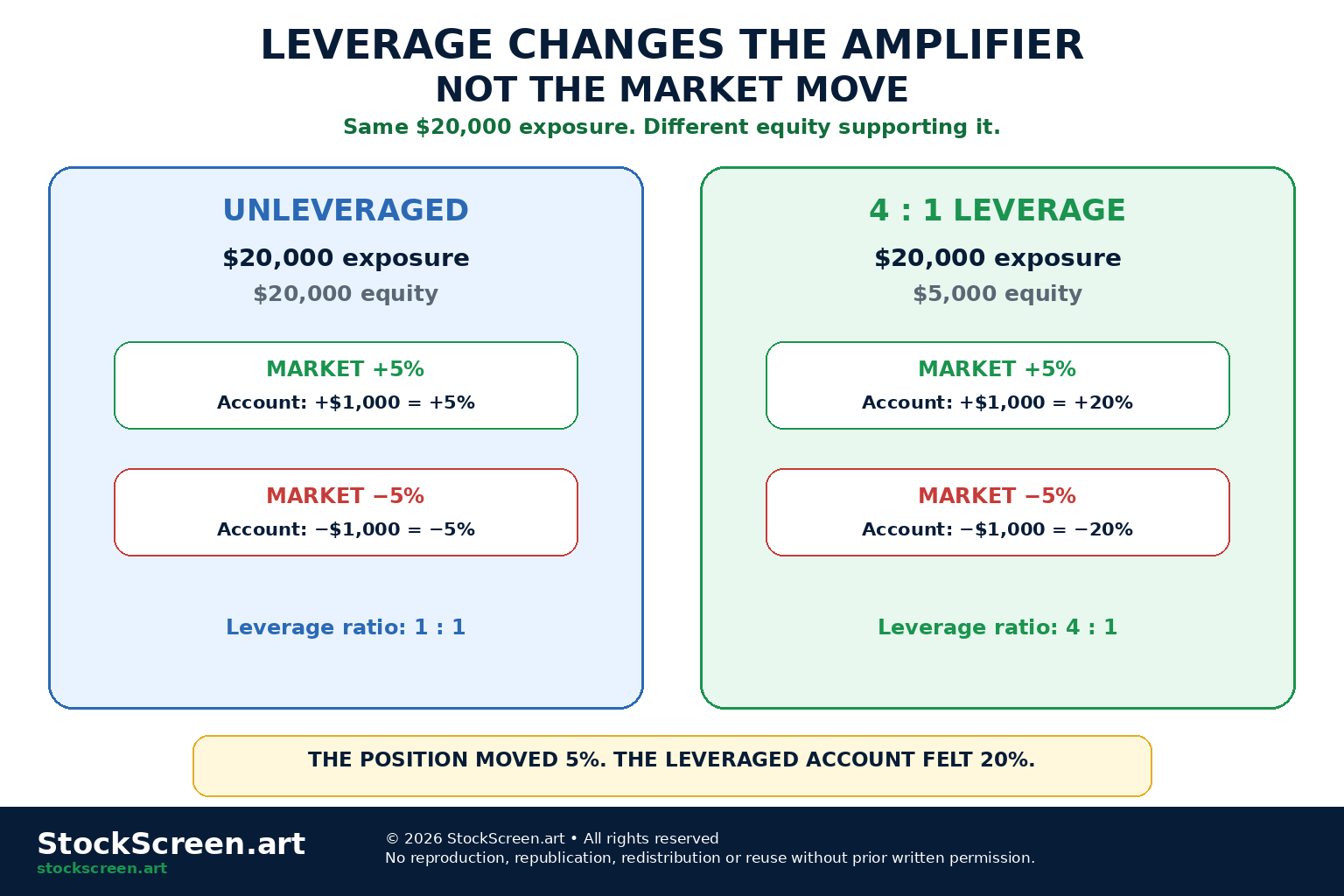
Suppose two fictional investors both gain 5% on $20,000 of market exposure.
5% × $20,000 = $1,000
Investor A funded the full $20,000. Investor B supported the same exposure with $5,000 of equity.
- Investor A earned $1,000 on $20,000 = 5%.
- Investor B earned $1,000 on $5,000 = 20%.
The market move did not change. The denominator did.
5. Why leverage magnifies losses
Reverse the move. A 5% decline on $20,000 of exposure produces a $1,000 loss.
- Relative to $20,000 of equity: −5%.
- Relative to $5,000 of equity: −20%.
6. Leverage is an amplifier, not an edge
Better research, data, execution, risk control or a tested strategy might create an edge.
Leverage does none of those things by itself.
It amplifies the financial result of the position you already chose.
7. A small forecast error can become an expensive account error
Suppose you expect a market to move 2% in your favour and it moves 2% against you.
At 10:1 leverage, that 2% adverse market move corresponds to roughly 20% of the supporting equity before costs, assuming the position remains open.
The forecast error did not get bigger. Its account consequence did.
8. Leverage vs. Position Size: Related but Different
Leverage describes the relationship between exposure and supporting equity.
Position size describes how much of the instrument you actually hold or control.
- Stocks: shares.
- Options: contracts.
- Futures: contracts.
- Forex: currency notional.
9. The wrong question: “How much buying power do I have?”
Buying power tells you what the platform may allow.
It does not tell you what exposure is sensible.
A credit-card limit is not a shopping recommendation.
Margin buying power is not a position-size recommendation either.
10. The better question: “How much can this position hurt?”
Position planning starts from downside. The earlier Risk/Reward and Position Planning lesson develops the entry, invalidation and payoff side of that process before leverage is introduced.
Before entering a trade, define:
- entry;
- invalidation level;
- distance between them;
- planned account risk budget.
11. Risk budget is a planning input
A risk budget is the amount of account loss you choose to plan for if the trade reaches its invalidation level.
It can be expressed in dollars or as a percentage of account equity.
This lesson does not prescribe a universal percentage.
12. Risk per share
For a simple long-stock example:
Risk per Share = Entry Price − Invalidation Price
Fictional setup:
- entry = $50;
- invalidation = $47.
Risk per Share = $3
This is planned price risk, not a guarantee that an order will execute exactly at $47.
13. A Simplified Position-Sizing Formula for Leveraged Risk
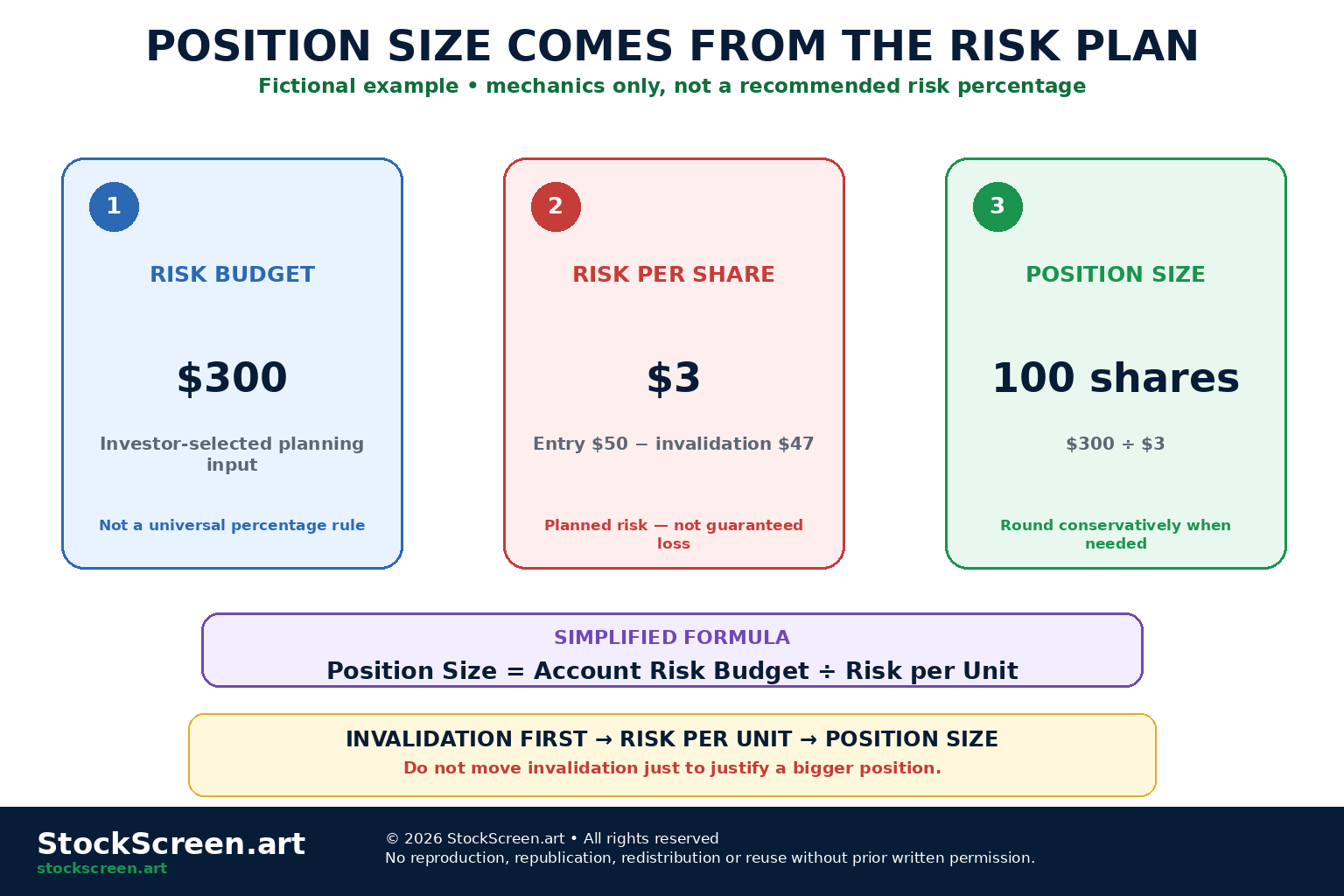
Position Size = Account Risk Budget ÷ Risk per Share
Fictional example:
- account risk budget = $300;
- risk per share = $3.
$300 ÷ $3 = 100 shares
Real losses can differ because of gaps, slippage, fees and execution.
14. Invalidation comes before size
If you decide first that you want 500 shares and then move the stop until the potential loss looks comfortable, the process is backwards.
The invalidation level should answer where the thesis is no longer valid.
Position size should adapt to that answer.
15. A tighter stop mathematically creates a bigger position
- $300 ÷ $3 risk per share = 100 shares.
- $300 ÷ $1 risk per share = 300 shares.
That does not mean you should tighten the stop merely to trade bigger.
The stop still has to make market sense.
16. Volatility and position size belong together
A more volatile instrument may require a wider invalidation distance.
With the same risk budget, a wider distance produces a smaller position.
That is the math adapting size to the market.
17. Liquidity changes practical risk
Thin markets can create larger spreads, slippage, partial fills, gaps and market impact.
Therefore the calculated size may still be too large for the market's real liquidity.
18. Gap risk breaks neat formulas
A planned stop at $47 does not guarantee an exit at $47.
If the market closes at $49 and reopens at $42 after bad news, the actual loss can be much larger than planned.
19. Stops are triggers, not insurance policies
A stop order generally becomes a market order when triggered.
Execution can occur away from the stop price.
A stop-limit order provides more price control but adds the risk of no execution.
20. Position size changes with product structure
Stocks
Position size is usually shares.
Options
Position size is contracts, each with a multiplier and nonlinear payoff.
Futures
Position size is contracts, each representing standardized notional exposure.
Forex
Position size is currency notional, often supported by margin.
21. Stock margin creates borrowed exposure
In a securities margin account, the broker may lend money secured by account assets.
If the position falls, losses can exceed the investor's original equity and interest or fees may also be owed.
22. Margin calls are about equity, not conviction
If account equity falls below required levels, the broker may require additional funds or securities.
Depending on the account agreement and circumstances, positions may be liquidated.
23. Forced liquidation is leverage's emergency exit
A leveraged position can fail operationally before it fails analytically.
You may still believe the market will recover, but the account may no longer support the position.
24. Options have leverage without a simple fixed ratio
Option leverage changes as Delta changes, the stock price moves, time passes and implied volatility changes. The Foundation article on options leverage explains why an option is not simply a fixed-leverage version of a stock position.
Treating an option as permanently “5:1 leverage” is often too simplistic.
25. Futures Leverage: Notional Exposure vs. Margin
Futures margin can be only a fraction of the notional exposure represented by the contract. The How Futures Trading Works guide explains contract multipliers, tick values, daily settlement and expiration in more detail.
Daily mark-to-market means adverse moves can quickly create additional margin needs.
26. Forex Leverage and Position Size
A relatively small amount of margin can support a much larger currency position. The Forex and Currency Pairs lesson shows how notional currency exposure, pip value and margin connect in practice.
For example, a 2% margin requirement corresponds mathematically to as much as 50:1 exposure if the full available leverage is used.
Available leverage and legal limits depend on jurisdiction and provider.
27. Leverage across instruments is not interchangeable
“4:1 leverage” does not tell the whole story.
You still need to know:
- instrument;
- payoff structure;
- margin methodology;
- volatility;
- liquidity;
- liquidation rules;
- whether losses can exceed initial capital.
28. Gross exposure and net exposure are different
Suppose a portfolio is:
- long $50,000 of one asset;
- short $40,000 of another.
Gross exposure = $90,000
Net exposure = $10,000 long
A small net number does not mean the portfolio has only $10,000 of risk.
29. Correlation can turn several positions into one big position
A technology stock, a growth ETF and a call option on another technology stock may have different labels while sharing similar underlying risk factors.
Position sizing must eventually become portfolio sizing. Later in the Foundation Path, Position Sizing examines that broader portfolio-level question without making leverage the central topic.
30. Portfolio heat
Some traders use the term portfolio heat for total planned risk across open positions.
31. Confidence should not automatically determine size
Human confidence is not a calibrated probability machine.
“I really like this one” is not a sizing formula.
32. Winning streaks can quietly increase risk
Several successful trades do not prove the next trade deserves more leverage.
Position-size changes deserve evidence and a defined process.
33. Losing streaks can provoke revenge sizing
Increasing size to “make it back” turns emotional repair into a market position.
Markets are poorly qualified therapists.
34. A position can be too small too
If transaction costs, spreads or minimum contract sizes dominate the expected edge, the trade may not make economic sense at the calculated size.
Sometimes the correct position size is zero.
35. Whole-share and contract constraints matter
The formula might produce 137.6 shares.
Fractional-share availability varies.
Futures and options require whole contracts.
Practical rounding should not accidentally exceed the intended risk budget.
36. Transaction costs consume risk budget too
A complete plan may need to consider:
- commissions;
- bid-ask spread;
- financing cost;
- borrow fees;
- slippage;
- tax consequences.
37. Leverage changes drawdown mathematics
| Loss | Gain Needed to Recover |
|---|---|
| −10% | +11.1% |
| −20% | +25% |
| −50% | +100% |
| −75% | +300% |
Leverage can accelerate the journey into the ugly side of that table.
38. Survival is a compounding feature
A strategy needs capital to continue operating.
One oversized loss can erase the benefit of many ordinary wins.
39. A Practical Leverage and Position-Sizing Checklist
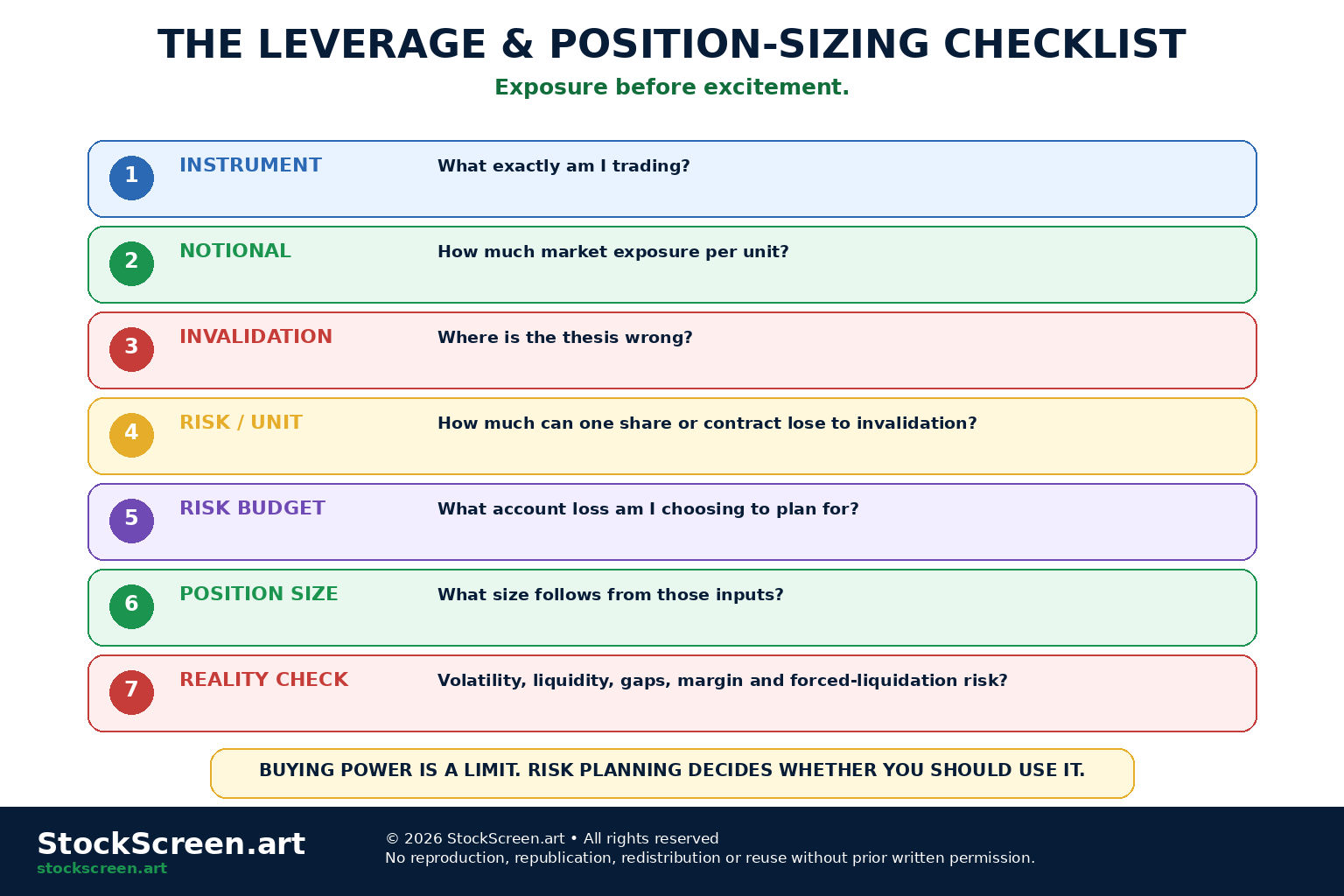
- What exactly is the instrument?
- What is the notional exposure per unit?
- What is my entry?
- Where is the thesis invalidated?
- What is the planned risk per unit?
- What account risk budget am I choosing?
- What position size does that imply?
- Do volatility and liquidity make that size realistic?
- What leverage ratio results?
- Could a gap, margin call or forced liquidation make the loss larger?
40. Six mistakes that make leverage dangerous
- Thinking margin equals position size.
- Choosing size before defining invalidation.
- Using a tighter stop only to justify a larger position.
- Ignoring gaps and slippage.
- Adding correlated positions without considering total exposure.
- Using maximum available leverage because the platform permits it.
41. Nine mental models worth keeping
- Notional is exposure. Margin is collateral.
- Leverage amplifies results; it does not create edge.
- Position size should come from the risk plan.
- Invalidation comes before sizing.
- Volatile markets generally require more breathing room or smaller size.
- Stops reduce planned risk but cannot guarantee execution price.
- Buying power is a limit, not a recommendation.
- Portfolio exposure matters more than isolated trade labels.
- The first job of risk control is to preserve the ability to make the next decision.
Leverage and Position-Sizing Questions
What is leverage in trading?
Leverage is the relationship between the market exposure controlled by a position and the equity or collateral supporting it. If $5,000 of equity supports $20,000 of market exposure, the simplified leverage ratio is 4:1.
How does leverage affect position sizing?
Leverage increases the amount of market exposure that can be controlled with a given amount of capital. That makes position size more important, because the same percentage move in the underlying market can have a much larger percentage effect on the equity supporting the trade.
What is the difference between margin and position size?
Margin is collateral required to support a position. Position size is the amount of the instrument you actually hold or control—such as shares, option contracts, futures contracts or currency notional. Margin should not be mistaken for the economic size of the exposure.
How do you calculate position size from a risk budget?
In a simplified stock example, position size can be estimated as account risk budget divided by planned risk per share. The invalidation level should be determined first; the position size then adapts to that downside distance rather than forcing the stop to fit a preferred number of shares.
Does more buying power mean you should use more leverage?
No. Buying power describes what the account or broker may permit, not what exposure is appropriate. Volatility, liquidity, gap risk, correlation, margin rules and the investor's overall risk plan all matter.
Quick knowledge check
1. What is notional exposure?
The economic size of the market position—the amount of market value the position responds to.
2. If a $20,000 position is supported by $5,000 of equity, what is the simplified leverage ratio?
4:1.
3. Does 4:1 leverage mean the market itself became four times more volatile?
No. The market move is unchanged; the account becomes more sensitive to that move because the same exposure is supported by less equity.
4. What is risk per share in a long stock trade entered at $50 with invalidation at $47?
$3 per share before gaps, slippage, transaction costs or execution differences.
5. If the chosen account risk budget is $300 and planned risk per share is $3, what simplified position size results?
100 shares.
6. Why should invalidation usually be defined before position size?
Because position size should adapt to where the thesis is wrong, rather than moving the invalidation merely to justify a preferred size.
7. Why can a stop order still produce a loss larger than the plan?
The market can gap or move rapidly through the stop price, causing execution at a worse price.
8. What is the difference between gross and net exposure?
Gross exposure adds the absolute size of long and short positions; net exposure offsets longs against shorts.
9. Why is maximum broker buying power not a sensible sizing rule?
It reflects what the platform may permit, not what exposure fits the investor's risk plan, strategy, volatility, liquidity or portfolio.
10. What question should come before “How much can I buy?”
“How much exposure am I creating, and what happens to my account if the position moves against me?”
Where we go next
We now have stocks, options, futures, forex, leverage and position sizing.
The final Derivatives & Leverage lesson puts the instruments side by side in Stocks vs. Options vs. Futures vs. Forex:
FND-DER-06 — Stocks vs. Options vs. Futures vs. Forex.
Primary sources & further reading
- Investor.gov — Leveraged Investing Strategies: Know the Risks
- Investor.gov — Understanding Margin Accounts
- FINRA — Know What Triggers a Margin Call
- FINRA — Brokerage Accounts and Margin
- U.S. Securities and Exchange Commission — Margin: Borrowing Money to Pay for Stocks
- CFTC — Eight Things You Should Know Before Trading Forex
- CFTC — Futures Glossary