Welcome to the instrument petting zoo.
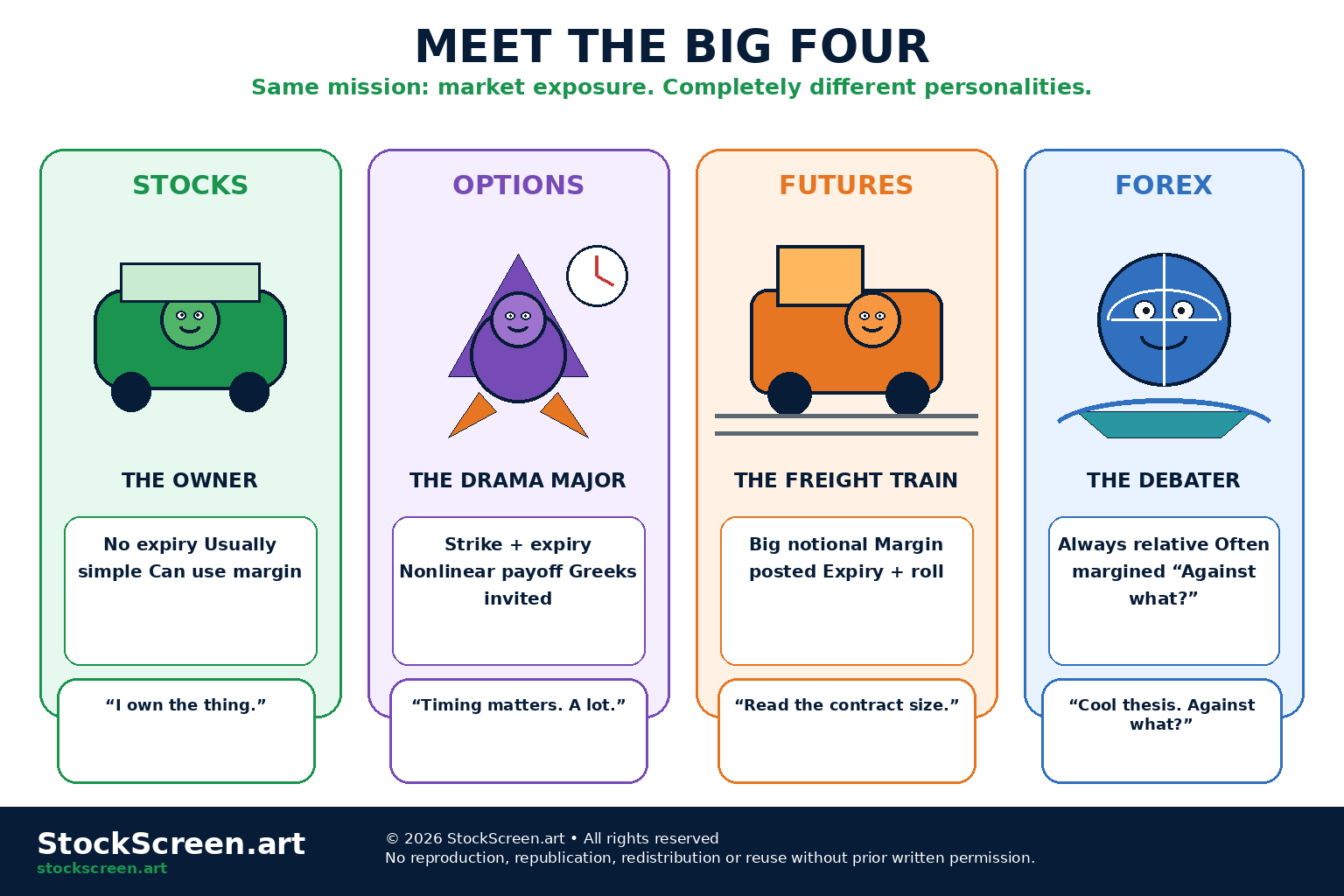
On our left:
- a stock, quietly owning a company;
- an option, carrying a stopwatch and several Greek letters;
- a futures contract, wearing a hard hat and asking about margin;
- a currency pair, refusing to answer any question until you specify “against what?”
They all have prices.
They can all be traded.
They can all make money.
They can all make money disappear with impressive efficiency.
1. Start with what you actually own or control
Before discussing leverage, returns or clever strategies, ask the boring question that saves expensive confusion:
“What exactly is this instrument?”
That question separates the four markets immediately.
2. Stocks: ownership
A share of common stock represents an ownership interest in a corporation.
Depending on the company and share class, stockholders may have:
- economic participation in the company's value;
- potential dividends;
- voting rights;
- capital appreciation or loss.
The key word is:
ownership
You are not buying a contract that expires next Friday.
You own shares until you sell them, the company is acquired, reorganized, liquidated or something else changes the security.
3. Options: contractual rights and obligations
An option is a derivative contract.
A call gives the holder the right to buy the underlying according to the contract terms.
A put gives the holder the right to sell.
The writer has the corresponding obligation if assigned.
So an option is not “a smaller stock position.”
It is a different legal and economic instrument.
4. Futures: standardized obligations across time
A futures contract is a standardized agreement traded on a futures exchange.
It specifies:
- the underlying asset or reference;
- contract size;
- delivery or settlement month;
- price terms;
- settlement or delivery procedures.
Futures are built for transferring price risk through time.
They are not stock ownership with a cowboy hat.
5. Forex: one currency against another
Forex is different again.
A currency pair expresses the value of one currency in another.
In EUR/USD:
- EUR is the base currency;
- USD is the quote currency.
Going long EUR/USD is a relative view:
euro stronger versus dollar
The sentence is incomplete without both sides.
6. The four instruments in one sentence each
- Stock: own part of a company.
- Option: hold or write a contract tied to an underlying asset.
- Future: hold a standardized exchange-traded contract for future settlement or delivery.
- Forex: hold exposure to the relative value of one currency versus another.
7. Expiration: who has a clock?
Time behaves differently across these markets.
Stocks
Common stock has no fixed expiration date.
Options
Options expire.
Time is part of the contract.
Futures
Futures contracts have delivery or settlement months and expiration cycles.
Spot forex
A rolling spot or OTC currency position typically does not have a single listed-contract expiration date, but financing, rollover and settlement conventions still matter.
Currency futures, of course, do expire.
8. Why expiration changes the thesis
A stock investor can sometimes survive being early.
An option buyer may be directionally correct and still run out of time.
A futures trader may need to roll into a later contract.
A forex trader can keep a position open but may accumulate financing charges or credits.
Same opinion.
Different clock.
9. Linear versus nonlinear payoff
Stocks, futures and spot-style forex exposure are broadly linear instruments: a given price move produces a roughly proportional change in position value, subject to product details.
Options are nonlinear.
Their value depends on:
- underlying price;
- strike;
- time remaining;
- implied volatility;
- interest rates and other pricing inputs.
Options brought math friends.
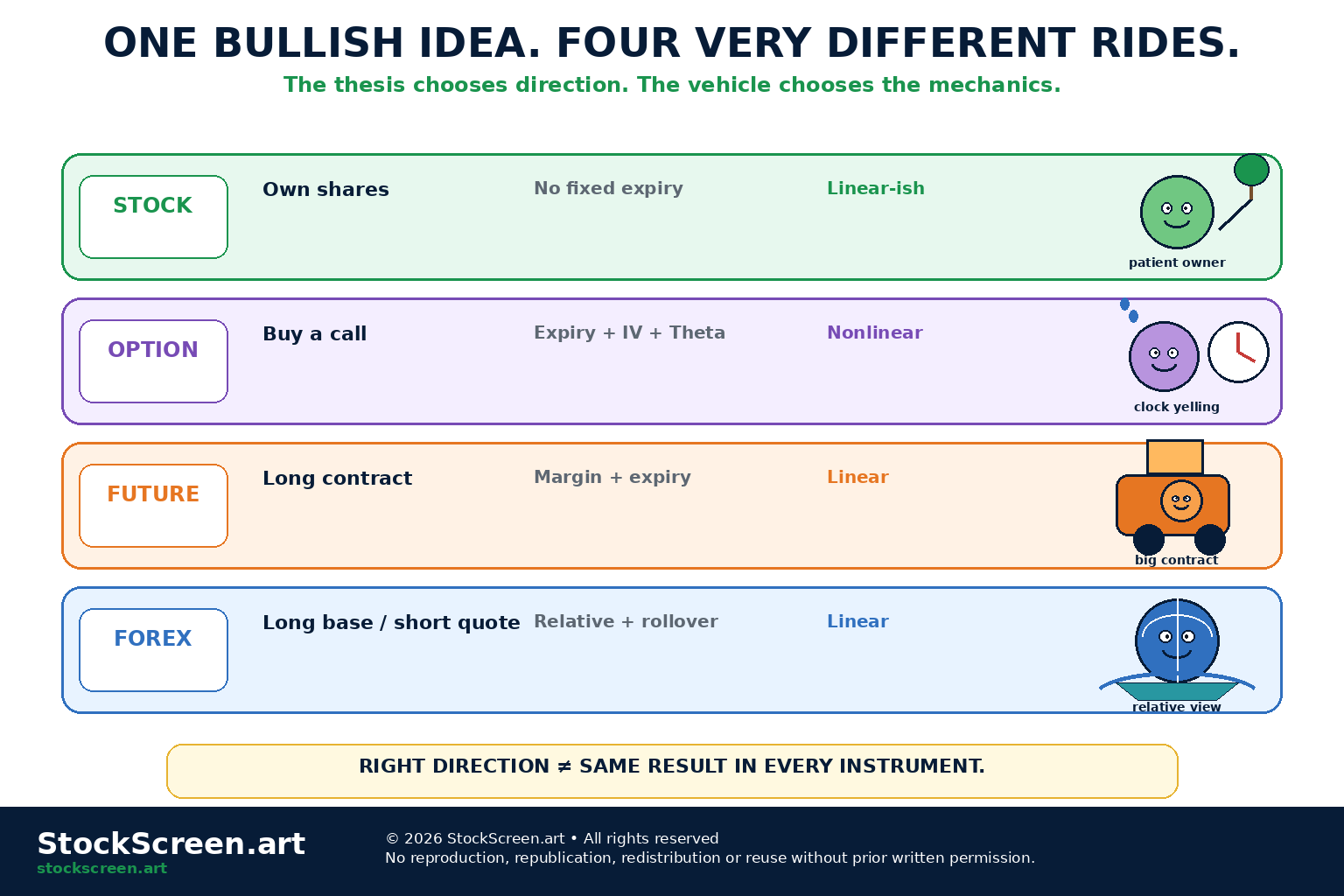
10. The same bullish idea can produce four different positions
Imagine the thesis:
“I expect Asset X to rise over the next three months.”
You might express that through:
- buying shares;
- buying a call;
- buying a futures contract;
- buying a currency pair if the thesis is actually a relative currency view.
Those positions do not have the same capital requirements, expiration, payoff or risk.
11. Leverage in stocks
Stock ownership can be completely unleveraged.
Buy $10,000 of stock with $10,000 of cash and the simplified leverage ratio is 1:1.
Margin accounts can create leverage by borrowing against securities and account equity.
That introduces:
- interest costs;
- maintenance requirements;
- margin-call risk;
- forced-liquidation risk.
12. Leverage in options
Options can create substantial exposure for a premium that is smaller than the value of the underlying shares represented.
That is leverage.
But it is not a stable fixed ratio.
Option sensitivity changes as:
- Delta changes;
- Gamma changes Delta;
- Theta changes time value;
- Vega responds to implied volatility.
If someone tells you an option is “exactly 7.3:1 leverage forever,” the Greeks would like a meeting.
13. Leverage in futures
Futures positions are supported by margin that can be a fraction of the contract's notional exposure.
That can create large account sensitivity to relatively small market moves.
Futures are also marked to market, so adverse moves can create additional margin requirements before the final thesis horizon arrives.
14. Leverage in forex
Retail forex is commonly margined.
A relatively small security deposit can support a much larger notional currency position.
The CFTC specifically warns that this degree of leverage amplifies both gains and losses.
The currency may move 1%.
The account may experience something much more emotionally educational.
15. Leverage is not a ranking system
It is tempting to rank markets like this:
more leverage = more opportunity
That is incomplete.
More leverage also means:
- less room for error;
- faster drawdowns;
- greater sensitivity to gaps and volatility;
- more margin pressure;
- higher liquidation risk.
Turbochargers are fun.
Brakes remain popular for a reason.
16. Capital required is not the same as economic exposure
A recurring mistake across derivatives is to focus on cash outlay.
Examples:
- option premium;
- futures margin;
- forex margin deposit.
Those numbers may be much smaller than the economic exposure created.
17. Maximum loss: stocks
A fully paid long-stock position can lose up to the amount invested if the company becomes worthless.
Leveraged stock positions can lose more than the investor's equity because money may be borrowed.
Short stock creates a very different risk profile and can have theoretically unlimited loss as the stock price rises.
So even within “stocks,” position structure matters.
18. Maximum loss: options
For a buyer of a long call or long put, the premium paid can be lost entirely if the option expires worthless.
Option writers face different risks.
Some short-option strategies can create losses much larger than premium received, and uncovered short calls can have theoretically unlimited loss.
“Options risk is limited” is therefore true only for specific structures.
19. Maximum loss: futures
Futures gains and losses are based on the full contract exposure, not merely the margin deposit.
Losses can exceed the amount initially posted as margin.
Adverse moves can also trigger margin calls or forced liquidation.
20. Maximum loss: forex
Leveraged retail forex can also produce losses exceeding the initial deposit, depending on account protections, dealer structure, jurisdiction and market movement.
The CFTC's retail-forex materials emphasize that leverage can rapidly magnify losses.
“It only moved one cent” is not a useful defence when the notional exposure is enormous.
21. Income and cash-flow characteristics
Stocks
Some companies pay dividends.
Options
Options themselves do not pay company dividends, although expected dividends can affect option pricing.
Futures
Futures contracts do not distribute dividends from the underlying company or commodity.
Forex
Currency positions may have financing or rollover adjustments related to interest-rate differences and dealer terms.
22. Time decay belongs mainly to options
Options are unique in this comparison because time value can decay as expiration approaches.
Stocks do not have Theta.
Futures have expiration and curve effects, but not option-style time decay.
Spot forex does not have option Theta either.
The calendar is specifically rude to long option premium.
23. Futures have curve and roll effects instead
Futures positions may need to be rolled from an expiring contract into a later-dated contract.
The price difference between contracts can affect performance.
Contango and backwardation therefore matter in ways that have no direct equivalent for ordinary stock ownership.
24. Forex has carry and rollover instead
Currency positions held through rollover may receive or pay financing adjustments.
A favourable interest-rate differential can help.
An adverse currency move can make that carry income look like finding a nickel before being hit by a wheelbarrow.
25. Trading venue: stocks
U.S. listed stocks trade through regulated securities markets and broker-dealers, with orders routed to exchanges, alternative trading systems and other venues according to market structure and broker practices.
The exact execution path can be complicated, but the security itself is standardized by ticker and share class.
26. Trading venue: listed options
U.S. listed options trade on options exchanges through broker-dealers.
Liquidity can differ dramatically by:
- underlying;
- strike;
- expiration;
- call versus put;
- market conditions.
One stock can have hundreds of option contracts.
Congratulations, the menu has become a database.
27. Trading venue: futures
Futures contracts are standardized and traded on regulated futures exchanges.
Contract specifications define:
- unit size;
- tick size;
- expiration;
- settlement;
- delivery terms where applicable.
28. Trading venue: forex
Much global FX activity occurs over-the-counter.
Retail OTC forex customers generally trade against or through a dealer rather than through one centralized stock-style exchange order book.
Exchange-traded currency futures and options also exist, so “forex” is not one single market structure.
29. Liquidity: stocks
Stock liquidity varies enormously.
A mega-cap company may trade millions of shares with narrow spreads.
A tiny company may trade lightly with wide spreads.
“Stocks are liquid” is too broad to be useful.
30. Liquidity: options
Options add another dimension because liquidity is contract-specific.
The underlying stock can be liquid while a particular option strike is not.
Always inspect the exact contract.
31. Liquidity: futures
Major benchmark futures can be extremely liquid, but liquidity varies by contract and delivery month.
The nearby contract can be active while a distant month is comparatively thin.
32. Liquidity: forex
Major currency pairs can be highly liquid, but spreads and depth vary by:
- pair;
- session;
- dealer or venue;
- news events;
- market stress.
“Forex trades all day” does not mean “every pair has perfect liquidity at every second.”
33. Directional simplicity: stocks
Long stock is conceptually simple:
stock up = position value up
That simplicity is useful.
No expiration.
No strike.
No implied volatility.
Just the company and the price.
34. Directional complexity: options
Options can be directionally simple in intention and mechanically complicated in outcome.
A stock can rise while a call loses money because:
- the move was too small;
- the move was too slow;
- implied volatility fell;
- the premium paid was too high.
“I was right” and “I made money” are different sentences.
35. Directional power: futures
Futures offer direct linear exposure to the contract price.
That makes them useful for:
- hedging;
- price discovery;
- macro exposure;
- commodities;
- interest rates;
- equity indexes;
- currencies.
The price relationship may be simple.
The contract size may not be.
36. Relative thinking: forex
Forex forces you to compare.
You are never just:
“long euro”
You are long euro versus something else.
That makes forex naturally suited to relative macro views.
37. When stocks may fit the job
Stocks may be a natural fit when the objective is:
- long-term company ownership;
- participation in business growth;
- potential dividend income;
- simple linear exposure;
- no fixed contract expiration.
Boring can be a feature.
Refrigerators are boring too.
Society kept them.
38. When options may fit the job
Options may be useful when the objective requires:
- defined long-premium risk;
- asymmetric payoff;
- hedging;
- precise strike and time exposure;
- volatility exposure;
- income strategies with appropriately understood obligations.
The price of flexibility is complexity.
39. When futures may fit the job
Futures may be useful for:
- hedging standardized exposures;
- commodity exposure;
- index exposure;
- interest-rate exposure;
- currency exposure;
- efficient notional exposure for sophisticated users.
The phrase “efficient exposure” should always be followed by:
“...and I understand the contract size.”
40. When forex may fit the job
Forex may be useful when the thesis is specifically about:
- relative monetary policy;
- interest-rate differentials;
- international growth;
- trade and capital flows;
- currency hedging;
- relative macroeconomic performance.
The pair must match the thesis.
41. The comparison table that actually matters
| Feature | Stocks | Options | Futures | Forex |
|---|---|---|---|---|
| Core Exposure | Company ownership | Contract right / obligation | Standardized future contract | Relative currency value |
| Fixed Expiration | No | Yes | Yes | Spot: generally no fixed listed expiry; futures: yes |
| Leverage | Optional via margin | Often embedded / variable | Common via margin | Common in retail OTC |
| Payoff | Generally linear | Nonlinear | Generally linear | Generally linear |
| Special Clock Risk | No fixed expiry | Time decay + expiry | Expiry + roll | Rollover / financing |
| Key Sizing Unit | Shares | Contracts | Contracts | Currency notional |
42. The “right tool” checklist
Before choosing an instrument, ask:
- What is the thesis?
- What do I need to own or control?
- How long might the thesis need?
- Do I want expiration or do I want to avoid it?
- Do I need linear or nonlinear payoff?
- How much notional exposure will one unit create?
- What leverage or margin is involved?
- What can cause losses beyond my simplified plan?
- Is the exact instrument liquid enough?
- Do I understand settlement, rollover, assignment or delivery rules?
43. Seven terrible reasons to choose a market
- “The leverage is huge.”
- “Someone on social media said it is easier.”
- “The contract is cheap.”
- “It trades almost all day, so I can lose sleep professionally.”
- “I am bored with stocks.”
- “I need to make back last week's loss.”
- “I do not understand it yet, but the chart looks spicy.”
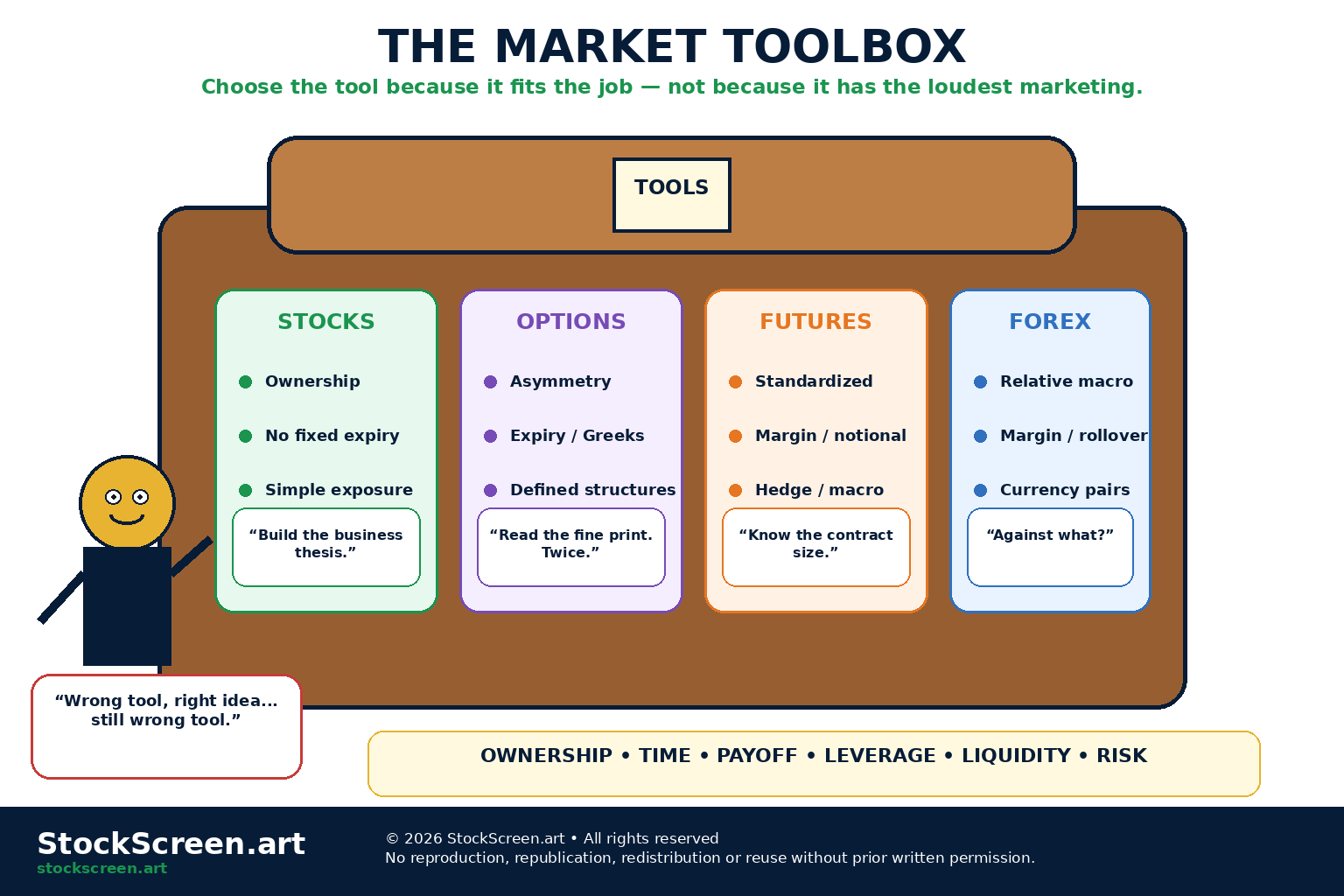
44. The instrument should solve a problem
A strong reason sounds like:
“I want long-term ownership of this company, so stock fits.”
Or:
“I need downside protection through a defined period, so an option structure may fit.”
Or:
“I need standardized commodity-price exposure, so a futures contract may fit.”
Or:
“My thesis is euro strength relative to the dollar, so EUR/USD is the relevant pair.”
Instrument choice should be explainable.
45. Risk management survives every instrument change
Different instruments have different mechanics.
But the core risk questions survive:
- How much exposure?
- What invalidates the idea?
- How much can be lost?
- What can make the actual loss worse?
- What happens if liquidity disappears?
- What happens if I am early?
- What happens if I cannot exit?
New market.
Same adult supervision.
46. There is no graduation from humility
Completing the Derivatives & Leverage module does not mean:
“I am now qualified to max out every margin slider available.”
It means you now have a vocabulary for asking better questions.
That is much more useful.
47. Ten mental models worth keeping
- Stocks = ownership.
- Options = rights and obligations with expiration.
- Futures = standardized contracts with notional exposure and margin.
- Forex = one currency relative to another.
- Expiration changes the thesis.
- Options are nonlinear; the other three are generally more linear.
- Margin is not the same as position size.
- Cash outlay is not the same as economic exposure.
- There is no universally best market.
- The best instrument is the one whose mechanics fit the thesis and risk plan.
Quick knowledge check
Ten questions. If you get all ten right, the futures contract still does not waive margin.
1. Which of the four instruments represents direct ownership in a company?
Common stock.
2. Which instrument is inherently nonlinear in its payoff?
Options.
3. Which two listed-contract categories in this lesson have fixed expirations?
Options and futures.
4. What is the key sizing unit for a futures position?
Contracts, each with a standardized contract size and notional exposure.
5. Why is saying “I am bullish on the dollar” incomplete?
Because currency value is relative. The dollar must be compared with another currency or a defined basket.
6. Can a long option buyer lose the entire premium even if the underlying moved somewhat in the expected direction?
Yes. The move may be too small, too slow, or offset by changes in time value or implied volatility.
7. Why can futures losses exceed the margin initially posted?
Because gains and losses are based on the full contract exposure, while margin is only collateral supporting that exposure.
8. Does “forex” always mean OTC spot trading?
No. Much FX activity is OTC, but exchange-traded currency futures and options also exist.
9. What is the most important distinction between cash posted and notional exposure?
Cash posted is the capital or collateral committed; notional exposure is the amount of market value controlled.
10. What is the best market?
There is no universally best market. The better instrument is the one whose ownership, payoff, expiration, leverage, liquidity and risk mechanics fit the specific objective.
Where we go next
That completes the Derivatives & Leverage module.
You now know enough to look at a giant leverage number and ask:
“Yes, but what is the notional exposure?”
This is progress.
The Foundation Path now moves from individual instruments to the problem that arrives when you own several things at once:
FND-PR-01 — Diversification and Concentration.
Because five positions do not automatically create diversification.
Sometimes they create one position wearing five different hats.
Primary sources & further reading
- Investor.gov — Stocks
- Investor.gov — An Introduction to Options
- FINRA — Options
- CFTC — Basics of Futures Trading
- CME Group — Definition of a Futures Contract
- CFTC — Eight Things You Should Know Before Trading Forex
- Bank for International Settlements — OTC Foreign Exchange Turnover in April 2025