Diversification has one of the most famous slogans in investing:
“Don’t put all your eggs in one basket.”
Excellent advice.
Unfortunately, investors immediately found ways to make it complicated.
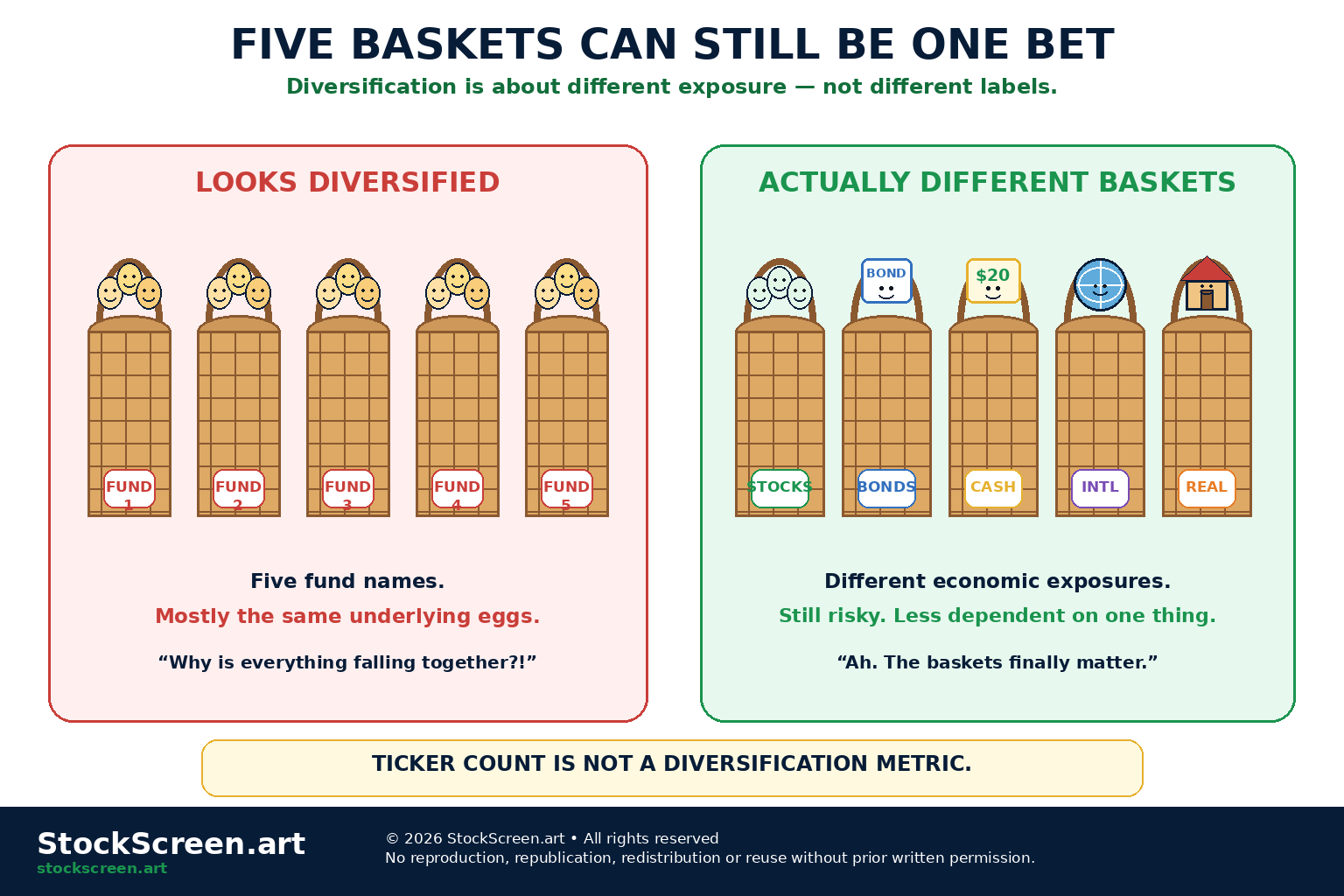
We bought five baskets.
Then discovered all five baskets contained the same seven technology stocks.
Progress!
1. What diversification actually means
Diversification is the practice of spreading investments across different holdings or categories in order to reduce reliance on any single outcome.
The basic idea is simple:
If one investment has a bad day, the entire portfolio should not automatically need counselling.
Diversification works best when the investments are exposed to meaningfully different risks.
2. What diversification is not
Diversification is not:
- buying ten random tickers;
- owning three funds with nearly identical holdings;
- owning six technology companies and calling them “different companies”;
- adding more positions simply because the portfolio looks sparse;
- guaranteeing that the portfolio will not lose money.
More holdings can help.
More holdings can also create a beautifully organized spreadsheet containing the same risk repeatedly.
3. Concentration is the opposite force
Concentration risk appears when too much of a portfolio depends on one investment, market segment or economic driver.
Examples include:
- one stock representing a large share of the portfolio;
- most holdings belonging to one sector;
- several funds owning many of the same companies;
- most wealth tied to one country;
- career income and investment wealth both tied to one employer.
4. Concentration is not automatically irrational
Some investors intentionally concentrate.
They may believe:
- they understand a small group of businesses exceptionally well;
- their highest-conviction ideas deserve larger weights;
- too much diversification would dilute expected returns.
That is a strategy choice.
The important distinction is:
5. Security-level concentration
The most obvious form of concentration occurs when one stock becomes a large share of the portfolio.
Suppose a fictional portfolio contains:
- Company A = 45%;
- ten other holdings = 55% combined.
That portfolio technically owns eleven securities.
But Company A may dominate the outcome.
Eleven names do not create eleven equal risks.
6. Portfolio weight matters more than ticker count
Compare two fictional portfolios.
Portfolio A
- 10 stocks at 10% each.
Portfolio B
- 1 stock at 55%;
- 9 stocks sharing the remaining 45%.
Both portfolios own ten stocks.
Their concentration is very different.
Counting names without counting weights is like counting passengers without noticing one of them is an elephant.
7. Sector concentration
You can own many companies and still have one sector dominate the portfolio.
Imagine holdings in:
- semiconductors;
- cloud software;
- cybersecurity;
- consumer electronics;
- internet platforms.
They are different businesses.
They may still share exposure to:
- technology spending;
- growth expectations;
- interest-rate sensitivity;
- semiconductor supply chains;
- investor appetite for growth stocks.
8. Industry concentration can be even narrower
A portfolio might look diversified by sector but still be concentrated inside a specific industry.
For example:
- five regional banks;
- four homebuilders;
- six biotechnology companies;
- several oil producers.
The companies are distinct.
The economic weather forecast may be identical.
9. Asset-class concentration
A portfolio can also be concentrated in one broad asset class.
Examples:
- 100% equities;
- 100% long-duration bonds;
- 100% commodities;
- 100% cash;
- 100% real estate exposure.
Whether that concentration is appropriate depends on the objective, horizon and risk tolerance.
The lesson here is identification, not a universal allocation recipe.
10. Geographic concentration
Investors often prefer companies and markets they know.
That can create home-country bias.
Geographic concentration can expose a portfolio heavily to one country's:
- economy;
- currency;
- politics;
- regulation;
- interest rates;
- market structure.
Familiarity feels comfortable.
Risk does not care how familiar the logo is.
11. Employer-stock concentration
Employer stock deserves special attention because it can connect two parts of your financial life.
Your employer may provide:
- salary;
- bonus;
- health benefits;
- pension or retirement contributions;
- stock awards;
- career opportunities.
If a large portion of your investment wealth is also company stock, one corporate problem can affect both income and investments.
12. Theme concentration
A portfolio can appear diversified because the holdings live in several sectors while still depending on one theme.
Examples might include:
- artificial intelligence spending;
- clean-energy policy;
- housing demand;
- commodity prices;
- falling interest rates;
- consumer credit growth.
Different tickers.
Same economic script.
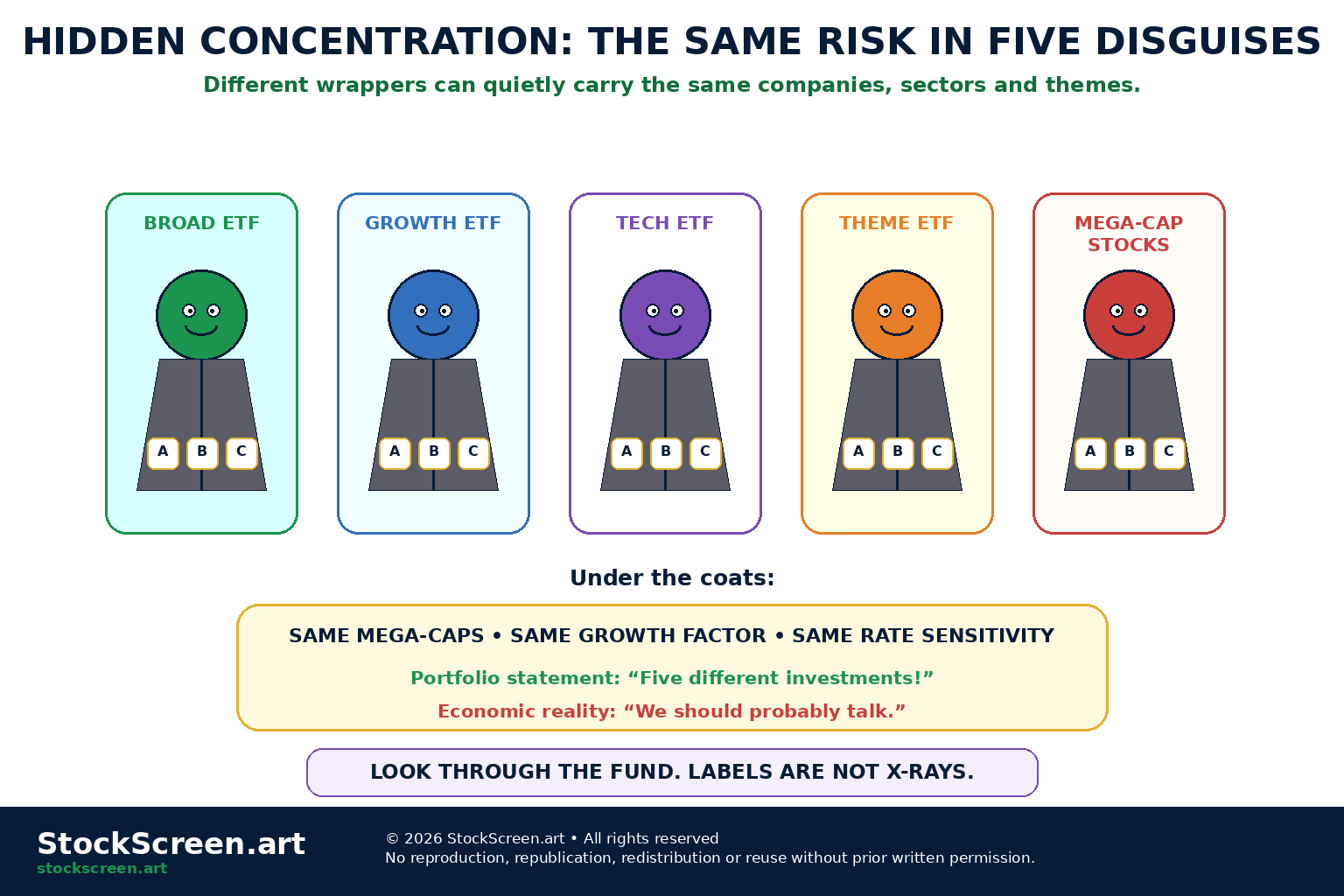
13. Hidden concentration inside funds
Mutual funds and ETFs can make diversification easier.
They can also hide overlap.
You might own:
- a broad-market ETF;
- a growth ETF;
- a technology ETF;
- several individual mega-cap stocks.
The account statement shows four categories.
The holdings report may show the same companies repeatedly.
14. Look-through analysis
A basic look-through process asks:
- What does each fund actually own?
- Which securities appear in more than one fund?
- How much exposure do I have after combining all wrappers?
- Which sectors and industries dominate?
- Which countries dominate?
This does not require a doctoral dissertation.
It does require clicking past the fund name.
15. A fund can itself be concentrated
Not every ETF is broad and diversified.
Funds can target:
- one sector;
- one industry;
- one country;
- one commodity;
- one factor;
- one narrow theme.
“ETF” describes a vehicle structure.
It does not mean:
automatically diversified
16. Market-cap weighting can create large exposures
Some broad indexes weight companies by market capitalization.
If a small number of companies become very large, their index weights can also become large.
That does not make the index “bad.”
It means investors should understand where the weight actually sits.
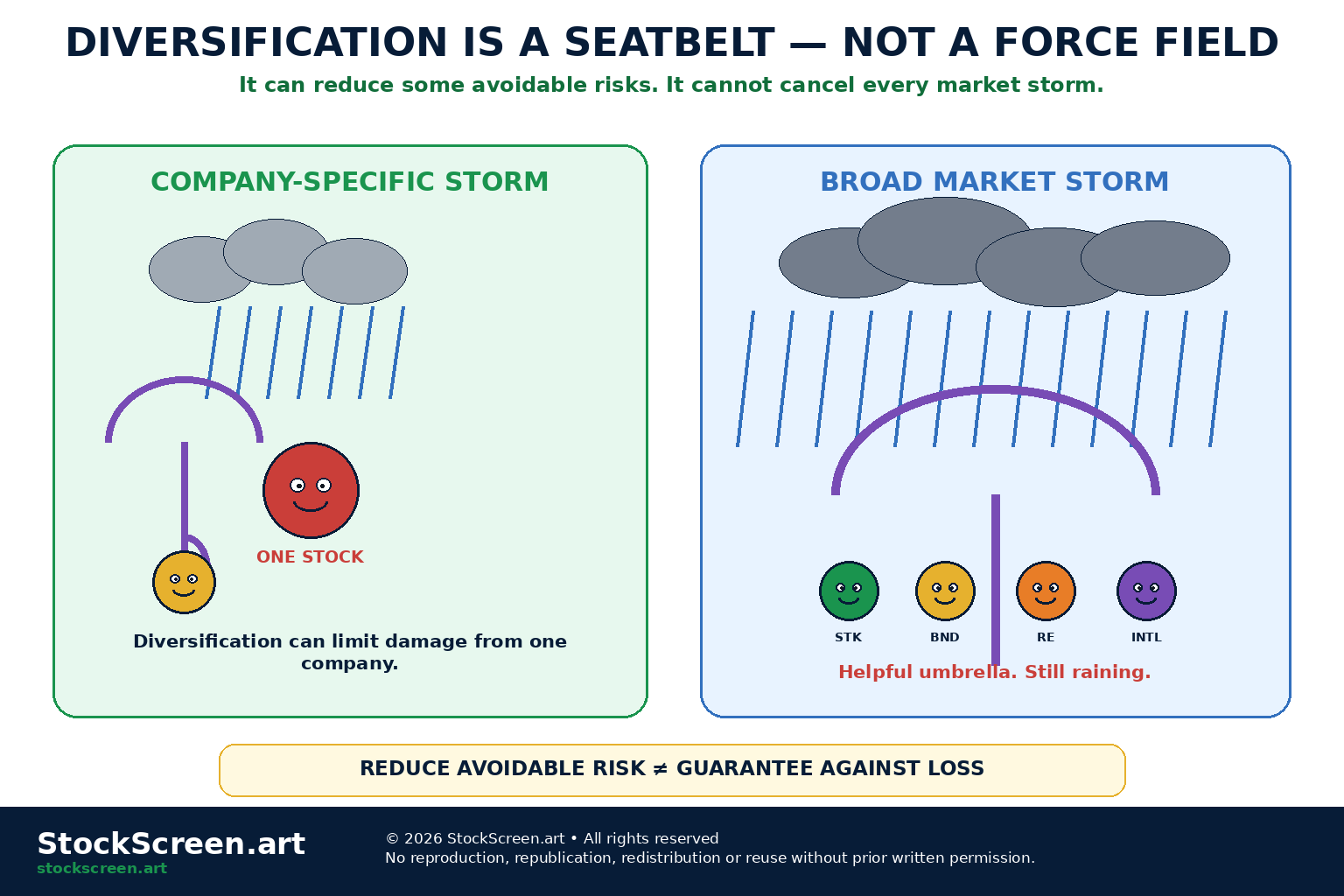
17. Diversification can reduce company-specific risk
Company-specific risk includes events such as:
- management failure;
- fraud;
- product problems;
- customer loss;
- litigation;
- competitive disruption.
If one company is a small piece of a diversified portfolio, damage from that company can have a smaller portfolio effect.
18. Diversification can reduce narrow industry risk
An industry can suffer from:
- regulation;
- technology change;
- commodity shocks;
- credit stress;
- changing consumer demand.
Exposure to other industries can reduce dependence on that one industry outcome.
19. Diversification cannot abolish market risk
Broad market declines can affect many investments at the same time.
Recessions, financial crises, inflation shocks, liquidity events or sharp changes in interest rates can affect entire asset classes.
Diversification may reduce the damage.
It cannot promise immunity.
20. Systematic versus non-systematic risk
A useful high-level distinction is:
Non-systematic risk
Risk tied to a company, industry or other relatively narrow exposure.
Systematic risk
Risk affecting broad markets or the financial system.
Diversification is particularly useful against narrow, non-systematic risks.
Broad systematic risks are much harder to diversify away completely.
21. Diversification does not guarantee better returns
A concentrated portfolio can outperform a diversified portfolio.
It can also underperform dramatically.
Diversification is primarily a risk-management concept.
It trades some dependence on a few outcomes for exposure to a broader set of outcomes.
22. The best-performing stock will always make diversification look foolish afterward
Imagine two portfolios:
- Portfolio A owned the year's best-performing stock at 100% weight.
- Portfolio B owned a diversified basket.
After the fact, Portfolio A looks brilliant.
Before the fact, the identity of the year's winner was not printed on the label.
Diversification exists because foresight is less reliable than hindsight.
23. Concentration magnifies both skill and error
If your best idea is correct, a concentrated position can have a large positive impact.
If your best idea is wrong, it can have a large negative impact.
Concentration increases the importance of being right.
Markets continue refusing to sign agreements requiring that.
24. Equal-weight diversification
One simple way to reduce security-level concentration is to assign similar weights to holdings.
Equal weighting can prevent one holding from dominating solely because it has risen dramatically.
But equal weighting does not solve every problem.
Ten equal-weight semiconductor stocks are still ten semiconductor stocks.
25. Diversifying across sectors
Sector diversification spreads exposure across parts of the economy that may respond differently to:
- interest rates;
- commodity prices;
- consumer spending;
- business investment;
- economic growth;
- regulation.
The goal is not to collect one stock from every sector like trading cards.
The goal is to understand where the portfolio's economic dependence sits.
26. Diversifying across asset classes
Asset allocation can spread exposure across categories such as:
- equities;
- bonds;
- cash;
- real estate;
- commodities;
- other appropriate assets.
Different asset classes can behave differently under different economic conditions.
Whether a particular mix is appropriate is personal and outside the scope of this lesson.
27. Diversifying across geography
International diversification can reduce dependence on one country's:
- economy;
- policy;
- currency;
- market leadership.
It also introduces additional risks such as:
- currency movements;
- political risk;
- different regulations;
- different accounting and market structures.
Diversification does not mean risk disappears.
Sometimes it means the risk learns a new accent.
28. Diversifying across company size
Large-cap, mid-cap and small-cap companies can have different:
- growth profiles;
- financing conditions;
- liquidity;
- economic sensitivity;
- business maturity.
Size diversification can prevent the portfolio from depending entirely on one part of the corporate landscape.
29. Diversifying across investment styles
Portfolios can also become concentrated in styles such as:
- growth;
- value;
- momentum;
- income;
- quality;
- low volatility.
Styles can go through long periods of strength and weakness.
Owning different style exposures can reduce dependence on one market regime.
30. Too much diversification can create its own problems
More holdings are not automatically better.
Extremely broad portfolios can create:
- duplication;
- difficulty monitoring holdings;
- more transaction complexity;
- small positions that barely affect outcomes;
- an accidental copy of the market with extra paperwork.
The objective is not maximum ticker count.
It is intentional risk structure.
31. Diworsification
Investors sometimes use the joking term diworsification for adding investments that increase complexity without meaningfully improving the portfolio.
Example:
“I already own a broad U.S. market fund, so naturally I bought four more nearly identical U.S. equity funds for emotional support.”
More products.
Possibly the same exposures.
32. Diversification changes as prices move
Suppose one holding starts at 10% of the portfolio and then triples while the rest barely move.
Its weight can grow substantially.
A once-diversified portfolio can become concentrated without any new purchase.
Winners can create concentration all by themselves.
33. New money can change concentration
Portfolio weights can also change when:
- new contributions are invested;
- cash is withdrawn;
- dividends accumulate;
- positions are sold;
- an employer stock grant vests.
Diversification is therefore a condition to monitor, not a checkbox permanently completed in 2023.
34. Rebalancing will matter later
When portfolio weights drift, investors may choose to rebalance.
Rebalancing can involve:
- selling some overweight holdings;
- adding to underweight holdings;
- directing new contributions strategically.
We will cover that process in FND-PR-06.
35. Diversification and taxes can interact
Selling a concentrated holding may create tax consequences in taxable accounts.
That can make diversification decisions more complicated.
Tax rules depend on jurisdiction and individual circumstances.
This lesson does not provide tax advice.
36. Diversification and liquidity can interact
A portfolio can own many assets but still be poorly diversified operationally if several holdings are hard to sell during stress.
Liquidity itself can become a common risk factor.
The portfolio may look varied until everyone tries the same exit door.
37. Diversification and leverage can interact
Leveraged positions can create more exposure than their cash allocation suggests.
A portfolio with:
- 20% cash posted as margin;
- 80% ordinary investments;
may still have much more than 100% gross market exposure.
Allocation by cash balance alone can therefore hide concentration.
38. Diversification by capital is not the same as diversification by risk
Two positions can each receive 10% of portfolio capital but contribute very different risk.
A highly volatile small-cap stock and a short-term government bond are not equivalent simply because both occupy a 10% line item.
This idea becomes important when we discuss portfolio construction later.
39. A practical concentration audit
Ask these questions:
- What is my largest single position?
- What percentage sits in my largest sector?
- Do several funds own the same companies?
- How much exposure is tied to one country?
- Does my employer also represent a large investment position?
- Do several holdings depend on the same macro theme?
- Has one winner grown into an oversized weight?
- Am I diversified by capital only, or by actual risk drivers?
40. A practical diversification framework
A useful beginner framework is:
- Look at weights, not ticker count.
- Look through funds to underlying holdings.
- Check sector and industry exposure.
- Check geographic exposure.
- Identify employer and thematic concentration.
- Ask what could hurt several holdings at once.
- Review the portfolio again after large market moves.
41. Eight terrible diversification tests
- “I own more than ten tickers.”
- “They all have different company names.”
- “I own three ETFs, therefore science has occurred.”
- “My biggest stock has never fallen before.”
- “Every holding is technology, but different kinds of technology.”
- “My employer stock is safe because I know the cafeteria menu.”
- “I diversified across six funds without reading any holdings.”
- “If one thing falls, surely everything else must rise.”
42. Ten mental models worth keeping
- Diversification is about risk sources, not labels.
- Weight matters more than ticker count.
- Different companies can share the same economic risk.
- Different funds can own the same companies.
- Concentration can hide in sectors, countries, themes and employers.
- Diversification can reduce narrow risks, not eliminate market risk.
- A portfolio can become concentrated simply because one holding rises.
- Equal capital does not mean equal risk.
- Intentional concentration should be recognized as concentration.
- Look under the hood before calling a portfolio diversified.
Quick knowledge check
Ten questions. Please keep all eggs inside the educational vehicle until the quiz has stopped.
1. Does owning twenty securities automatically mean a portfolio is diversified?
No. The holdings may overlap heavily or depend on the same sector, country, theme or economic risk.
2. Which matters more for concentration: ticker count or portfolio weight?
Portfolio weight. A very large position can dominate portfolio behavior even if many smaller holdings are present.
3. Can several ETFs create hidden concentration?
Yes. Different ETFs can own many of the same underlying securities or sectors.
4. Why can employer stock create unusual concentration risk?
Because employment income, benefits and career exposure may already depend on the same company that also represents a large investment holding.
5. Can diversification guarantee that a portfolio will not lose money in a broad market decline?
No. Diversification can reduce some risks but cannot eliminate systematic market risk or guarantee gains.
6. What is security-level concentration?
When one individual security represents an unusually large share of the portfolio.
7. Can a broad-looking portfolio still be concentrated in one theme?
Yes. Different holdings can still depend on the same economic driver, such as interest rates, AI spending, housing or commodity prices.
8. Why should investors look through an ETF to its holdings?
To understand actual security, sector and geographic exposure and to identify overlap with other holdings.
9. Why can diversification drift over time?
Because market prices change, winners can become larger portfolio weights, contributions and withdrawals change allocations, and new positions may be added.
10. What is the central purpose of diversification?
To reduce dependence on avoidable single outcomes by spreading exposure across genuinely different sources of risk and return.
Where we go next
We now know that five holdings can secretly be one risk wearing five name tags.
The next question is:
“How do we know which holdings actually move together?”
That takes us to:
FND-PR-02 — Correlation and Overlapping Risk.
Correlation is where diversification stops being a basket-counting exercise and starts becoming a relationship problem.
Think Thanksgiving dinner, but with covariance.
Primary sources & further reading
- Investor.gov — Diversify Your Investments
- Investor.gov — Asset Allocation and Diversification
- FINRA — Concentrate on Concentration Risk
- FINRA — Risk
- FINRA — Love Your Company Stock? Here's What to Know