StockScreen.art

Engineering · Research · Architecture

StockScreen.art Labs

A transparent look at how StockScreen.art is designed, tested and improved. Labs publishes engineering papers, research notes and architecture updates about AlphaEngine™, market-analysis systems, risk models and decision logic. For the broader investor-facing explanation of how these ideas fit together, start with quantitative stock analysis for the systematic methodology and AI stock analysis for the role of AI and machine learning.

Latest publication

Featured research

StockScreen.art Labs documents both the systems behind the platform and the lessons learned while testing them—including the results that looked promising, the models that added complexity without adding value, and the data problems that quietly tried to ruin everyone’s afternoon.

Latest technical engineering article

Building a Python Research Stack for Machine-Learning Stock Selection

A code-level look at the machinery around financial ML: point-in-time reconstruction, temporal leakage controls, feature contracts, reproducible experiments, promotion gates and the path from research code to production inference.

August 15, 2026 Python & ML engineering 22-minute read
Python MLAlpha Financial ML Model governance

Article summary

The model is only one box. This article focuses on the engineering controls around it— while deliberately keeping MLAlpha's proprietary feature definitions, thresholds, ranking logic and current research signals private.

Read the technical article
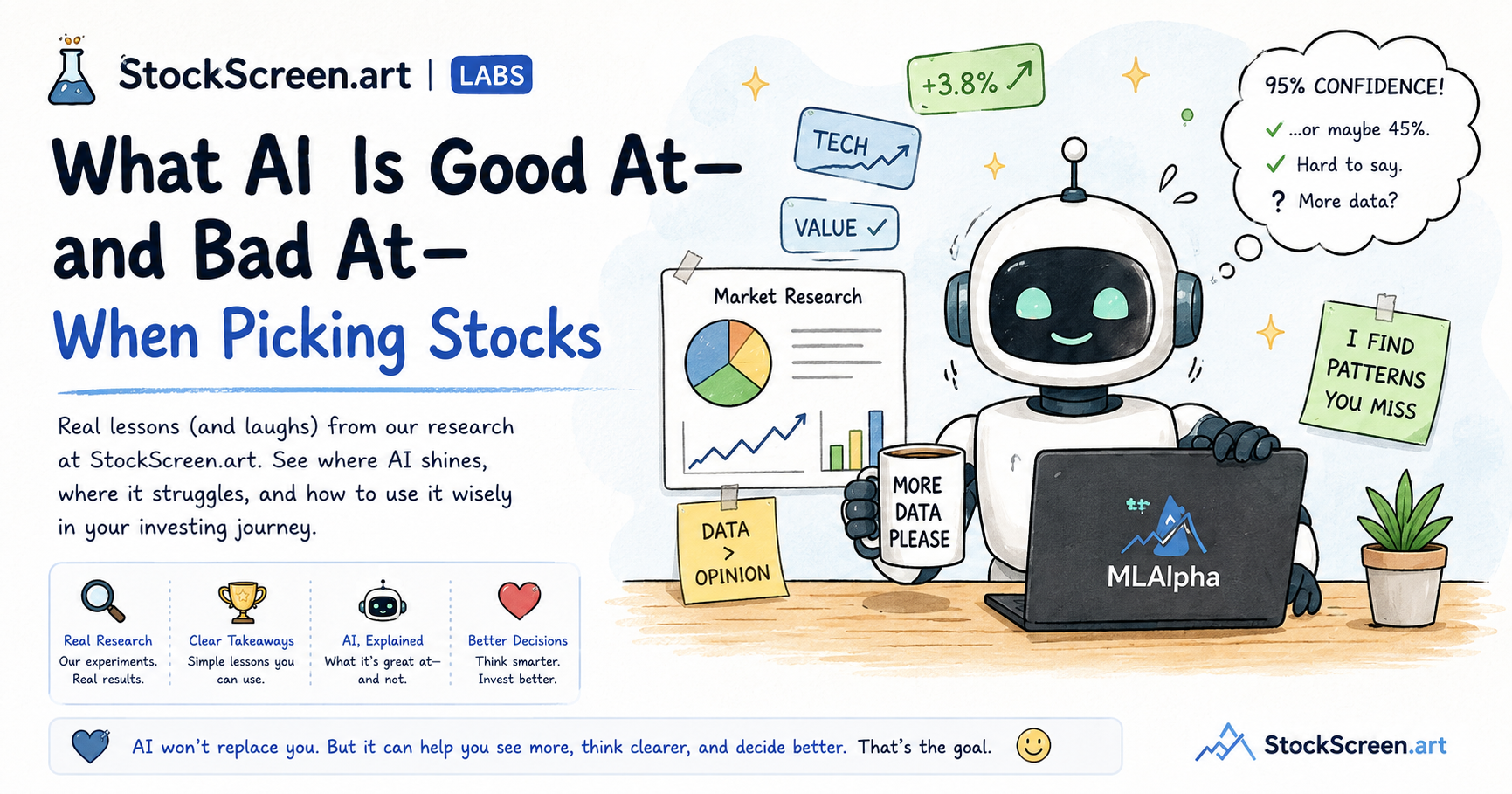
A playful StockScreen.art illustration about the strengths and weaknesses of AI stock picking
New AI research article

AI Can Help Pick Stocks. It Can Also Be Very Confidently Wrong.

A candid and occasionally amused look at where artificial intelligence genuinely improves stock research—and where it still needs complete data, careful testing and a human nearby asking, “Are we sure about this?”

August 5, 2026 AI research and model risk 18-minute read
AI stock picking MLAlpha Backtesting Model risk

Article summary

AI is excellent at screening large universes, applying rules consistently and comparing qualified candidates. It is much less capable of noticing that an experiment is incomplete, the historical data is unavailable, or a beautifully precise answer is built on a questionable assumption.

Read the article
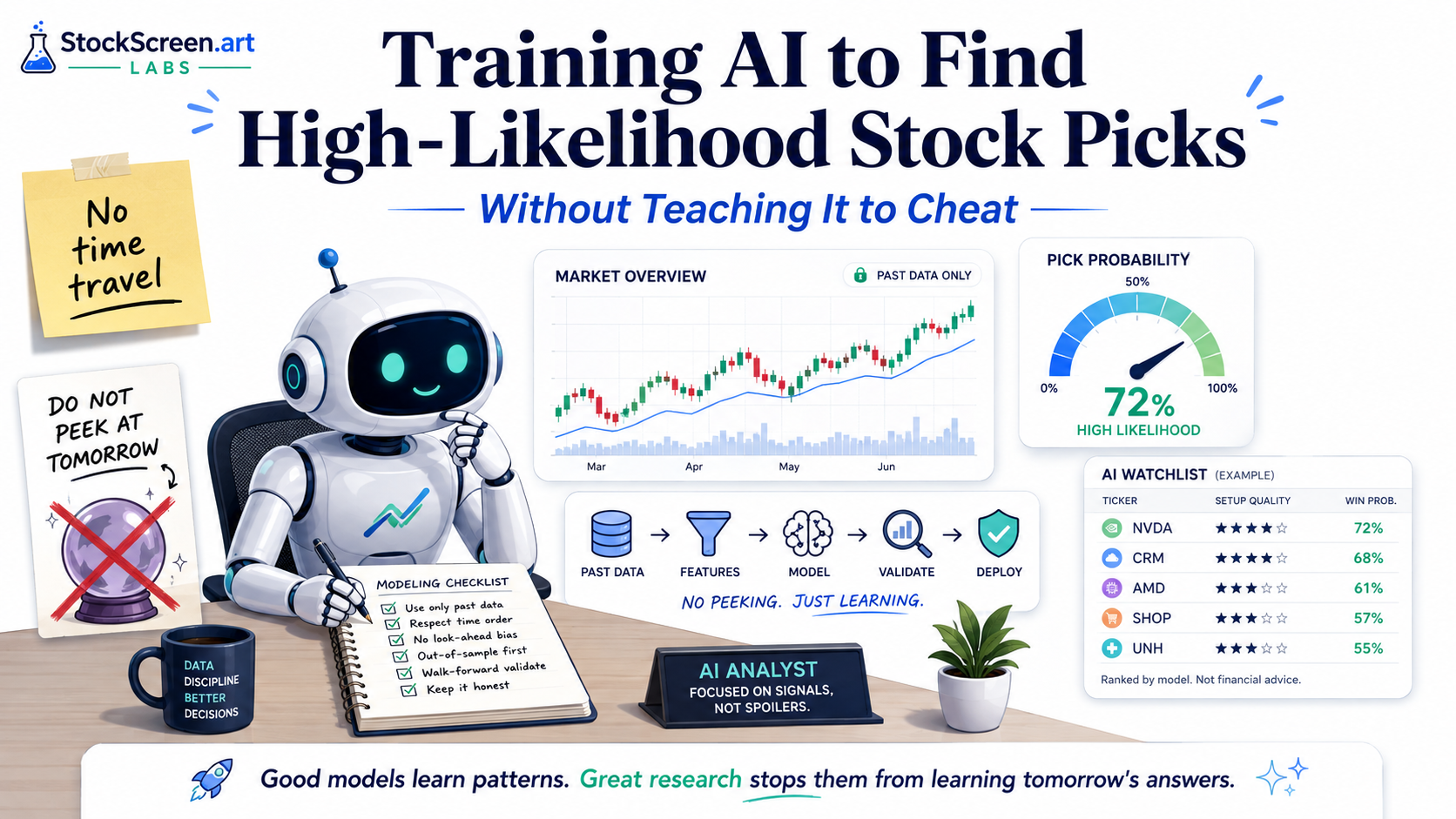
An MLAlpha engineering illustration showing an AI analyst learning from historical market data without looking into the future
New methodology paper

Inside the Training Loop: How an AI Stock-Ranking Model Actually Learns

A practical look inside the machinery used to train a high-likelihood stock-ranking model—from historical candidate cohorts and feature matrices to purged walk-forward folds, probability calibration and live shadow testing.

August 6, 2026 Machine-learning methodology 25-minute read
MLAlpha Model training Walk-forward folds Calibration

Article summary

The model itself is only one part of the system. This paper explains how point-in-time data, deterministic outcome labels, purged chronological validation, nested tuning, out-of-fold predictions and production gates work together to keep an impressive backtest from becoming a sophisticated historical misunderstanding.

Read the methodology paper

Research tracks

Explore quantitative finance research by topic

Each Labs publication owns a distinct research question. Use these topic links to move directly to the article that goes deepest on that subject without mixing machine-learning selection, ranking, AI stock picking and market-regime analysis into one catch-all page. For a plain-English overview of how technical analysis, quantitative models, machine learning, screening and model limitations fit together, see the Quantitative Stock Analysis guide. For the AI-specific layer, continue to the AI Stock Analysis guide.

Machine Learning Stock Selection

Python research architecture, point-in-time reconstruction, leakage controls, feature contracts, temporal validation and reproducible financial ML experiments.

Machine Learning Stock Ranking

How historical candidate cohorts, chronological validation, calibration and production gates support an ML stock-ranking model.

AI Stock Picker

Where AI helps stock research, where it can fail, and why data quality, validation and model risk matter before trusting a confident output.

AI Market Regime Analysis

Adaptive market context, regime detection, risk calibration and the architecture used to interpret signals within changing market conditions.

Publication scope

What Labs covers

Labs is the technical publication layer of StockScreen.art. It focuses on how the platform is engineered, how its analytical assumptions are tested and where the research remains incomplete. Readers looking for the broader methodology before diving into experiments can start with how quantitative stock analysis works.

Architecture

How AlphaEngine, MarketEngine, universe construction, data pipelines, scoring layers and delivery systems fit together.

Research

Experiments involving market regimes, confidence calibration, relative strength, volatility and opportunity ranking.

Product engineering

Practical decisions involving explainability, security, reliability, performance tracking and the user experience.

Research standard

Labs publications distinguish between implemented production behaviour, proposed architecture and future research. They document limitations as well as intended improvements. New complexity is treated as useful only when it produces clearer explanations, stronger calibration or more robust outcomes than the simpler baseline.

From quantitative research to practical tools

Continue from Labs into quantitative stock analysis for the broader systematic methodology, AI stock analysis for AI-specific methods and limitations, use the Stock Analysis tool for an individual ticker, review quantitative stock rankings, explore stock market education, or return to the stock market research blog.