AlphaEngine Scan Summary
Executive summary
Most technical systems begin with an understandable simplification: calculate indicators, apply rules and map the result to a recommendation. That approach is useful, but it can become brittle when the same indicator configuration behaves differently across market environments.
AI Alpha 5.0 is designed to reduce that brittleness. It does not discard RSI, MACD, moving averages, relative strength or volatility. Instead, it adds a contextual layer around them. The system asks not only whether a setup is technically attractive, but also whether the surrounding environment supports conviction.
What is AI market regime analysis?
AI market regime analysis is the use of statistical or machine-learning methods to estimate the market environment in which an investment signal is occurring. Instead of treating the same technical pattern identically in every period, a regime-aware system asks whether the surrounding market appears supportive, unstable, stressed or in transition.
The purpose is not to predict every market turn. It is to provide context. A momentum signal that appears during a broad, stable advance may deserve a different confidence level from an otherwise similar signal appearing during deteriorating breadth, rising volatility or an unstable transition between market states. For the underlying market concept before the AI layer is added, see the Foundation lesson on economic cycles and market regimes.
In AI Alpha 5.0, market-regime analysis is therefore treated as a contextual layer around transparent technical evidence—not as a replacement for it. The model can adjust conviction, confidence and risk expectations while leaving the underlying trend, momentum and trade-quality evidence visible.
This is also why market regime analysis and stock ranking are separate jobs. AlphaEngine™ quantitative stock rankings identify and order research candidates, while a market-context layer helps interpret how supportive the surrounding environment appears to be.
Static rules can overstate conviction when the market environment is unstable.
Add market-pressure, regime, risk and confidence layers before recommendation mapping.
More explainable and better-calibrated decisions rather than more frequent signals.
The problem with static technical analysis
Technical indicators summarize market behaviour. They do not, by themselves, explain the forces producing that behaviour. An RSI reading, moving-average crossover or positive MACD configuration may look identical on two charts while the broader conditions behind those charts are materially different.
In a supportive environment, momentum can persist and pullbacks may attract liquidity. In a stressed environment, the same apparent momentum can be fragile, crowded or vulnerable to abrupt repricing. A system that treats both cases identically can confuse pattern detection with decision quality.

Figure 3. AI Alpha 5.0 inserts market context, regime, risk and confidence between technical evidence and the final recommendation.
The objective is not to produce more buy signals. It is to make the meaning and conviction of each signal more defensible.
Evolution of AlphaEngine
AlphaEngine has evolved incrementally. Early generations concentrated on technical qualification. Later versions added multi-factor scoring, trade-level discipline, relative strength, quality assessment and ranking. AI Alpha 5.0 extends this progression by making context a first-class input rather than an after-the-fact explanation.

Figure 1. Conceptual evolution from rule-based technical analysis toward adaptive market-context evaluation.
Why Market Regime Analysis Matters
Market behaviour is shaped by interacting pressures. Inflation affects margins and valuation. Interest rates alter the cost of capital and the relative appeal of future earnings. Geopolitical shocks can change energy prices, supply chains and investor risk tolerance. Liquidity influences breadth, crowding and the speed of reversals.
These forces are not independent. They can reinforce or offset each other, which makes a single-variable regime label insufficient. AI Alpha 5.0 therefore treats market pressure as a composite interpretation problem rather than a binary switch.

Figure 2. External market pressures alter the context in which technical evidence should be interpreted.
Market context should adjust conviction and risk expectations. It should not become an untestable narrative that overrides the underlying data.
AI Market Regime Model Architecture in Alpha 5.0
The architecture separates evidence generation from contextual interpretation. Price and volume history continue to produce transparent indicators. A market-pressure layer evaluates broader conditions. Regime detection summarizes state and stability. A risk engine evaluates volatility, liquidity, expected upside and risk-reward. A confidence model then combines the evidence without collapsing every dimension into a single opaque number.
Primary layers
Technical evidence
Trend, momentum, volatility, relative strength and liquidity measurements.
Market-pressure context
Conditions that may support, weaken or destabilize a technically valid setup.
Risk calibration
Trade-level constraints including upside, stop distance and risk-reward quality.
Confidence
A separate expression of evidence strength, agreement and environmental support.
Decision pipeline
The pipeline is intentionally staged. Each layer has a distinct responsibility and should be testable in isolation. This avoids a common failure mode in which one composite score hides whether a decision was driven by trend, momentum, market regime, volatility or a quality overlay. For a broader explanation of how artificial intelligence can support stock research, see the AI stock analysis guide. For ticker-level research after that context is established, MarketEngine™ stock analysis provides the individual-stock view.
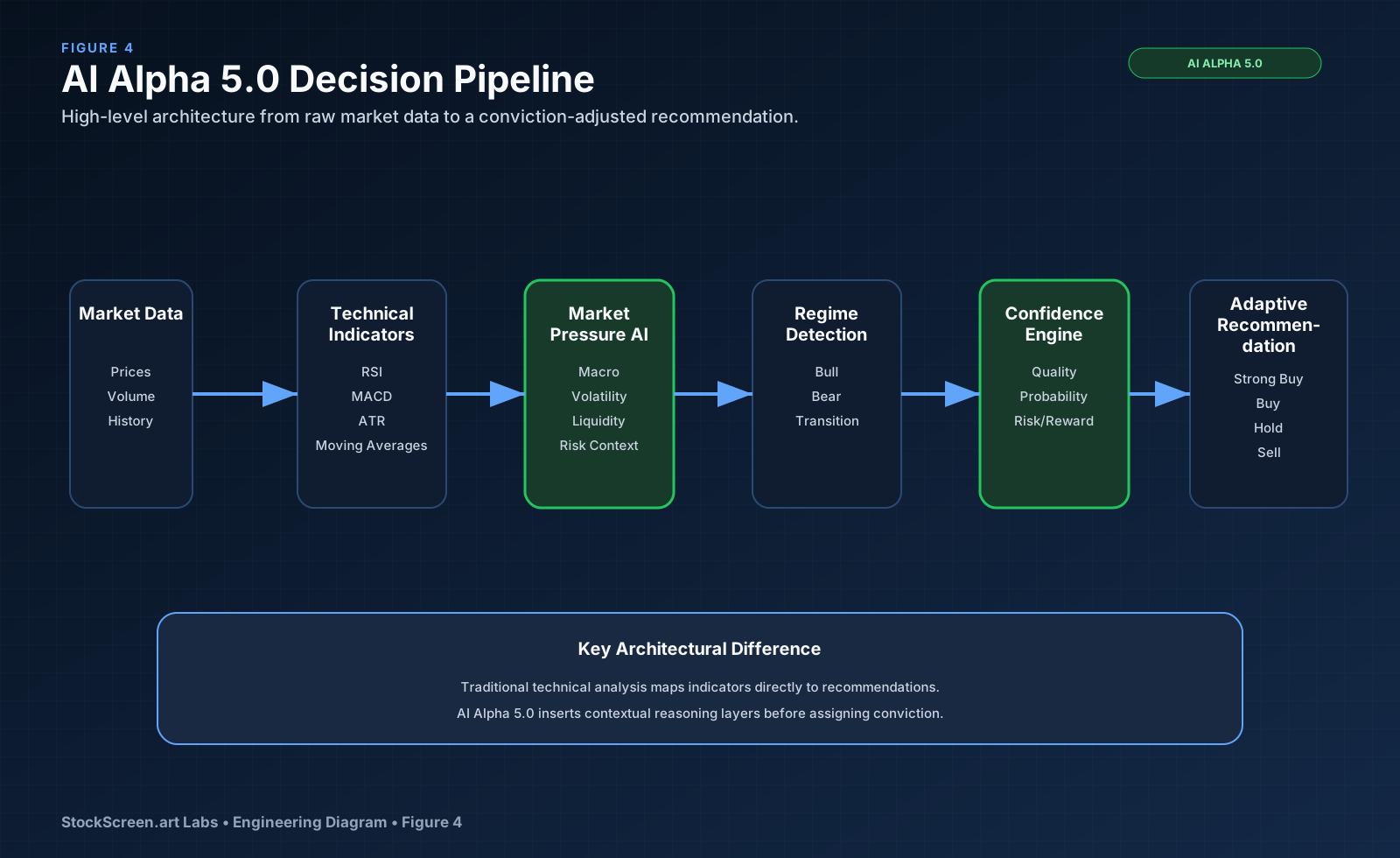
Figure 4. High-level decision flow from structured market data to an adaptive, conviction-adjusted recommendation.
- Acquire and validate data. Price history, volume and benchmark data must meet minimum freshness and completeness requirements.
- Generate transparent indicators. Technical calculations remain inspectable and reproducible.
- Evaluate market pressure and regime. The system estimates whether the broader environment supports or undermines persistence.
- Apply risk constraints. A technically attractive setup can still fail because upside or risk-reward is inadequate.
- Assign confidence separately. Confidence should reflect evidence quality and agreement, not merely repeat the ranking score.
- Produce an explainable recommendation. The output should show what qualified, what weakened conviction and what would invalidate the setup.
Design principles
1. Separate quality from opportunity
A strong company is not automatically a strong near-term trade. Quality classification and opportunity classification should remain separate so that a high-quality company can correctly appear as a hold when expected upside is limited.
2. Keep confidence independent from score
A ranking score measures relative attractiveness. Confidence measures the consistency and reliability of the evidence. Treating them as identical creates false precision.
3. Preserve explainability
Every major adjustment should be traceable. A user should be able to see whether conviction changed because of trend deterioration, regime instability, volatility, weak relative strength or inadequate risk-reward.
4. Prefer calibrated restraint
A research system is not improved merely by producing more recommendations. “No high-conviction opportunity” is a valid output when the evidence is weak or contradictory.
5. Measure outcomes over time
Architecture claims must eventually be evaluated through tracked selections, defined exits, benchmark comparison and version-aware performance records.
Current limitations
AI Alpha 5.0 is an architectural direction, not a claim of solved market prediction. Several limitations remain material:
- Market regimes are probabilistic and can change faster than daily models detect.
- Historical relationships can weaken when market structure changes.
- Macro and geopolitical context can be difficult to quantify consistently.
- Data-source failures or stale data can create misleading confidence.
- Backtests can overstate effectiveness when transaction costs, survivorship and selection bias are ignored.
- Sector and industry comparisons depend on complete and reliable classification data.
A more sophisticated architecture can still be wrong. Added complexity is justified only when it improves calibration, transparency or measured outcomes. The broader model-risk trade-off is explored separately in our AI stock picker research.
Future research and validation roadmap
The next stage of AI Alpha 5.0 is not simply to add more inputs or produce a more elaborate score. The central research question is whether market context improves the quality, calibration and consistency of decisions when compared with the existing technical framework. The validation philosophy follows the same discipline described in our machine learning stock-ranking research: added complexity has to earn its place through out-of-sample evidence. That requires a controlled, versioned evaluation process in which every recommendation can be traced back to the evidence available at the time. The broader point-in-time data, reproducibility and research-system architecture behind that process is covered in our guide to machine learning stock selection with Python.
1. Capture the full decision state
Each evaluated symbol should store more than its final recommendation. The research record should include the technical score, trend and momentum components, market-pressure inputs, detected regime, regime stability, volatility, liquidity, expected upside, risk-reward, confidence and every rule that materially increased or reduced conviction. This creates an auditable decision snapshot and makes it possible to determine which parts of the architecture are genuinely useful.
2. Establish a version-aware performance ledger
Recommendations should be tracked as paper positions using predefined entry, target, stop-loss and maximum-holding-period rules. Results should be compared with an appropriate benchmark over the same period and tagged with the exact engine version that produced them. Version-aware tracking is essential: without it, later threshold changes can become mixed with earlier results and make the historical record impossible to interpret.
3. Test confidence calibration
Confidence is useful only when it corresponds to observable differences in outcomes. A properly calibrated model should show that higher-confidence selections succeed more often, experience smaller adverse moves, or deliver better risk-adjusted results than lower-confidence selections. The research should therefore compare confidence bands against hit rate, average return, maximum adverse excursion, time to target and benchmark-relative performance.
4. Measure the value of market context through ablation tests
The contextual architecture should be tested against a technical-only baseline. One practical method is an ablation study: run the same historical decision set with the market-pressure layer enabled and disabled, then compare the resulting recommendations and outcomes. Similar tests can isolate regime detection, confidence adjustments and adaptive risk thresholds. This helps distinguish meaningful improvements from complexity that merely changes the language of the output.
5. Evaluate regime transitions and model stability
Regime models are most vulnerable near transitions, when classifications can change quickly or alternate between states. Future work should measure state persistence, transition probability and the frequency of unstable classifications. The engine may need a neutral or low-confidence transition state rather than forcing every observation into a clean bullish or bearish label.
6. Add sector-relative and industry-relative context
A stock can appear strong in absolute terms while lagging its own sector, or look weak while outperforming a deeply stressed industry. Once reliable sector and industry data are available, the engine should test whether relative strength against both the broad market and the relevant peer group improves ranking quality and reduces concentration in whichever sector happens to dominate the raw technical screen.
7. Test robustness under realistic operating conditions
Research results must account for stale data, missing bars, API interruptions, thin liquidity, transaction costs and delayed execution. The purpose is not to create a perfect backtest. It is to understand how the architecture behaves when exposed to the same imperfections that exist in production.
AI Alpha 5.0 should be considered an improvement only if the contextual layers produce measurably better calibration, clearer explanations or more robust risk-adjusted outcomes than the simpler technical baseline. Added complexity by itself is not evidence of progress.
Planned research sequence
- Instrument: capture every component used in each decision.
- Track: record paper outcomes with fixed, reproducible exit rules.
- Compare: evaluate the contextual model against a technical-only baseline.
- Calibrate: test whether confidence levels correspond to observed outcomes.
- Refine: change thresholds only when supported by versioned evidence.
- Publish: report both improvements and failures so the research remains falsifiable.
Frequently asked questions
What is AI market regime analysis?
AI market regime analysis uses statistical or machine-learning methods to estimate the broader market state surrounding an investment signal. The goal is to determine whether conditions appear supportive, unstable, stressed or transitional so that confidence and risk can be interpreted in context.
How is market regime analysis different from technical analysis?
Technical analysis describes price, trend, momentum, volatility and related market behaviour. Market regime analysis adds broader state context around those signals. A regime layer should adjust how technical evidence is interpreted rather than replace the underlying evidence.
Is AI Alpha 5.0 a generative-AI stock picker?
No. The architecture described here is a structured analytical system. It combines transparent technical indicators, market-context measurements, risk rules and confidence calibration. The goal is not to ask a language model to invent a market opinion, but to improve how measurable evidence is interpreted and communicated.
Why not use one score for everything?
A single score can hide important distinctions. A stock may rank well technically but have poor expected upside, unstable market context or weak confidence. Keeping quality, opportunity, risk and confidence separate makes the final recommendation easier to audit and less likely to create false precision.
Can market context override a valid technical setup?
It can reduce conviction or tighten risk requirements, but it should not replace the underlying evidence with an untestable narrative. The design principle is contextual adjustment: market pressure and regime affect how a setup is interpreted, while the technical and risk rules remain visible.
How will the architecture be validated?
Recommendations will be recorded with their full decision state and tracked using predefined entry, target, stop and holding-period rules. Results will be compared with a technical-only baseline and a market benchmark. Confidence calibration and regime-specific performance will be evaluated separately.
Does a Strong Buy recommendation guarantee a positive return?
No. A recommendation represents the engine’s interpretation of the available evidence at a specific time. Market conditions can change, data can be incomplete and every setup can fail. The architecture is intended to improve consistency and risk awareness, not eliminate uncertainty.
Research foundations and how they inform the architecture
The sources below are included because they support specific design choices discussed in this article. They are not presented as proof that AI Alpha 5.0 will outperform the market. The architecture must still be validated through its own versioned performance record.
Technical indicators and transparent evidence generation
The article’s use of RSI, directional movement and volatility-based measures such as ATR follows the indicator definitions introduced by J. Welles Wilder. These measures form part of the transparent technical-evidence layer described in the architecture; they are inputs to the decision process, not standalone forecasts.
- Wilder, J. Welles Jr. New Concepts in Technical Trading Systems. Trend Research, 1978. Relevant to the article’s discussion of RSI, volatility measurement and reproducible technical inputs.
Regime detection and changing market states
The regime layer is based on the idea that financial and economic time series can behave differently across latent states and that transitions between those states are probabilistic. Hamilton’s regime-switching framework provides the conceptual foundation for modelling changing states rather than assuming one stable market process.
- Hamilton, James D. “A New Approach to the Economic Analysis of Nonstationary Time Series and the Business Cycle.” Econometrica, 1989. Relevant to the article’s regime-detection and state-transition discussion.
Risk, expected return and disciplined trade constraints
The separation of opportunity from risk reflects the broader portfolio principle that expected return cannot be evaluated independently of uncertainty and downside exposure. Markowitz does not prescribe the engine’s specific target or stop rules, but his work supports the article’s insistence that an attractive signal is incomplete without an explicit treatment of risk.
- Markowitz, Harry. “Portfolio Selection.” The Journal of Finance, 1952. Relevant to the architecture’s separation of expected opportunity, risk and portfolio decision quality.
Multi-indicator confirmation and technical interpretation
The discussion of trend, momentum, moving averages, volume and confirmation is consistent with the established technical-analysis framework summarized by John J. Murphy. This supports the article’s argument that indicators should be interpreted together rather than treated as isolated prediction devices.
- Murphy, John J. Technical Analysis of the Financial Markets. New York Institute of Finance, 1999. Relevant to the article’s use of trend, momentum and confirmation within the technical-evidence layer.
These works inform the architecture’s components, but they do not validate StockScreen.art’s specific thresholds, scoring model, confidence mapping or recommendation logic. Those elements require direct testing through the research roadmap described above.
Disclaimer: This article describes the StockScreen.art research architecture and design direction. It is not investment advice, a performance claim or a guarantee of future results.