Use the course navigation below to continue through the curriculum or jump to closely related lessons.
You run a stock screen.
One company stands out.
The trend is positive. Momentum is strong. Relative strength is improving. The stock is trading around $100, your analysis suggests a reasonable technical target around $112, and the setup starts to look interesting.
So far, so good.
Then a dangerous little thought enters the room:
“Instead of buying the stock, what if I bought a call option?”
And just like that, a fairly straightforward stock thesis has acquired leverage, an expiration date, implied volatility, several Greek letters and significantly more opportunities to become confusing.
Welcome to options.
Options can be extremely useful. They can reduce the amount of capital required for a particular exposure, create asymmetric payoff structures, hedge an existing position and allow investors to express market views that are difficult to replicate with shares alone.
They can also turn a perfectly reasonable stock idea into a 100% loss.
Sometimes remarkably quickly.
The difference is not necessarily that the original stock research was wrong. It is that an option asks considerably more of you than a stock does.
With a stock, being right about direction may be enough.
With an option, you may need to be right about direction, magnitude, timing, volatility and price.
Options are needy that way.
What Is Options Leverage?
Options leverage refers to the ability to gain meaningful exposure to a stock's price movement with a smaller upfront amount of capital than buying the equivalent number of shares outright. A call option, for example, may provide exposure to changes in a stock while the buyer risks only the premium paid for the contract.
That does not mean an option simply behaves like a cheaper stock position. The payoff is nonlinear and depends on factors the shareholder does not face in the same way, including the strike price, expiration date, time remaining, implied volatility and the option's sensitivity to changes in the underlying stock.
Options leverage can therefore magnify percentage gains when the stock moves enough, quickly enough, under favorable pricing conditions. It can also magnify losses: a modestly disappointing stock outcome can result in a large percentage loss—or the complete loss of the option premium.
The useful mental model is simple: leverage changes the payoff structure; it does not improve the underlying investment thesis. Start with the stock, then decide whether the option structure actually fits that thesis.

Start With the Stock, Not the Option
For the rest of this article, we're going to abuse one entirely fictional company named XYZ.
Imagine a StockScreen.art screen produces something like this:
- XYZ current price: $100
- Trend: Positive
- Momentum: Strong
- Relative strength: Improving
- Technical target: $112
- Risk level: $94
None of this means XYZ is guaranteed to rise. There are no guarantees here. A screener is helping us narrow the market and structure a research thesis, not receiving tomorrow's closing prices from a time traveller. The Risk/Reward and Position Planning lesson explains how to define the underlying stock thesis before leverage is added.
But suppose you've researched XYZ and decide the bullish thesis is reasonable.
The simplest expression of that opinion is obvious:
Buy the stock.
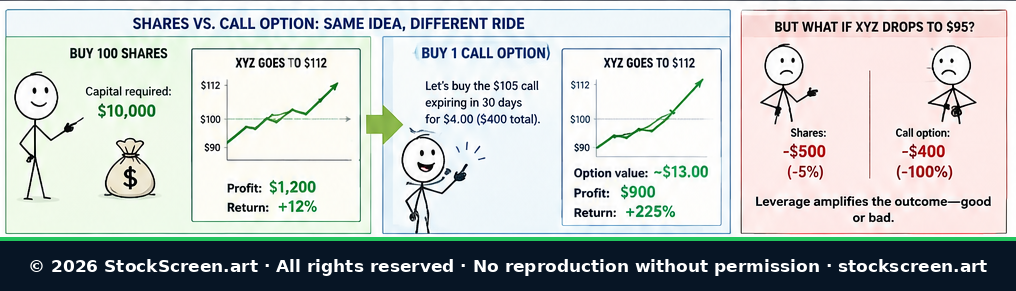
Buy 100 shares at $100 and you've invested $10,000.
If XYZ reaches $112, the position is worth $11,200.
Profit: $1,200
Return on the original $10,000: 12%
Simple enough.
And then somebody shows you an option chain.
Enter the Call Option
Suppose XYZ has a $105 call option expiring in 30 days.
The option costs $4 per share.
Since a standard equity option contract normally represents 100 shares, that contract costs:
$4 × 100 = $400
Suddenly the investor's brain notices something.
Exposure to a $100 stock.
Only $400 out of pocket.
This is approximately where leverage walks into the room wearing sunglasses.
A call gives its buyer the right to buy the underlying stock at the strike price—in this example, $105—before or at expiration, depending on the contract style.
But the easiest way to understand the economics is to look at expiration.
You paid $4 for the right to buy XYZ at $105.
That means your effective break-even at expiration is:
$105 strike + $4 premium = $109
| XYZ at expiration | $105 call value | Profit/loss on $400 premium |
|---|---|---|
| $95 | $0 | -$400 / -100% |
| $100 | $0 | -$400 / -100% |
| $105 | $0 | -$400 / -100% |
| $108 | $300 | -$100 / -25% |
| $109 | $400 | Break-even |
| $112 | $700 | +$300 / +75% |
| $120 | $1,500 | +$1,100 / +275% |
This is leverage doing exactly what leverage does.
XYZ rises from $100 to $112.
The stockholder earns about 12%.
The call buyer earns 75% at expiration in this simplified example.
Wonderful.
Champagne.
Screenshots.
A newly discovered interest in compound annual growth rates.
But look at the other side.
If XYZ finishes at $100, the shareholder's position is approximately unchanged.
The call buyer loses 100% of the premium.
Same stock. Same bullish idea. Very different ride.
How Options Leverage Amplifies Stock Exposure
Leverage lets you control a larger economic exposure with less capital.
That's powerful.
It can also be dangerously seductive because people naturally compare the exciting part:
“I could make 75% instead of 12%!”
while mentally minimizing the less exciting part:
“I could also lose the entire investment while the stock barely moves.”
The option doesn't make XYZ a better company.
It doesn't improve momentum.
It doesn't strengthen relative strength.
It doesn't increase the probability that the technical target will be reached.
It changes the payoff structure.
That's an enormously important distinction.
Leverage magnifies the consequences of the thesis. It does not magnify the intelligence behind the thesis.
The Most Important Lesson: Being Right About the Stock Isn't Enough
Return to our original XYZ thesis.
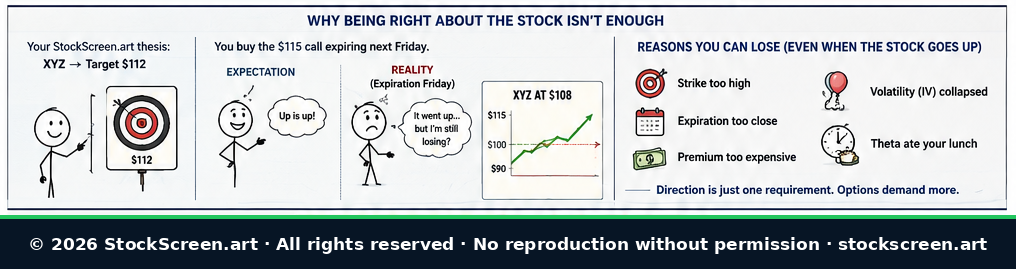
StockScreen.art surfaces XYZ at $100.
Trend positive. Momentum strong. Relative strength improving. Target around $112.
You decide to buy a $115 call expiring next Friday.
XYZ rises to $108.
Your underlying analysis was directionally correct.
The stock gained 8%.
That's a very respectable move.
The option may still lose money.
Why?
- The strike may be too high.
- There may be almost no time left.
- You may have paid a large premium.
- Implied volatility may have fallen.
- Theta may have consumed much of the remaining extrinsic value.
This is the conceptual leap that matters.
A stock thesis asks: Where might the stock go?
An options thesis asks: Where might it go, how quickly might it get there, what did I pay for the exposure, and how will volatility behave while I'm waiting?
Options don't merely magnify a stock trade.
They add dimensions to it.
Calls: “I Think This Stock Is Going Up”
A call is fundamentally bullish.
But saying “bullish” isn't enough.
Buying our $105 call for $4 really means:
“I believe XYZ will rise enough, soon enough, to overcome the premium I'm paying.”
That is very different from simply saying:
“I think XYZ is undervalued and will eventually trade higher.”
Eventually can work wonderfully for a shareholder.
Eventually is not especially comforting to an option contract expiring Friday.
A stock can disappoint you indefinitely.
An option has the courtesy to put the expiration date directly on the disappointment.
Puts: The Other Direction
Now imagine the StockScreen.art analysis looks very different.
XYZ is at $100, but trend is deteriorating. Momentum has weakened. Relative strength is poor.
You believe the stock may fall.
One way to express that thesis is through a put option.
A put gives the buyer the right to sell the underlying stock at the strike price.
Suppose a $95 put costs $3.50, or $350 per contract.
At expiration, its break-even is:
$95 - $3.50 = $91.50
If XYZ remains above $95, the put expires worthless.
If XYZ falls to $90, the put has $5 of intrinsic value.
If XYZ collapses to $80, the put has $15 of intrinsic value.
Again, the percentage movements of the option can be dramatically larger than those of the underlying stock.
Which sounds fantastic right up until the stock doesn't cooperate.

Strike Prices: How Optimism Becomes a Number
Options introduce something ordinary stock ownership doesn't require:
the strike price.
Suppose XYZ trades at $100.
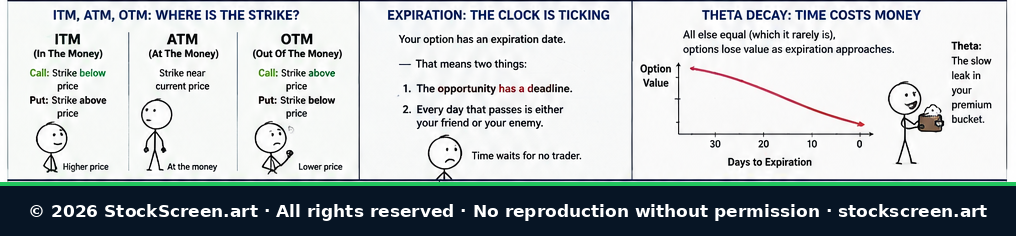
A $90 call is already in the money.
A $100 call is roughly at the money.
A $110 call is out of the money.
For calls:
- ITM: strike below the stock price
- ATM: strike near the stock price
- OTM: strike above the stock price
For puts, the relationship reverses.
This seems simple.
The interesting part is what investors do with it.
Imagine your underlying StockScreen.art thesis suggests:
XYZ: $100
Reasonable target: $112
Then you discover a $125 call that looks wonderfully cheap.
Fifty cents.
Only $50 per contract.
Surely that's better than paying $400 for the $105 call?
Not necessarily.
You've quietly changed the thesis.
Your stock analysis said:
“XYZ may have a reasonable path toward $112.”
Your option now requires something much closer to:
“XYZ needs to explode substantially beyond the target before expiration.”
Those are not the same idea.
If your analysis suggests $112 and you're buying a $125 call because it's cheap, that's not really leverage.
That's changing the thesis without admitting you've changed the thesis.
Expiration: Your Thesis Now Has a Deadline
This is perhaps the biggest psychological difference between stocks and options.
Stocks do not normally expire.
Your option does.
Imagine you are completely correct about XYZ.
You believe it will move from $100 to $115.
And it does.
Fantastic.
Unfortunately, it reaches $115 three months after your option expired.
The stock thesis was correct.
The option thesis was not.
This is why options demand something stocks generally do not:
timing accuracy.
Every day that passes reduces the remaining opportunity for the expected move to occur.
Time is no longer merely something investors experience while waiting.
It becomes part of the price.
Premium: What Are You Actually Paying For?
An option premium generally contains two broad components:
intrinsic value and extrinsic value.
Intrinsic value is the amount by which an option is already in the money.
If XYZ trades at $112 and you own a $105 call:
$112 - $105 = $7 intrinsic value
Extrinsic value is everything beyond intrinsic value.
That includes time remaining, expected volatility and other market factors.
Think of extrinsic value as the market saying:
“Interesting things could still happen before expiration, and we are charging you for that possibility.”
The option market is perfectly happy to sell you optimism.
At market prices.
Theta: Your Option Is Melting
One part of extrinsic value tends to disappear as expiration approaches.
This is commonly associated with theta.
All else equal—which in markets means “in the imaginary universe where everything politely holds still”—an option loses time value as expiration approaches.
Why?
Because there is less time left for something useful to happen.
Thirty days for XYZ to reach $115 is worth more than three hours.
That lost time value is often called time decay.
It is easy to underestimate.
The stock doesn't necessarily have to decline for the call holder to lose money.
XYZ can sit there doing absolutely nothing while the option becomes less valuable.
The stock may be peacefully drinking coffee.
Theta is quietly eating your premium.
Implied Volatility: The Market's Mood Swings Have a Price
Then there's implied volatility.
Usually shortened to IV, because options apparently needed more abbreviations.
Implied volatility reflects the market's expectations about future movement.
When traders expect large moves, option premiums tend to become more expensive.
When expectations fall, premiums can shrink.
This creates one of the strangest experiences available to a new options trader:
The stock moves in the direction you predicted—and the option still loses money.
Suppose XYZ trades at $100 before earnings.
Everybody expects fireworks.
Options become expensive because implied volatility rises.
You buy a call.
XYZ reports good earnings and rises to $104.
You were right.
But the market had been pricing the possibility of a much larger move.
Once the uncertainty disappears, implied volatility collapses.
The option loses part of the volatility premium embedded in its price.
Welcome to the IV crush.
The market has found a way to congratulate you and invoice you simultaneously.
The Greeks, Without Summoning a Mathematician
Options have several measurements commonly called the Greeks.
You can spend months studying them.
For an introductory understanding, think of them as describing different ways an option reacts when the world changes.
Delta — The Driver
Delta roughly describes how much an option's price may change when the underlying stock moves.
If XYZ moves $1, an option with a delta of 0.50 might theoretically move about $0.50, all else equal.
Delta also changes.
Naturally.
Because this was apparently not complicated enough.
Gamma — The Driver's Assistant
Gamma describes how quickly delta changes as the underlying stock moves.
Think of Delta as the steering direction.
Gamma tells you how aggressively the steering response itself is changing.
Theta — The Silent Thief
Theta describes time decay.
You have already met Theta.
Check your wallet.
Vega — The Volatility Influencer
Vega describes sensitivity to changes in implied volatility.
When IV expands, option values can rise.
When IV contracts, they can fall.
Rho — The Guy in the Corner
Rho measures sensitivity to interest rates.
Rho matters, particularly in certain circumstances and longer-dated contracts.
It is also the Greek most likely to appear at the party and discover nobody made it a name tag.

Options Leverage vs. Buying the Stock
This is one of the most useful comparisons to make.
Buying shares generally requires more capital but gives the investor something extremely valuable:
time.
There is no contractual expiration date forcing the thesis to work by next month.
A call can require dramatically less initial capital and offer substantial percentage upside.
But you are purchasing exposure with a clock attached.
That trade-off is fundamental.
The question isn't:
“Which makes more money?”
The question is:
“Which payoff structure actually matches the thesis?”
If your analysis says:
“This company may compound over the next five years,”
a 14-day call is probably an extraordinarily strange way to express it.
If your thesis involves a specific near-term catalyst or technical move, options may become more relevant—but the additional risks still need to be understood.
Covered Calls: Getting Paid to Potentially Sell Your Stock
Options aren't used only for leveraged speculation.
Suppose you already own 100 shares of XYZ.
You might sell a call against those shares.
That's a covered call.
You receive premium upfront.
In exchange, you accept the possibility that your shares will be called away at the strike price.
For example:
XYZ: $100
You own 100 shares.
You sell a $110 call.
If XYZ stays below $110 through expiration, you may keep both the shares and the premium.
If XYZ rockets to $140, you've discovered the emotional experience known as:
“I made money and somehow I'm furious.”
Your upside may effectively be capped because you've agreed to sell at $110.
Covered calls can generate income.
They are not free money.
Whenever someone describes an investment strategy as “basically free money,” it is worth locating the risk before locating the Buy button.
Protective Puts: Insurance With an Expiration Date
Suppose you own XYZ but are worried about a large decline.
You can buy a put.
That put may gain value if XYZ falls, partially offsetting losses on the shares.
This is called a protective put.
Conceptually, it works somewhat like insurance.
You pay a premium.
If the bad event never arrives, the premium may expire worthless.
Nobody complains that their home-insurance premium was “wasted” because the house failed to burn down.
Option hedges deserve similar emotional maturity.
Spreads: When One Option Apparently Wasn't Enough
Options can also be combined.
A vertical spread, for example, might involve buying one call while simultaneously selling another call at a different strike.
Why?
One reason is to reduce the initial premium and define the payoff more carefully.
The trade-off is that potential upside is generally capped.
Spreads can make risk more manageable and capital requirements smaller.
They also introduce multiple legs, assignment considerations, transaction costs and additional opportunities to stare at your brokerage screen wondering which line you're supposed to be looking at.
For a beginner, understanding calls and puts thoroughly is more important than memorizing a catalogue of exotic strategies.
Complexity is not a return source.
Buying Options and Selling Options Are Not the Same Risk
This distinction deserves emphasis.
When you buy a call or put, your maximum loss is generally limited to the premium paid.
Buy a contract for $400?
You can lose the entire $400.
Painful.
But defined.
Selling options can create very different risk profiles.
A covered call is backed by shares you already own.
An uncovered—or “naked”—call can expose the seller to theoretically unlimited losses because a stock can continue rising indefinitely.
That's not the kind of detail you want to discover halfway through the experience.
Option selling requires understanding assignment, margin and potentially very large risk exposures.
“Premium income” sounds substantially more relaxing than “short volatility exposure with nonlinear tail risk.”
Sometimes finance is mostly vocabulary management.
Liquidity Matters Here Too
Stock traders care about liquidity.
Options traders need to care about it twice.
You need liquidity in the underlying stock.
And you need liquidity in the specific option contract.
Two options on the same company can have dramatically different volume, open interest and bid-ask spreads.
Suppose an option is quoted:
Bid: $2.00
Ask: $3.00
The midpoint is $2.50, but the market is essentially saying:
“Welcome. Admission is expensive.”
Wide spreads can materially increase trading costs.
A beautifully structured theoretical trade can become much less beautiful when entering and exiting it costs a significant percentage of the premium.
The brokerage matters too. Options pricing, platform tools, market access and other costs vary substantially, so if you're comparing where to trade, see our independent comparison of major U.S. and Canadian online brokerages.
What About Risk/Reward?
This is another place where the StockScreen.art underlying thesis can help frame the question.
Suppose XYZ is:
- $100 entry
- $112 technical target
- $94 risk level
For the stock, that's relatively straightforward.
Potential upside: $12.
Potential downside to the thesis-invalidating level: $6.
Roughly 2:1 potential reward versus risk, before other considerations.
Now add an option.
Suddenly the payoff depends on strike price, premium, expiration, time remaining, implied volatility and option sensitivity.
The underlying stock still has a $112 target.
But your contract might require $109 simply to break even.
This is why option selection should follow the underlying thesis rather than replace it.
Why Cheap Options Are Not Automatically Good Leverage
Out-of-the-money options often look inexpensive.
That is not necessarily a bargain.
They may be inexpensive because the probability of finishing profitably is relatively low.
A $0.25 call controls 100 shares for only $25.
Fantastic.
So does a lottery ticket control exposure to several million dollars.
Price alone doesn't tell you whether the proposition is attractive.
One of the most dangerous phrases in options trading is:
“It's only $50.”
Because after saying that twenty times, you've conducted a rather expensive experiment.
How StockScreen.art Fits Into Options Research
This is where stock screening still matters.
An option contract derives its value from an underlying asset.
If you're trading equity options, the underlying stock still matters enormously.
A stock screener can help answer questions such as:
- Is the underlying trend constructive?
- Is momentum improving or deteriorating?
- Is the stock outperforming the broader market?
- Is liquidity healthy?
- Is volatility unusually high?
- Where might technically meaningful support or resistance exist?
- Is the expected upside large enough to make the idea interesting?
Those are useful questions before you start deciding whether a $105 call expiring in 30 days is preferable to a $110 call expiring in 90 days.
On StockScreen.art, the free U.S. stock screener can help narrow the universe, while MarketEngine™ AI stock analysis provides the deeper underlying-stock research view. Options-specific contract analysis still requires separate work.
The workflow becomes:
Find the underlying → analyze the underlying → decide whether the thesis is worthwhile → then evaluate the option structure.
Not:
Find cheap option → become emotionally attached to cheap option → invent stock thesis afterward.
That process has historically produced excellent educational material for whoever experiences it.

A Practical Options Leverage Checklist
Before translating a stock idea into an option, ask:
- Do I actually have a thesis for the underlying stock?
- What price movement am I realistically expecting?
- What time horizon does that thesis require?
- Does my selected expiration give the thesis enough time?
- Where is the strike relative to the expected move?
- What premium am I paying?
- What is my break-even at expiration?
- How high is implied volatility?
- Is the option liquid enough to trade efficiently?
- What happens if the stock moves in the correct direction more slowly than expected?
- What is my maximum loss?
- Am I comfortable losing that amount?
- Would buying the stock make more sense?
- Am I selecting an option because it fits the thesis—or because it looks cheap?
That final question catches a surprising amount of nonsense.
So Why Use Options at All?
After spending several thousand words explaining how options can hurt you, it's reasonable to ask why anyone bothers.
Because they can be enormously useful.
Options can provide:
- capital-efficient exposure
- defined-risk speculation
- portfolio hedging
- income strategies
- customized payoff structures
- ways to express views on volatility as well as direction
Those are genuine advantages.
The important point is that leverage isn't free. The Foundation lesson on leverage and position sizing develops that broader risk principle beyond options.
It trades capital requirements for additional variables and additional ways to be wrong.
That's not necessarily bad.
It's just a different instrument.
A chainsaw is more powerful than a handsaw.
That does not automatically make it the preferred device for opening Amazon packages.
The Underlying Idea Still Comes First
This brings us back to XYZ.
StockScreen.art surfaces a candidate.
You research it.
Trend looks constructive.
Momentum looks healthy.
Relative strength is improving.
You identify an expected price range and a reasonable risk level.
That is the beginning of the process.
Then you decide how—or whether—to express the thesis.
Shares may be appropriate.
An option may be appropriate.
A spread might eventually make sense.
Sometimes doing absolutely nothing is the highest-quality trade available.
Markets reopen tomorrow.
They are remarkably persistent that way.
Options Leverage Questions
How does leverage work with stock options?
A long option can provide exposure to a stock's movement for a smaller upfront premium than buying the equivalent share exposure outright. The trade-off is that the option has a strike, expiration date, time decay, volatility sensitivity and the possibility of losing the entire premium.
Are options more leveraged than stocks?
Options can produce much larger percentage changes than the underlying stock because the premium paid is smaller than the value of the share exposure being influenced. But the relationship is not fixed like a simple multiplier: delta, gamma, time and implied volatility can all change the option's sensitivity.
Can you lose 100% when buying a call option?
Yes. A purchased call can expire worthless, in which case the buyer can lose the entire premium paid. That can happen even when the underlying stock declines only modestly—or even rises, if it does not rise enough relative to the strike, premium and expiration.
Does using options make a good stock idea better?
No. An option changes how the thesis is expressed. It can make the exposure more capital-efficient or reshape the payoff, but it does not improve the company's fundamentals, trend, momentum or probability that the underlying thesis will be correct.
Final Thoughts: Leverage Is a Tool, Not a Personality
Options are fascinating because they allow investors to reshape risk.
Instead of simply asking whether a stock goes up or down, you can create positions around price levels, time horizons, volatility expectations and specific payoff structures.
That flexibility is exactly what makes them powerful.
It is also what makes them dangerous.
Our hypothetical XYZ example began with a fairly simple idea:
Stock at $100. Potential target around $112.
Buying the shares expressed that thesis directly.
Adding a call introduced a strike price, a premium, a break-even point, an expiration date, time decay, implied volatility, Delta, Gamma, Theta, Vega, and poor Rho standing quietly in the corner.
The original stock idea did not become smarter.
It became leveraged.
That's the lesson worth remembering.
Start with the thesis. Understand the underlying. Then choose the instrument.
And if the instrument comes with enough leverage to make a 5% stock move feel like an emotional life event, make sure you understood the contract before you clicked Buy.