Independent-review disclosure
StockScreen.art is not affiliated with any brokerage named in this article. We do not receive referral fees, affiliate commissions, account-opening bonuses, sponsorships, free services or any other compensation from these firms. There are no affiliate links in this guide. The opinions and comparisons are entirely editorial.
Over the past few months, we have received a surprising number of requests for brokerage recommendations.
Some came from new investors opening their first account. Others came from experienced investors wondering whether their current brokerage was still competitive or simply surviving on familiarity, inertia and the fact that changing financial institutions feels roughly as appealing as moving apartments during a snowstorm.
We also heard from Canadians trying to buy U.S. stocks without donating a noticeable portion of their portfolio to currency-conversion fees, options traders comparing contract costs and investors who wanted access to more than the usual menu of North American stocks and ETFs.
If options are one reason you're comparing platforms, the contract fee is only part of the story. Our guide What Happens When You Add Leverage to a Good Stock Idea? explains calls, puts, strike prices, expiration, time decay, implied volatility and why the underlying stock thesis still matters before the option contract enters the picture.
So we decided to publish a proper guide.
Not a two-paragraph list declaring one brokerage “best overall” and another “best for beginners” before sending everyone toward an affiliate button.
A real comparison.
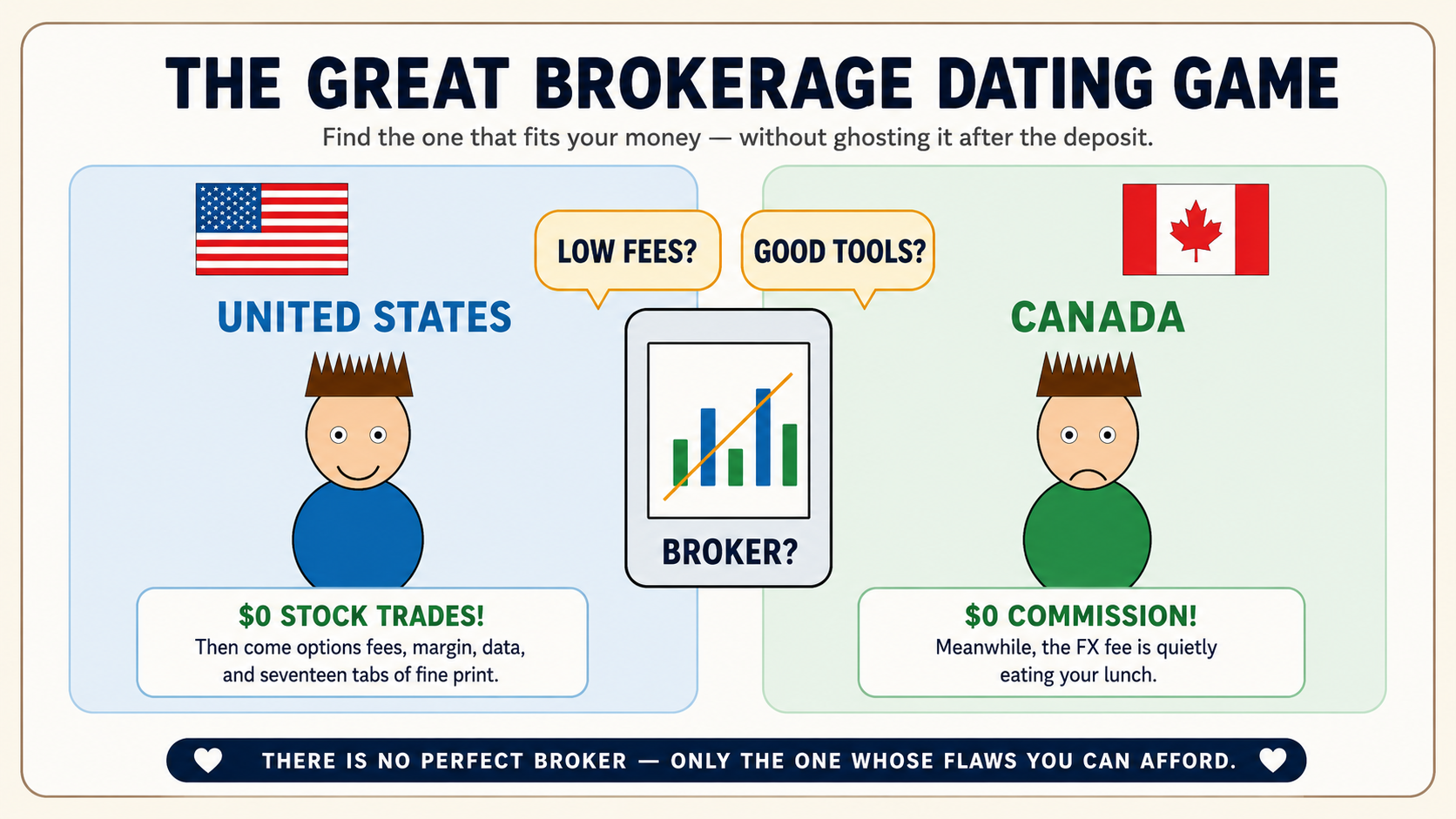
This guide examines leading self-directed brokerages available to investors in the United States and Canada, including:
- stock and ETF commissions;
- options and futures costs;
- foreign-exchange charges;
- international-market access;
- fractional shares;
- retirement and registered accounts;
- bonds, GICs, CDs and mutual funds;
- trading platforms and research tools;
- strengths, limitations and the fees hiding below the headline.
Choosing a brokerage used to be relatively simple. You checked the commission, looked for a nearby branch and tried to determine whether the trading website had been updated since the invention of Wi-Fi.
Today, most major U.S. brokers advertise commission-free stock and ETF trading. Several Canadian firms now do the same. Platforms offer fractional shares, recurring purchases, advanced options tools, extended-hours trading, futures and cryptocurrency.
At first glance, it appears that every brokerage is free and offers everything.
This is not the case.
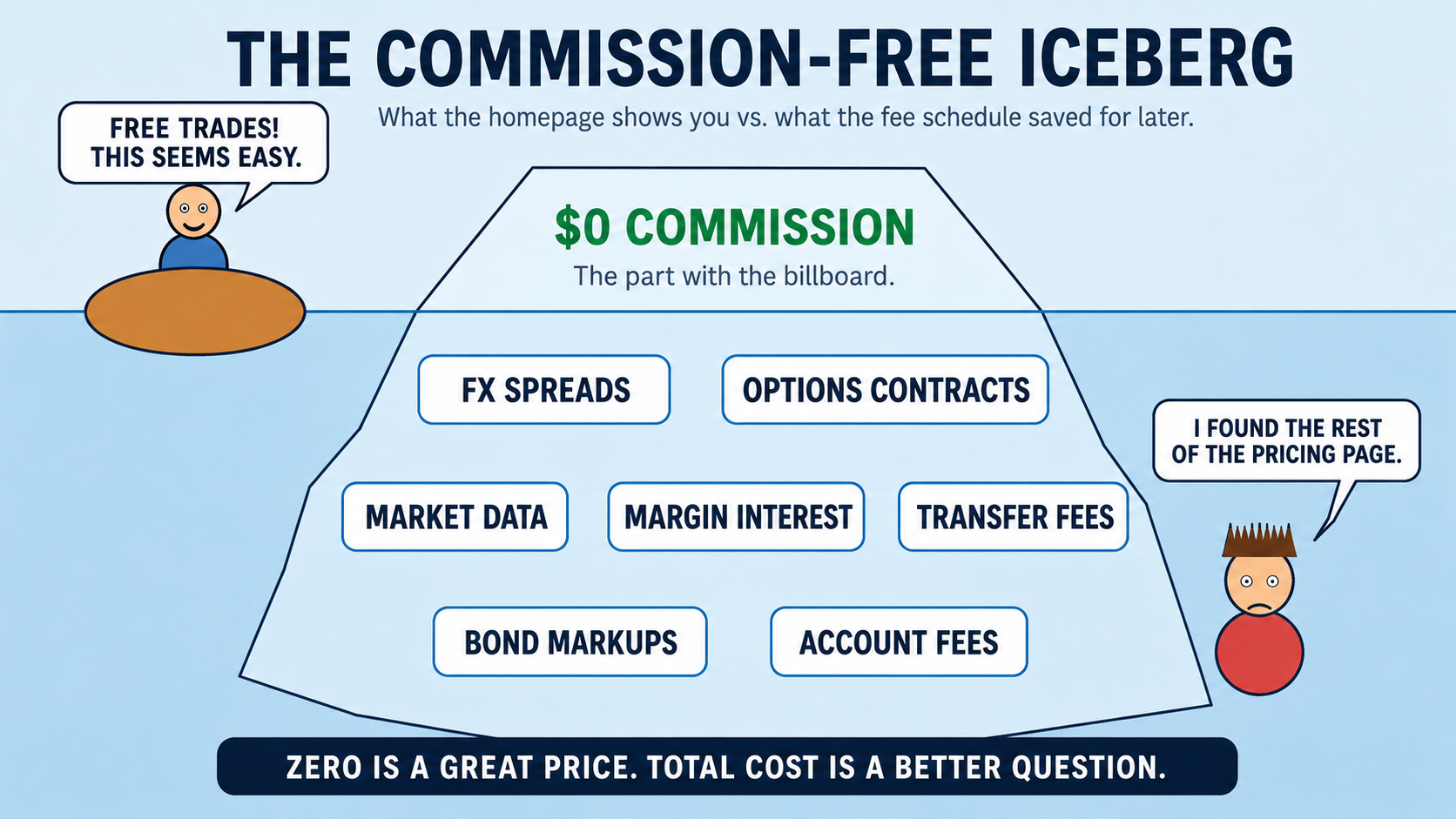
The important differences have moved away from the headline commission and into less visible areas: currency conversion, margin rates, options contracts, market-data subscriptions, bond markups, administrative charges, transfer-out fees, execution quality and product limitations.
A brokerage charging zero dollars for a stock trade can still become expensive if it converts your currency every time you buy or sell a U.S. security.
A platform offering access to 170 markets may be excessive for someone whose entire strategy is purchasing one Canadian index ETF on the first Monday of every month.
And a professional trading workstation with 147 order settings is not automatically better for an investor who would prefer one large button labelled:
Buy the thing. Please do not make this complicated.
There is no universally best brokerage. There is only the brokerage that best matches the investor, country, account type, portfolio size and tolerance for menus within menus.
Pricing date: August 6, 2026
Brokerage pricing changes frequently. Regulatory charges, exchange fees, ECN charges, bid-ask spreads, market-data subscriptions, fund expenses and special handling charges may still apply. Verify current pricing on the brokerage’s official website before opening or transferring an account.
The biggest difference between U.S. and Canadian brokerages
The United States reached widespread commission-free stock trading earlier than Canada.
At most major U.S. brokers, investors can trade U.S.-listed stocks and ETFs online without paying a base commission. Competition has therefore shifted toward cash management, retirement accounts, options pricing, trading technology, financial planning, fixed income, cryptocurrency and customer service.
Canada is moving in the same direction, but the market remains split.
Wealthsimple, Questrade, National Bank Direct Brokerage and Desjardins Disnat provide zero-commission online trading for Canadian and U.S. stocks and ETFs under their standard digital pricing. Several traditional bank-owned brokers continue to charge approximately $6.95 to $9.99 for many equity trades, although some offer commission-free ETF lists or discounted active-trader pricing.
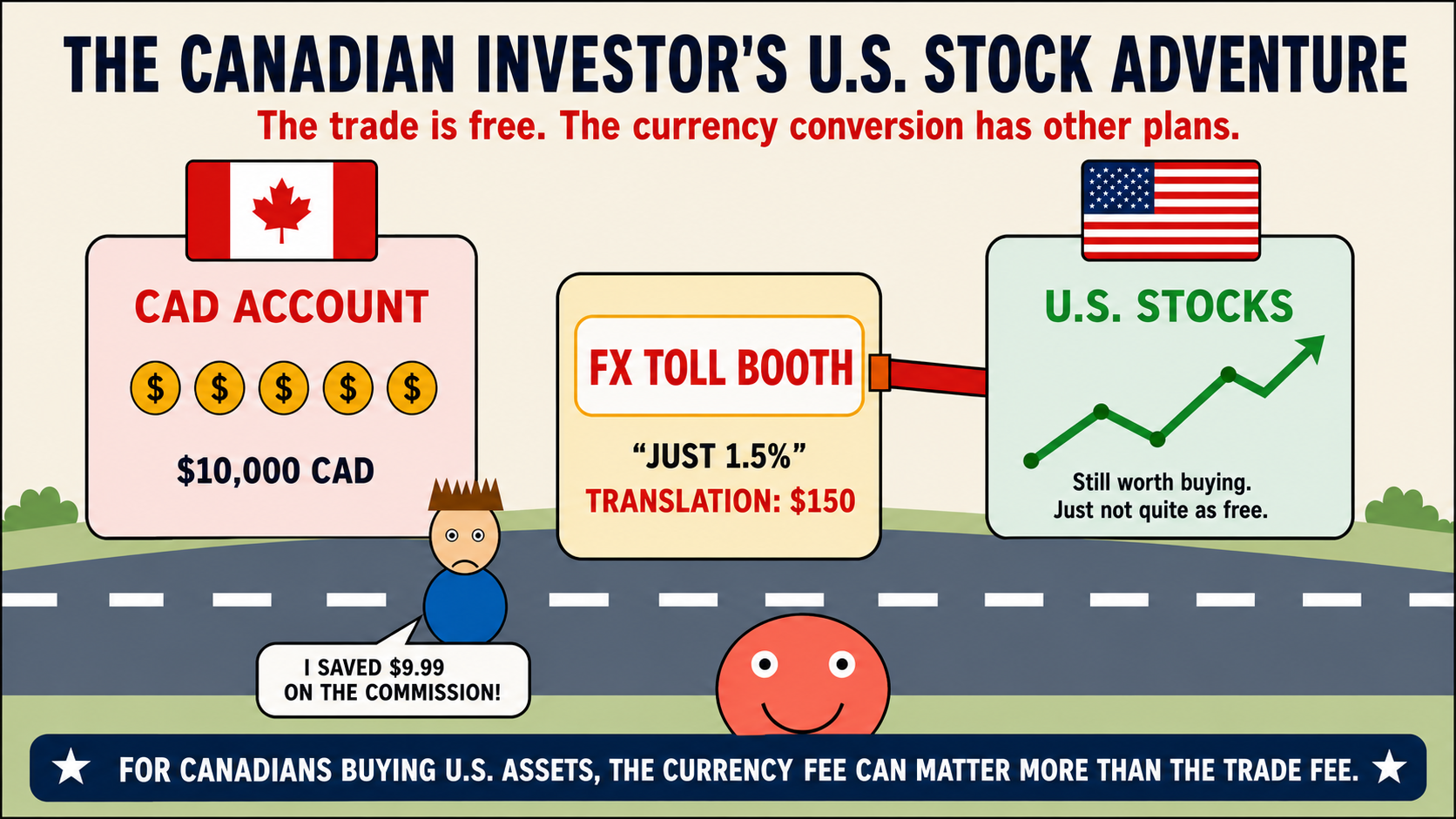
For Canadians, however, currency conversion can matter more than the stock commission.
A Canadian investor purchasing U.S. securities should determine whether the broker:
- supports separate Canadian- and U.S.-dollar balances;
- automatically converts currency on every transaction;
- charges a published or embedded FX spread;
- allows eligible securities to be journalled between Canadian and U.S. listings;
- charges a fee for journalling;
- keeps U.S. dividends in U.S. dollars.
Consider a $10,000 currency conversion with a 1.5% spread. That costs $150.
At that point, debating whether the stock commission was $6.95 or $9.99 becomes a little like discussing the price of parking after buying a boat.
Brokerage protection is not protection from investment losses
Investors sometimes see SIPC or CIPF coverage and assume their portfolio is insured against loss. It is not.
In the United States, SIPC may protect up to $500,000 per customer at a member brokerage, including up to $250,000 for cash, when eligible assets are missing following a brokerage failure.
SIPC does not protect an investor because the market fell, a company collapsed, an option expired worthless or a cryptocurrency became educational.
In Canada, CIPF generally protects eligible property missing because a member firm becomes insolvent. Coverage is separated into account categories and may include up to $1 million for combined general accounts, up to $1 million for combined registered retirement accounts and up to $1 million for qualifying RESP accounts.
Again, this is protection against missing property following brokerage insolvency.
It is not reimbursement for buying at the top.
United States: brokerage comparison at a glance
| Brokerage | Stock/ETF commission | Options pricing | Instrument access | Strongest fit |
|---|---|---|---|---|
| Fidelity | $0 | $0 base; contract fees apply | Stocks, ETFs, options, funds, bonds, CDs, IPOs, crypto | Long-term and retirement investors |
| Charles Schwab | $0 | $0 base + $0.65/contract | Stocks, ETFs, options, funds, bonds, futures, forex | Full-service and active traders |
| Interactive Brokers | $0 option available; low tiered alternatives | Low tiered pricing | Global stocks, options, futures, currencies, bonds, funds | Global and sophisticated traders |
| E*TRADE | $0 | $0 base + $0.65; $0.50 for qualifying active traders | Stocks, ETFs, funds, options, bonds, futures | Broad investing and active trading |
| Robinhood | $0 | No stock/ETF option contract commission; other fees apply | Stocks, ETFs, fractions, options, crypto | Mobile-first investors |
| Webull | $0 | $0 on many options; certain fees apply | Stocks, ETFs, fractions, options, futures, crypto | Chart-focused active traders |
| tastytrade | $0 | $1 to open, capped at $10/leg; $0 to close many stock/ETF options | Stocks, ETFs, options, futures, crypto | Options and futures traders |
| Merrill Edge | $0 | $0 base + $0.65/contract | Stocks, ETFs, options, funds, bonds, CDs | Bank of America customers |
1. Fidelity
Fidelity is one of the strongest all-purpose brokerages in the United States.
It works well for long-term investors, retirement savers, mutual-fund investors and people who would prefer not to open six financial accounts to accomplish six ordinary tasks.
Online U.S. stock and ETF trades cost $0. Online options have no base commission, although contract charges apply. Fidelity offers stocks, ETFs, options, thousands of mutual funds, bonds, Treasury securities, CDs, IPO access, precious metals, fractional shares and affiliated cryptocurrency services.
Fractional purchases are available across thousands of U.S. stocks and ETFs, allowing investors to buy by dollar amount rather than whole share.
This is useful when one share costs $600 and the investor’s monthly contribution is $200. The alternative would be to purchase one-third of a share using optimism and a calculator.
Fidelity advantages
- Excellent retirement and long-term investing infrastructure.
- Broad mutual-fund and fixed-income access.
- Fractional shares across thousands of securities.
- No standard brokerage-account minimum.
- Strong planning, research and cash-management tools.
Fidelity limitations
- No futures trading.
- Not a serious spot-forex destination.
- Several interfaces and applications can feel fragmented.
- Margin borrowing can be expensive for smaller balances.
- Dedicated derivatives traders may prefer a platform built around options.
Best for: long-term investors, retirement savers, fund investors and households wanting one broad financial ecosystem.
2. Charles Schwab
Charles Schwab combines the infrastructure of a giant traditional brokerage with one of the strongest active-trading platforms available to retail investors.
Online stock and ETF trades cost $0. Options cost $0.65 per contract with no base commission. Schwab also provides mutual funds, bonds, CDs, Treasuries, futures, retail forex, retirement accounts, managed portfolios and international investing.
The major attraction is thinkorswim.
The desktop, web and mobile versions provide advanced charting, multi-leg option tools, futures, paper trading, technical studies, probability analysis and more customization than many investors will use in a lifetime.
thinkorswim can be extraordinary for active traders.
It can also make a new investor feel as though they accidentally entered the cockpit of a commercial aircraft.
Schwab advantages
- Excellent balance of conventional investing and active trading.
- thinkorswim is among the strongest retail trading platforms.
- Futures and retail forex access.
- Broad fixed-income and mutual-fund selection.
- Strong retirement, service and branch infrastructure.
Schwab limitations
- Margin rates can be expensive for smaller accounts.
- The full platform can overwhelm occasional investors.
- International-market access is narrower than IBKR’s.
- Fractional-share functionality is more limited than some competitors.
Best for: investors who want advanced options, futures and charting tools without abandoning a large full-service brokerage.
3. Interactive Brokers
Interactive Brokers is the broadest brokerage in this comparison.
It provides access to stocks, ETFs, options, futures, currencies, bonds and funds across roughly 170 markets in about 40 countries, with multi-currency support and professional-grade order tools.
Eligible U.S. clients can use IBKR Lite for commission-free U.S.-listed stocks and ETFs. IBKR Pro provides fixed or tiered pricing that can be extremely economical for active traders.
Interactive Brokers is particularly strong in global equities, foreign exchange, options, futures, margin borrowing, direct market access, securities lending, APIs and portfolio margin.
Trader Workstation is enormously capable.
It is also not especially interested in making the first ten minutes emotionally comforting.
Interactive Brokers advantages
- Widest international-market access in this group.
- Strong multi-currency and foreign-exchange functionality.
- Competitive margin economics.
- Advanced routing, order types and APIs.
- Futures, options, currencies, bonds and global stocks in one account.
- Fractional trading across eligible U.S., Canadian and European securities.
Interactive Brokers limitations
- Trader Workstation has a substantial learning curve.
- Pricing schedules require careful reading.
- Market-data subscriptions can become complicated.
- Customer service is less hand-holding-oriented.
- Casual investors may never use most of the available functionality.
Best for: sophisticated traders, global investors, margin users and anyone who considers six countries insufficient diversification.
4. E*TRADE from Morgan Stanley
E*TRADE occupies the middle ground between a traditional full-service brokerage and an active-trading platform.
Online U.S. stocks, ETFs and many mutual funds have no base commission. Options generally cost $0.65 per contract, with a reduced rate for qualifying active traders. Futures are available with contract-based pricing plus exchange and regulatory charges.
E*TRADE supports stocks, ETFs, mutual funds, options, bonds, CDs, futures, taxable accounts, IRAs, custodial accounts, education accounts and small-business retirement accounts.
Power E*TRADE adds charting, strategy tools and options analytics.
The regular platform is approachable. Power E*TRADE is where the broker gently reveals that it has opinions about implied volatility.
E*TRADE advantages
- Broad account and investment selection.
- Good balance of usability and active-trading functionality.
- Competitive options pricing for qualifying active clients.
- Futures access.
- Morgan Stanley research and planning resources.
E*TRADE limitations
- Less global reach than Interactive Brokers.
- Less advanced derivatives analysis than thinkorswim.
- The main platform and Power E*TRADE can feel like separate experiences.
- Margin borrowing can be expensive.
Best for: investors wanting retirement accounts, funds, stocks, options and occasional futures in one broadly capable platform.
5. Robinhood
Robinhood forced the brokerage industry to take commission-free trading seriously.
Before Robinhood, many brokers explained why trading commissions were reasonable. After Robinhood, they discovered that zero dollars was also reasonable.
Stocks and ETFs trade without a commission. Stock and ETF options have no base or per-contract commission, although clearing, regulatory and exchange charges may apply.
The platform supports U.S. stocks, ETFs, fractional shares, recurring investments, options, cryptocurrency, selected overnight trading, retirement accounts, margin features and cash products.
Robinhood’s greatest strength is simplicity.
Its greatest risk is also simplicity.
The app can make placing a trade feel approximately as consequential as ordering takeout. The market may later provide additional context.
Robinhood advantages
- Very simple mobile experience.
- Fractional shares and recurring investments.
- No stock or ETF commissions.
- No per-contract commission on stock and ETF options.
- Integrated cryptocurrency and extended-hours features.
Robinhood limitations
- Limited conventional fixed-income and mutual-fund depth.
- Lighter research and portfolio analysis than large traditional brokers.
- Fewer complex order and execution controls.
- The design may encourage frequent trading.
- Crypto and non-security products may have different protections.
Best for: mobile-first investors, fractional-share users and cost-conscious options traders who do not need a traditional investment supermarket.
6. Webull
Webull targets active self-directed traders who want stronger charting and technical tools than a basic mobile brokerage provides.
Stocks and ETFs trade commission-free. Many options transactions have no commission, although certain index products, oversized orders and exchange-related charges can add costs.
Webull offers fractional shares, options, futures, cryptocurrency, paper trading, extended-hours access, technical charting, screeners and optional market-data packages.
Its platform provides a large amount of information.
Charts, indicators, rankings, order flow, market signals and community comments can all appear in close proximity.
This is either highly useful or the financial equivalent of opening twenty browser tabs and forgetting which one is playing music.
Webull advantages
- Strong charting for a commission-free platform.
- Good mobile and desktop applications.
- Paper trading and extended-hours access.
- Fractional shares and low options costs.
- Futures access for approved users.
Webull limitations
- Weak fit for mutual funds, bonds and comprehensive planning.
- Some market data require subscriptions.
- The interface can feel noisy.
- Customer-service depth does not match the largest legacy firms.
- Community features may provide more opinions than insight.
Best for: technically oriented stock and options traders wanting more charting depth than a basic investing app.
7. tastytrade
tastytrade was built for options and futures traders.
It did not begin as a retirement brokerage and later decide that derivatives looked fashionable.
Stocks, ETFs and fractional shares trade without commission. Stock and ETF options generally cost $1 per contract to open, capped at $10 per leg, and $0 to close. Futures and options on futures use product-specific contract pricing.
The platform emphasizes probability of profit, implied volatility, multi-leg strategy construction, futures, futures options and efficient position management.
tastytrade is excellent for users who understand theta, delta and short strangles.
It is less ideal for someone who hears “iron condor” and assumes the brokerage has expanded into wildlife conservation.
tastytrade advantages
- Purpose-built derivatives workflow.
- Capped stock and ETF option opening commissions.
- No commission to close many stock and ETF options.
- Strong probability and multi-leg strategy tools.
- Futures and futures-options support.
tastytrade limitations
- Weak mutual-fund and conventional fixed-income offering.
- Limited long-term planning tools.
- Assumes familiarity with derivatives terminology.
- Crypto percentage fees can be material.
- Not an ideal first brokerage for a complete beginner.
Best for: frequent options traders, volatility traders and futures users.
8. Merrill Edge
Merrill Edge is most compelling for investors already using Bank of America.
Online U.S. stock and ETF trades cost $0. Options have no base commission and use per-contract pricing. The brokerage also supports mutual funds, bonds, CDs, Treasuries, retirement accounts, custodial accounts and education accounts.
The central benefit is integration with Bank of America, including potential relationship benefits based on combined eligible balances.
Merrill also provides strong access to Bank of America research.
Merrill Edge advantages
- Excellent Bank of America integration.
- Strong proprietary and third-party research.
- Broad conventional investment selection.
- Competitive Treasury and bond access.
- No minimum for many self-directed accounts.
Merrill Edge limitations
- No serious futures or spot-forex platform.
- Limited direct-crypto functionality.
- Trading tools lag thinkorswim and Trader Workstation.
- Less compelling without a Bank of America relationship.
- Transfer and account-closure fees may apply.
Best for: Bank of America customers and research-focused investors consolidating banking and brokerage assets.
Canada: brokerage comparison at a glance
| Brokerage | Stock/ETF pricing | Options pricing | Instrument access | Strongest fit |
|---|---|---|---|---|
| Wealthsimple | $0 | No contract commission under current standard pricing; other fees may apply | Stocks, ETFs, fractions, options, crypto, margin | Beginners and mobile investors |
| Questrade | $0 Canadian/U.S. stocks and ETFs; ECN fees may apply | Current U.S. equity-option pricing is highly competitive; product conditions vary | Stocks, ETFs, options, bonds, GICs, mutual funds | Broad Canadian self-directed investing |
| Interactive Brokers Canada | Low per-share fixed or tiered pricing | Low tiered contract pricing | Global stocks, options, futures, currencies, bonds | Active and global investors |
| National Bank Direct Brokerage | $0 | $1.25/contract; minimum applies | Stocks, ETFs, options, funds, GICs, debentures | Zero-commission bank brokerage |
| Desjardins Disnat | $0 | $1.25/contract; minimum applies | Stocks, ETFs, options, funds, bonds, new issues | Quebec investors and education |
| TD Direct Investing | $9.99 standard; selected ETFs may be $0 | Base commission + per-contract fee | Broad bank-broker product range | TD customers and research users |
| RBC Direct Investing | $9.95 standard; active pricing may apply | Contract charges apply | Stocks, ETFs, options, funds, bonds, GICs | RBC customers |
| BMO InvestorLine | $9.95; selected ETFs $0 | Base commission + per-contract fee | Stocks, ETFs, options, funds, GICs, bonds | BMO customers |
| CIBC Investor’s Edge | $6.95; selected ETFs $0 | Contract charges apply | Stocks, ETFs, options, funds, fixed income | Lower-cost bank integration |
| Scotia iTRADE | $9.99 standard; active pricing may apply | Base commission + per-contract fee | Stocks, ETFs, options, funds, GICs, bonds | Scotiabank customers and ETF users |
1. Wealthsimple
Wealthsimple provides one of the most approachable self-directed investing experiences in Canada.
Canadian and U.S. stocks and ETFs trade without commission. The platform supports fractional shares, recurring purchases, dividend reinvestment, options, cryptocurrency, eligible margin accounts and several common Canadian registered accounts.
The central cost question is currency conversion.
Smaller CAD-to-USD conversions can carry a percentage-based FX fee. USD-account features differ by service tier and subscription.
This may not matter to someone purchasing Canadian ETFs.
It matters considerably to someone actively trading U.S. securities.
The commission may be free while the currency conversion quietly arrives carrying a chair.
Wealthsimple advantages
- No standard stock or ETF commissions.
- Excellent mobile experience.
- Fractional shares and recurring investments.
- Integrated cryptocurrency and a broadening financial ecosystem.
- Simple TFSA, RRSP, FHSA and non-registered investing.
Wealthsimple limitations
- Currency conversion can be expensive without careful USD management.
- Limited traditional bond, GIC and mutual-fund inventory.
- Research and charting are relatively light.
- Advanced order and routing controls remain limited.
- Less suitable for globally diversified active traders.
Best for: beginners, passive ETF purchasers, fractional-share users and Canadians mainly investing in Canadian-dollar securities.
2. Questrade
Questrade has evolved into one of the broadest low-cost Canadian brokerages.
Online Canadian- and U.S.-listed stocks and ETFs trade without a commission, although ECN fees may apply to certain orders. The platform also supports options, fractional shares, bonds, GICs, mutual funds, IPOs, new issues, precious metals and a broad selection of registered accounts.
Questrade supports Canadian- and U.S.-dollar sides of an account and allows eligible securities to be journalled between listings.
Journalling can help reduce currency-conversion costs, although the process and any applicable fees require attention.
The phrase “Norbert’s Gambit” sounds like a Scandinavian board game.
In Canadian investing, it is often a currency-conversion strategy.
Questrade advantages
- Zero commissions on Canadian and U.S. stocks and ETFs.
- Broader product range than most app-first brokers.
- Strong registered-account support.
- Separate CAD and USD balances.
- Options, fixed income, GICs, mutual funds and fractional shares.
Questrade limitations
- ECN fees can still appear.
- Currency conversion and journalling require attention.
- Premium data and advanced tools may cost extra.
- Less powerful than IBKR for global trading.
- Bonds and mutual funds are not commission-free.
Best for: Canadians wanting broad product and registered-account access without traditional bank-broker equity commissions.
3. Interactive Brokers Canada
Interactive Brokers Canada is the strongest choice for Canadians seeking international markets, multiple currencies and sophisticated trading products.
It provides access to Canadian, U.S. and international equities, options, futures, currencies, bonds, fractional shares, advanced orders and margin.
Canadian and U.S. shares use low fixed or tiered per-share pricing rather than a headline zero-commission model.
For active traders, global investors and frequent currency converters, the total cost may still be substantially lower than at a commission-free broker with a large FX spread.
IBKR is a reminder that zero is not always the lowest number once the entire transaction is included.
IBKR Canada advantages
- Best global-market access among the Canadian choices.
- Competitive foreign-exchange execution.
- Low margin rates relative to many Canadian competitors.
- Advanced options, futures and multi-currency functionality.
- Professional tools and fractional trading across several regions.
IBKR Canada limitations
- No headline zero-commission Canadian stock pricing.
- Trader Workstation is complex.
- Market-data subscriptions can add cost.
- Customer service is not beginner-focused.
- Registered-account features should be checked carefully.
Best for: active Canadian traders, global investors, frequent currency converters, futures traders and margin users.
4. National Bank Direct Brokerage
National Bank Direct Brokerage was the first major Canadian bank-owned brokerage to eliminate standard online commissions on Canadian and U.S. stocks and ETFs.
Its published pricing includes zero-dollar online stock and ETF trades, while options use a per-contract price with a minimum charge. The platform also supports investment funds, GICs and exchange-traded debentures.
Research resources include National Bank Financial, Morningstar and Trading Central content.
NBDB advantages
- Zero stock and ETF commissions.
- Backed by a major Canadian bank.
- Strong research resources.
- Competitive options minimum relative to several bank brokers.
- GICs, funds, debentures and registered accounts.
NBDB limitations
- Primarily focused on North American markets.
- Platform design may feel more conventional than fintech alternatives.
- Options remain more expensive than at specialist brokers.
- Administrative charges may apply.
- Fewer advanced trading tools than IBKR.
Best for: Canadian investors wanting bank ownership, research and zero-commission stock trading.
5. Desjardins Disnat
Desjardins Disnat offers zero-commission stock and ETF trading with strong bilingual support and education.
Options use per-contract pricing with a minimum charge. The platform supports Canadian and U.S. stocks, ETFs, options, mutual funds, bonds, new issues and registered accounts.
Disnat places more emphasis on investor education than many competitors.
This is useful because the market generally provides the lesson after the trade.
Disnat attempts to provide some of it beforehand.
Disnat advantages
- No stock or ETF commissions.
- Strong French and English education and support.
- Real-time quotes included.
- Broad registered-account selection.
- Particularly strong fit for Quebec investors.
Disnat limitations
- Options minimum is higher than NBDB’s.
- Fixed-income minimum charges can be substantial.
- Limited direct international-market access.
- More conventional interface.
- Certain mutual-fund and short-term trading fees may apply.
Best for: Quebec investors, Desjardins members and Canadians valuing education and support.
6. TD Direct Investing
TD Direct Investing remains one of Canada’s largest and most established bank brokerages.
Standard online Canadian and U.S. equity trades cost $9.99. Active traders can qualify for lower pricing. Options combine a base commission with a per-contract charge. Selected ETFs and mutual funds may be available commission-free under programme conditions.
TD also offers stocks, ETFs, partial shares, options, bonds, GICs, mutual funds, registered accounts, market research, education and Advanced Dashboard for qualifying clients.
TD’s strengths are integration, research and support.
Its weakness is that several competitors now charge zero dollars for something TD still charges $9.99 to perform.
TD appears to be betting that convenience, familiarity and branches remain worth the difference.
For many clients, they are.
For active traders, the calculator may disagree.
TD advantages
- Excellent TD banking integration.
- Strong Canadian research and education.
- Broad account and product selection.
- Real-time quotes and partial shares.
- Branch, telephone and advanced-platform support.
TD limitations
- High standard commission.
- Expensive options pricing.
- Small accounts must monitor maintenance-fee waivers.
- Foreign-exchange conversion can be costly.
- Advanced tools may require account or trading thresholds.
Best for: TD clients valuing integration, research and service more than the lowest transaction cost.
7. RBC Direct Investing
RBC Direct Investing charges $9.95 for standard equity and ETF trades, with lower pricing available to qualifying active traders.
The brokerage offers stocks, ETFs, options, mutual funds, bonds, GICs, registered accounts, research and screeners.
Its strongest advantage is integration with RBC banking.
Convenience is valuable.
It simply needs to be worth $9.95 each time.
RBC advantages
- Strong RBC banking integration.
- Broad product and account range.
- Research, screeners and market news.
- Extensive branch and service network.
- Suitable for consolidated households.
RBC limitations
- High standard commission.
- Active pricing requires substantial trading activity.
- Options and fixed income add additional costs.
- Trading functionality is less extensive than IBKR’s.
- Less attractive without an RBC relationship.
Best for: RBC customers prioritizing consolidated service and account integration.
8. BMO InvestorLine
BMO InvestorLine charges $9.95 per standard online equity trade, while a selected list of ETFs can be traded without commission.
Options add a base commission and per-contract charge. The platform supports stocks, ETFs, options, mutual funds, CDRs, GICs, bonds, registered accounts, corporate accounts and trusts.
BMO has expanded its active-trading tools, including multi-leg options, strategy builders and paper trading.
This improves the platform’s active capabilities, although the standard stock commission remains firmly attached to the past.
BMO advantages
- Strong BMO banking integration.
- Broad conventional investment selection.
- Commission-free selection of eligible ETFs.
- Improving active-trader and options tools.
- Extensive account-type support.
BMO limitations
- High standard stock commission.
- Options are expensive.
- Only selected ETFs are commission-free.
- Administrative charges may apply.
- Less streamlined than app-first competitors.
Best for: BMO clients and investors primarily purchasing eligible commission-free ETFs.
9. CIBC Investor’s Edge
CIBC Investor’s Edge charges $6.95 for standard online Canadian and U.S. stock and ETF trades.
That undercuts the standard rate at TD, RBC, BMO and Scotia.
CIBC also offers a list of commission-free ETFs and supports stocks, ETFs, options, mutual funds, bonds, fixed income and registered accounts.
CIBC publishes its currency-spread schedule.
This is helpful because many brokers prefer FX costs to remain an abstract concept discovered after the transaction.
CIBC advantages
- Lower standard commission than most large Canadian bank brokers.
- Commission-free ETF list.
- Strong CIBC banking integration.
- Transparent published FX pricing.
- Registered accounts and several account-fee exemptions.
CIBC limitations
- Still more expensive than zero-commission brokers for ordinary stocks.
- Commission-free ETFs are limited to an approved list.
- Smaller currency conversions can be costly.
- Active-trading tools are less sophisticated than IBKR’s.
- Smaller accounts need to monitor annual-fee rules.
Best for: CIBC customers wanting bank integration with a lower standard commission than most large-bank competitors.
10. Scotia iTRADE
Scotia iTRADE charges $9.99 for standard online equity trades.
Qualifying active traders can receive lower pricing after meeting a substantial quarterly-trading threshold.
The brokerage also offers a large list of commission-free ETFs, subject to programme conditions, along with stocks, options, mutual funds, GICs, bonds, fixed income and registered accounts.
The active-trader rate can be competitive.
The requirement means the investor must trade frequently enough to qualify.
At that point, the lower commission may be the least interesting thing happening in the account.
Scotia iTRADE advantages
- Broad bank-broker product selection.
- Large commission-free ETF list.
- Competitive active-trader rate for qualifying users.
- Strong Scotiabank integration.
- Good fixed-income inventory and registered-account support.
Scotia iTRADE limitations
- High standard commission.
- Commission-free ETF programme has conditions.
- Active pricing requires substantial trading.
- Options are expensive for occasional traders.
- ECN charges may apply in some trading sessions.
Best for: Scotiabank customers, active clients meeting the pricing threshold and investors using the eligible ETF list.
Which broker offers the widest instrument access?
United States
For product and geographic breadth, Interactive Brokers is the strongest option. It provides direct access to global stocks, ETFs, options, futures, currencies, bonds and funds.
Charles Schwab is the strongest conventional full-service choice for U.S.-focused investors who also want futures, forex, fixed income and advanced tools.
E*TRADE covers most mainstream and active-trading needs, including futures.
Fidelity is particularly strong for stocks, funds, bonds and retirement investing, but is not a futures or spot-forex platform.
tastytrade is highly capable in derivatives but deliberately narrower elsewhere.
Canada
For global access and sophisticated instruments, Interactive Brokers Canada wins comfortably.
Questrade offers one of the broadest practical product ranges among mainstream lower-cost Canadian platforms.
Traditional bank brokerages remain strong in GICs, bonds, new issues, mutual funds and Canadian registered-account support.
Wealthsimple is the easiest to use but offers a narrower traditional investment inventory than Questrade, IBKR or a full bank broker.
Which brokerage is actually cheapest?
This question requires a second question:
Cheapest for what?
U.S. buy-and-hold stock investors
Fidelity, Schwab, E*TRADE, Robinhood, Webull, Merrill Edge and tastytrade all provide commission-free online trading for U.S.-listed stocks and ETFs.
The important differences therefore move to options, margin, cash yields, mutual-fund fees, transfer charges, research, execution and service.
Canadians buying Canadian ETFs
Wealthsimple, Questrade, NBDB and Disnat all offer zero-commission stock and ETF trading.
For regular Canadian ETF purchases, each can provide strong economics.
Canadians buying U.S. securities
Currency becomes the deciding factor.
A zero-commission trade combined with a 1.5% FX cost can be dramatically more expensive than a small stock commission paired with efficient currency conversion.
For frequent or large conversions, Interactive Brokers Canada deserves close attention. Questrade supports USD balances and journalling. Wealthsimple can become more competitive when the investor uses a USD account and avoids repeated conversions.
Options traders
In the United States, Robinhood and Webull offer very low headline option costs, tastytrade can be attractive for multi-contract positions, Schwab provides strong analytics and IBKR combines low pricing with international access.
In Canada, IBKR and Questrade deserve close examination. Wealthsimple’s headline pricing is attractive, while traditional bank brokers are generally the most expensive choice for occasional options trades.
Best brokerage by investor type
Fidelity
Charles Schwab / thinkorswim
Interactive Brokers
tastytrade, Schwab or IBKR
Wealthsimple
Questrade
Interactive Brokers Canada
NBDB or Disnat
What to compare before opening an account
1. Residency and eligibility
Brokerage availability depends on legal residence, tax status and the local regulated entity through which the account is opened.
A Canadian cannot simply admire an American pricing page hard enough to become eligible for it.
2. Account types
Canadian investors may need a TFSA, RRSP, FHSA, RESP, LIRA, RRIF, corporate account or joint account.
U.S. investors may need a traditional IRA, Roth IRA, rollover IRA, SEP or SIMPLE IRA, custodial account, education account, trust or business retirement account.
The cheapest taxable brokerage is not useful if it does not support the account the investor needs.
3. Currency handling
Canadians should confirm whether USD can remain in the account, what the conversion spread is, whether dividends remain in USD, whether journalling is permitted and whether registered accounts handle currencies differently.
4. Investment products
Do not assume every brokerage offers individual bonds, new issues, GICs, CDs, mutual funds, futures, spot currencies, international exchanges, cryptocurrency, IPOs or precious metals.
A broker can advertise “thousands of investments” and still not offer the one thing the investor opened the account to purchase.
5. Trading tools
An active trader may require multi-leg options, conditional orders, bracket orders, direct routing, futures spreads, Level 2 data, APIs, portfolio margin and paper trading.
A passive investor may need none of them.
Buying professional trading software to purchase one index fund each month is a little like buying an aircraft carrier for the weekly grocery trip.
Impressive. Technically capable. Difficult to park.
6. Secondary fees
Review account-maintenance charges, transfer-out fees, wire fees, FX spreads, ECN charges, market-data subscriptions, telephone-trade charges, option assignment fees, bond markups, fund redemption fees and corporate-action charges.
The homepage contains the headline.
The fee schedule contains the plot.
Official pricing pages and primary sources
The following are direct links to the brokerages’ official websites. They are provided for verification only and are not affiliate or referral links.
United States
- Fidelity commissions and margin rates
- Charles Schwab pricing
- Interactive Brokers commissions
- E*TRADE pricing and rates
- Robinhood trading fees
- Webull pricing
- tastytrade pricing
- Merrill Edge pricing
- SIPC protection overview
Canada
- Wealthsimple pricing
- Questrade pricing and fees
- Interactive Brokers Canada commissions
- National Bank Direct Brokerage pricing
- Desjardins Disnat pricing
- TD Direct Investing pricing
- RBC Direct Investing fees
- BMO InvestorLine Self-Directed
- CIBC Investor’s Edge pricing
- Scotia iTRADE pricing
- CIPF coverage overview
Final assessment
The U.S. brokerage market offers stronger commission-free competition, more mature active-trading platforms and generally broader access to sophisticated derivatives.
The Canadian market has improved considerably. Investors now have several credible zero-commission choices, but currency conversion, registered-account support and product breadth remain major differentiators.
For many American households, Fidelity and Charles Schwab are excellent all-purpose starting points.
For sophisticated or international investors in either country, Interactive Brokers is the most capable.
For Canadian beginners, Wealthsimple is the simplest. For Canadians seeking broader functionality without standard bank commissions, Questrade is highly competitive. For those wanting a bank-owned zero-commission brokerage, National Bank Direct Brokerage and Disnat stand out.
The best brokerage is not necessarily the one displaying the largest zero on its homepage.
It is the one providing the required accounts, markets, instruments and service at the lowest total cost.
Because in brokerage pricing, as in investing generally, the number receiving the most attention is not always the number that matters most.
No affiliation or compensation
StockScreen.art is not affiliated with, sponsored by or endorsed by any brokerage discussed here. We receive no referral fees, affiliate revenue, commissions, account-opening compensation, free products or other benefits from these firms. No link in this article generates compensation for us.
General disclaimer: Pricing and product availability were reviewed on August 6, 2026 and may change. Brokerage eligibility, commissions, exchange fees, market-data costs, currency charges, account features and investor-protection rules vary by client and jurisdiction. This article is for educational purposes and does not constitute personalized investment, legal or tax advice.