Investors spend enormous amounts of time asking:
“What should I buy?”
Then, approximately twelve seconds later:
“Cool. I’ll put half the account in it.”
This is how a good idea becomes a portfolio hostage situation.
Quality matters.
Price matters.
Timing matters.
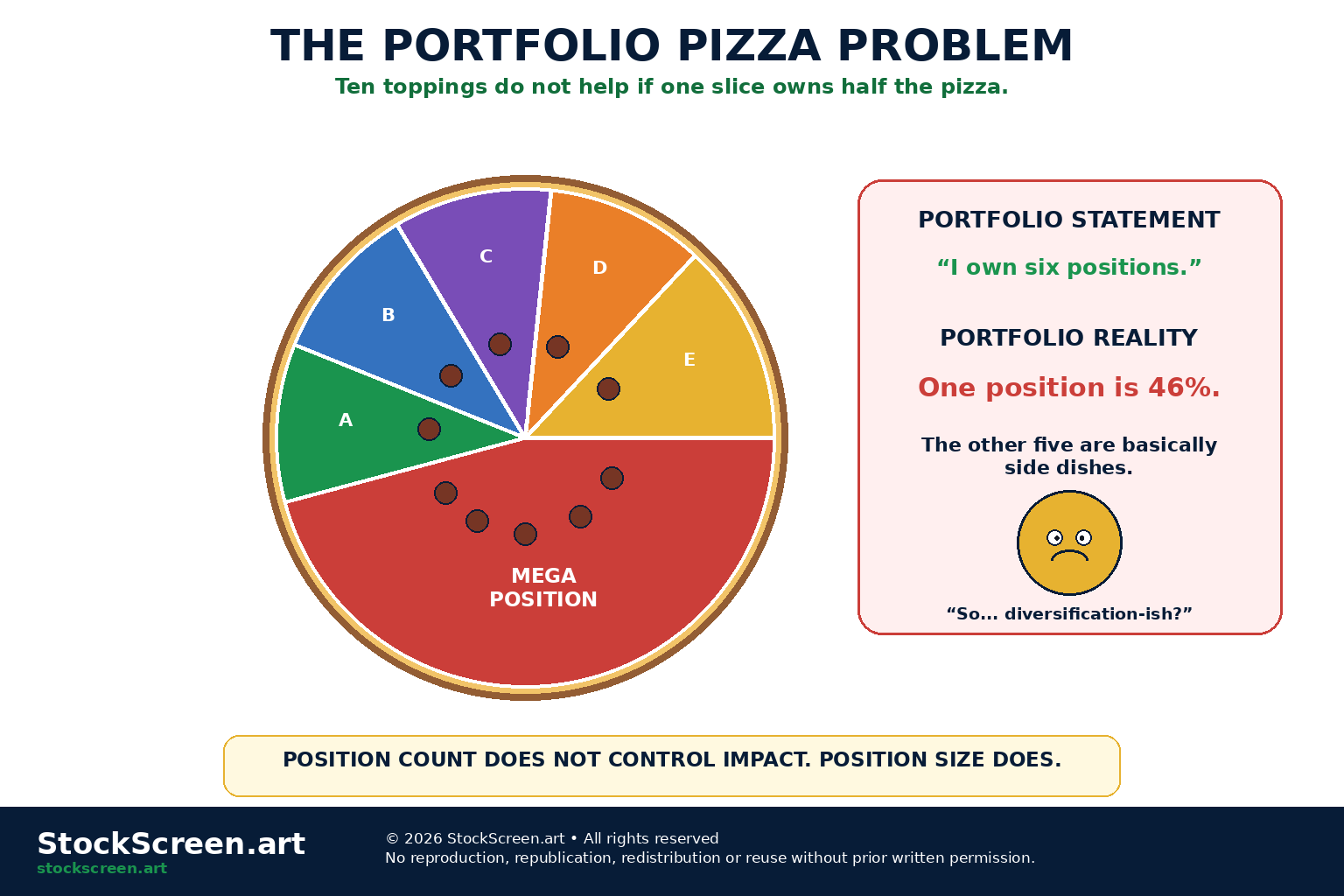
But size determines how loudly the result speaks inside the portfolio.
1. What position sizing means
Position sizing answers a simple question:
“How large should this position be relative to the portfolio?”
The answer can be expressed in:
- dollars;
- shares;
- contracts;
- currency notional;
- percentage of portfolio equity;
- planned risk contribution.
The measurement should match the instrument.
2. Portfolio weight
For an ordinary unleveraged holding:
Portfolio Weight = Position Market Value ÷ Total Portfolio Value
Fictional example:
- portfolio = $100,000;
- stock position = $8,000.
$8,000 ÷ $100,000 = 8%
The position has an 8% capital weight.
3. Capital weight is not the whole story
Two positions can each represent 8% of portfolio capital.
One might be:
- a relatively stable large company;
while the other is:
- a highly volatile small-cap stock;
- a leveraged ETF;
- an option position;
- a futures contract.
Same percentage on the statement.
Very different capacity for drama.
4. Dollar exposure
Dollar exposure describes the market value or economic amount tied to the position.
For a fully paid stock position, dollar exposure and cash committed may be similar.
With derivatives or margin, the relationship can be very different.
5. Notional exposure
Notional exposure represents the economic quantity controlled by the position.
This matters for:
- futures;
- forex;
- options;
- leveraged products;
- margin positions.
A small margin deposit can support a much larger notional position.
The cash line item may whisper.
The notional exposure may be using a megaphone.
6. Risk contribution
Risk contribution asks how much a position contributes to the portfolio's overall variability or downside exposure.
It depends on more than position weight.
Important inputs include:
- position size;
- volatility;
- correlation with other holdings;
- leverage;
- payoff structure.
7. Same capital, different volatility
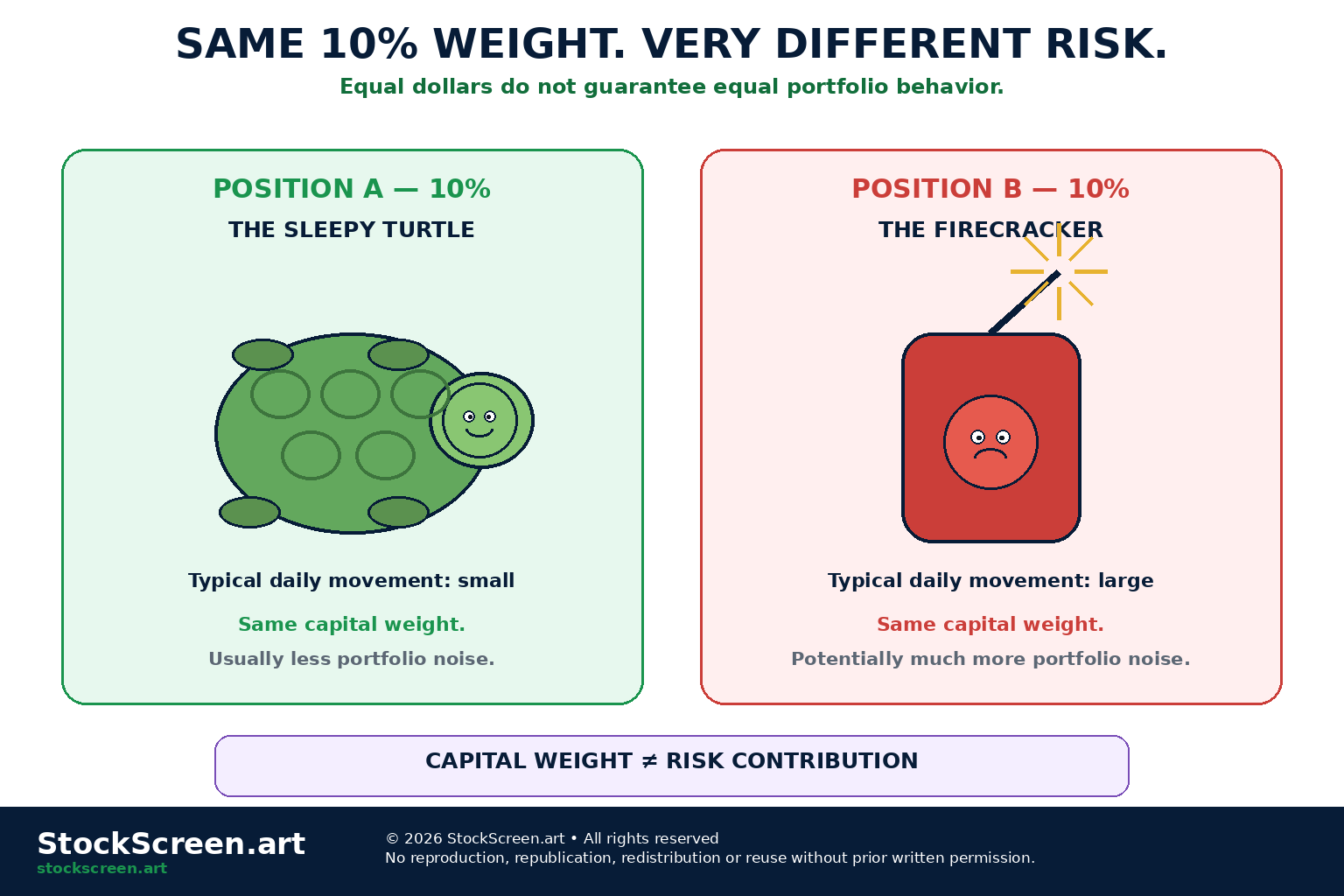
Suppose two fictional positions are each 10% of a portfolio.
Position A typically moves around 0.5% in a day.
Position B often moves 4% in a day.
Equal capital does not imply equal risk contribution.
8. Volatility-aware sizing
One conceptual approach is to size more volatile positions smaller and less volatile positions larger.
The objective is not:
“Reward boring investments with more money.”
It is:
“Avoid letting one naturally volatile position dominate portfolio movement.”
This principle appears in many professional risk frameworks.
9. Volatility is historical, not a speed limit
Historical volatility estimates what happened in the past.
Future volatility can be:
- higher;
- lower;
- suddenly much higher at 9:31 a.m.
Volatility-aware sizing is therefore a framework, not a guarantee.
10. Stop-distance sizing
For a simple long-stock trade, a planned loss distance can be defined as:
Risk per Share = Entry Price − Invalidation Price
Then:
Shares = Chosen Risk Budget ÷ Risk per Share
This is the same arithmetic introduced in DER-05, but now we care about how that one trade fits beside everything else in the portfolio.
11. Fictional stop-distance example
Suppose:
- entry = $50;
- invalidation = $47;
- chosen planning risk budget = $300.
Risk per share:
$50 − $47 = $3
Simplified size:
$300 ÷ $3 = 100 shares
The result is a planning estimate, not a guaranteed maximum loss.
12. Why actual loss can exceed planned loss
Markets can:
- gap;
- skip prices;
- become illiquid;
- trigger a stop far from the eventual fill;
- move while an order is being executed.
The formula is tidy.
Markets have not signed the tidiness agreement.
13. Gap risk deserves size respect
A stock facing:
- earnings;
- clinical trial results;
- regulatory decisions;
- court rulings;
- major product announcements
can jump far beyond a planned stop level.
Event risk may justify treating the potential loss distance as wider than ordinary daily movement.
14. Liquidity affects practical size
Position size should also consider how easily the position can be entered and exited.
Large positions in thin markets can face:
- wide spreads;
- partial fills;
- price impact;
- slippage;
- difficulty exiting during stress.
A spreadsheet can fit 20,000 shares.
The order book may have other plans.
15. Liquidity risk can grow with size
A position may be easy to trade at 100 shares and difficult at 100,000 shares.
Liquidity is therefore partly a property of:
- the security;
- the market;
- your own position size.
Your trade can become its own problem.
16. Correlation changes how size should be interpreted
From PR-02, we know that different holdings can move together.
Suppose the portfolio contains:
- 8% semiconductor ETF;
- 8% AI infrastructure stock;
- 8% growth ETF;
- 8% cloud software stock.
Each position looks moderate by itself.
Together, they may represent a large overlapping growth-and-technology risk cluster.
17. Cluster sizing
A useful portfolio-level question is:
“How large is this whole risk cluster?”
rather than:
“Is each individual line item below my preferred maximum?”
Four medium elephants remain a substantial amount of elephant.
18. Sector limits are one form of cluster control
Some portfolio frameworks use limits on:
- individual holdings;
- industries;
- sectors;
- countries;
- factors;
- asset classes.
A limit is not a forecast.
It is a rule about how much one type of mistake is allowed to matter.
19. Maximum position weights
Another simple control is a maximum position weight.
The exact number is not universal.
A maximum-weight rule says:
“Even if I love this idea, it cannot become larger than the portfolio limit I selected.”
This separates enthusiasm from damage capacity.
20. Minimum position weights
Some portfolios also use minimum meaningful sizes.
If a position is so small that even a large gain barely affects portfolio return, the complexity may not be justified.
A portfolio with 150 microscopic positions can become a very expensive filing cabinet.
21. Equal-weight sizing
Equal weighting gives each holding the same capital weight.
Advantages include:
- simplicity;
- clear concentration control;
- reduced dependence on one forecast.
Limitations include:
- ignoring volatility differences;
- ignoring liquidity differences;
- ignoring correlation clusters;
- treating every thesis as equally attractive.
22. Conviction-based sizing
Conviction-based frameworks assign larger weights to higher-confidence ideas.
That sounds sensible.
The problem is that human confidence is frequently sponsored by:
- recency;
- confirmation bias;
- good storytelling;
- three green candles;
- a podcast host with excellent lighting.
Conviction needs discipline if it influences size.
23. Confidence is not calibrated probability
Feeling 90% confident does not prove an investment has a 90% chance of success.
Investors tend to be overconfident, especially in domains where outcomes contain large amounts of noise.
Size should not be allowed to become a direct emotional volume knob.
24. Market-cap weighting
Index portfolios often weight companies by market capitalization.
Larger companies receive larger weights.
This approach is systematic, but it can still create concentration when a small group of companies becomes extremely large.
“Index weight” is a methodology.
It is not a magical exemption from concentration.
25. Volatility targeting
A volatility-targeting framework attempts to adjust exposure based on measured volatility.
Conceptually:
- higher volatility → less exposure;
- lower volatility → more exposure.
Sophisticated implementations can become mathematically involved.
Foundation Path only needs the core idea: risk can be scaled, not just capital.
26. Risk parity as a concept
Risk-parity approaches seek to balance contributions to portfolio risk rather than simply assigning equal capital.
This can result in larger capital weights for lower-volatility assets and smaller capital weights for higher-volatility assets.
The approach may also use leverage.
We are introducing the concept here, not recommending or implementing a risk-parity portfolio.
27. Options complicate sizing
Options are nonlinear.
Position risk depends on:
- premium;
- Delta;
- Gamma;
- Theta;
- Vega;
- expiration;
- strike;
- underlying movement.
“This option only cost $500” does not describe its full portfolio exposure.
28. Long-option premium and exposure are different
A long option buyer may have a defined premium loss, but the option can still create significant directional exposure relative to the premium paid.
Small cash outlay does not automatically mean small portfolio influence.
29. Short options require even more care
Option writers can face obligations much larger than the premium received.
Certain uncovered strategies can have very large or theoretically unlimited losses.
Position size cannot be inferred from premium income.
“I collected $300” is not a risk report.
30. Futures sizing begins with contract notional
Futures contracts represent standardized quantities.
Before choosing the number of contracts, identify:
- contract multiplier;
- current contract price;
- notional exposure;
- tick value;
- margin requirement;
- expected volatility.
One contract can be plenty.
“One” is not always small.
31. Forex sizing begins with currency notional
Forex positions are measured in currency units or notional amount.
Margin may be only a fraction of that exposure.
Therefore:
deposited cash ≠ position size
The market responds to the notional exposure.
32. Leverage multiplies sizing mistakes
If a cash position is accidentally twice as large as intended, the risk may be roughly doubled.
Add substantial leverage and the account consequences can become much larger much faster.
Leverage is not merely another line in the sizing spreadsheet.
It is an amplifier attached to every other sizing assumption.
33. Existing positions matter before adding a new one
A candidate position cannot be sized in isolation.
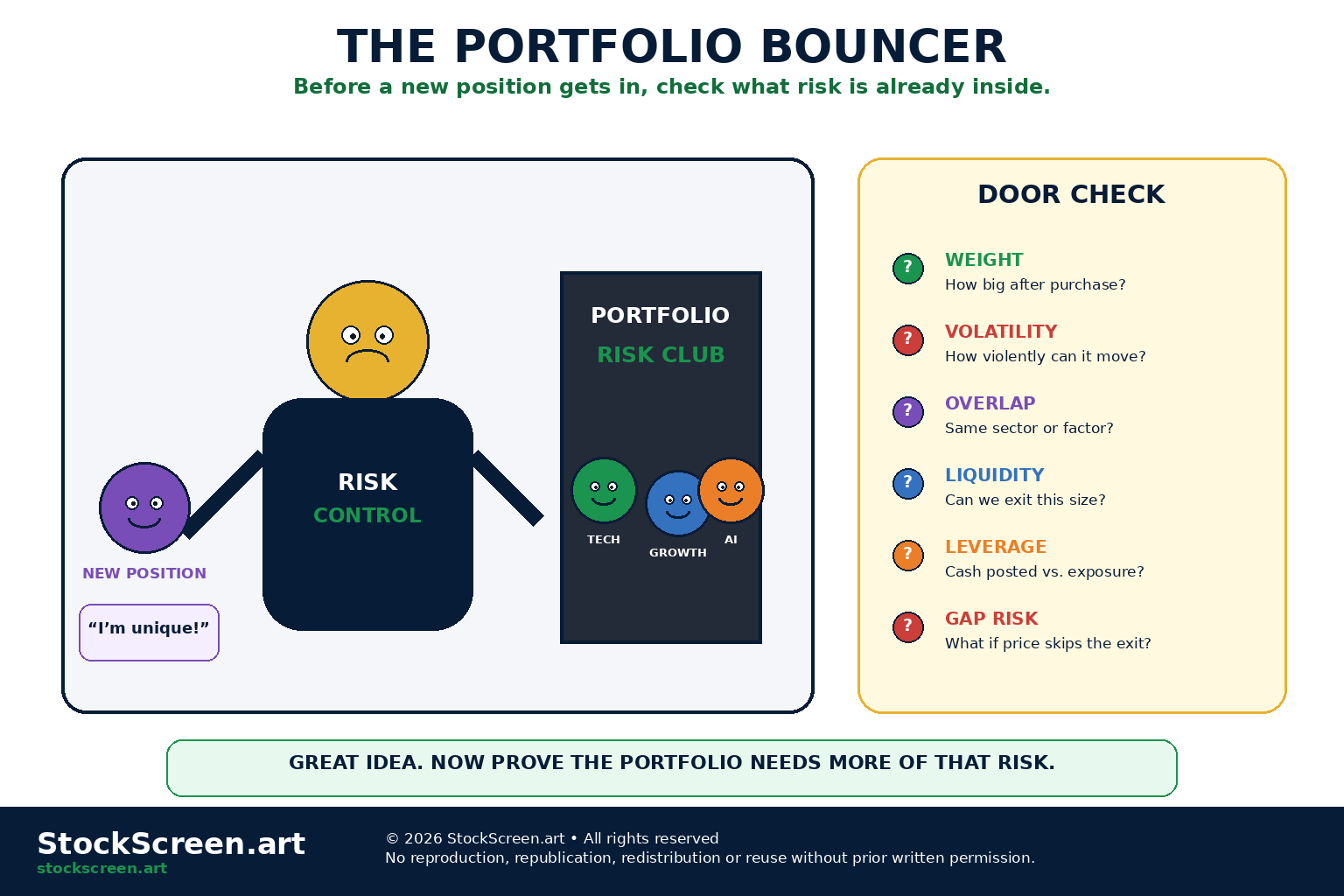
Before adding it, ask:
- Do I already own similar securities?
- Does an ETF already contain this stock?
- Is the sector already large?
- Does this add the same interest-rate or commodity sensitivity?
- Will this position increase leverage?
The answer may be:
“Great idea. Portfolio already has enough of that risk.”
34. Position sizing after a large winner
A successful holding can become oversized simply because it rose.
Suppose a 7% position doubles while the rest of the portfolio barely moves.
Its new weight becomes substantially larger.
The investor did not choose more concentration.
The market delivered it free of charge.
35. Letting winners run versus concentration control
There is a legitimate tension between:
- allowing strong investments to compound;
- preventing one winner from dominating the portfolio.
Different strategies resolve this trade-off differently.
The key is to recognize the trade-off rather than discover it during the next 30% drawdown.
36. Averaging down changes size
Buying more after a position falls is often called averaging down.
The average purchase price declines.
But portfolio exposure increases.
That means the strategy is simultaneously saying:
“The market disagrees with me more than before, so I am increasing the amount at risk.”
Sometimes that is deliberate and disciplined.
Sometimes it is bargaining with the chart.
37. Adding to winners changes size too
Momentum-oriented strategies may intentionally add to positions that are working.
That can increase exposure as evidence improves.
But cluster and maximum-weight limits still matter.
“Winning” is not the same as “incapable of becoming oversized.”
38. Position sizing and thesis horizon
Short-horizon trades and long-horizon investments can face different risks.
A short-term position may care more about:
- intraday volatility;
- event risk;
- execution;
- stop distance.
A long-term position may care more about:
- business deterioration;
- valuation risk;
- economic cycles;
- permanent capital loss.
Position size should fit the risk process actually being used.
39. Time horizon does not make concentration harmless
Long-term investing can reduce the importance of short-term noise.
It does not turn a concentrated position into a diversified one.
Companies can permanently lose value over long horizons too.
“I’m long term” is not a concentration exemption form.
40. Portfolio-level loss scenarios
A useful thought experiment is:
“What happens to the whole portfolio if this position falls 30%, 50% or more?”
For a 5% position:
- a 50% loss reduces the portfolio by roughly 2.5 percentage points, ignoring interactions and other changes.
For a 30% position:
- a 50% loss reduces the portfolio by roughly 15 percentage points.
Same security loss.
Very different portfolio event.
41. Scenario thinking is often more useful than false precision
Risk models can produce many decimal places.
Markets can produce:
SURPRISE
Simple scenarios help ask:
- What if volatility doubles?
- What if correlations rise?
- What if liquidity disappears?
- What if the stock gaps 25%?
- What if several related positions fall together?
Precision is useful.
Robustness is more useful.
42. Position sizing and rebalancing
Once target weights or ranges exist, portfolio drift creates a rebalancing problem.
Rebalancing can:
- trim oversized positions;
- restore underweight positions;
- redirect new contributions;
- reduce accidental concentration.
We will return to rebalancing in PR-06.
43. Position sizing and taxes
Reducing an oversized winner in a taxable account may create capital-gains consequences.
Tax considerations can affect implementation.
They do not change the fact that the concentration exists.
Tax rules vary by jurisdiction and individual circumstances.
44. Position sizing and transaction costs
Frequent resizing can create:
- commissions;
- spreads;
- market impact;
- tax effects;
- administrative complexity.
A sizing system should not require the portfolio to perform interpretive dance every afternoon.
45. Position sizing is partly about survival
The purpose of sizing is not to ensure every position is small.
It is to prevent one ordinary mistake from becoming an extraordinary account event.
Investing is a repeated game.
Capital that survives can participate in future decisions.
46. A practical portfolio sizing audit
For a new or existing position, ask:
- What percentage of portfolio capital does it represent?
- What is the real notional exposure?
- How volatile is the instrument?
- What could a realistic adverse gap look like?
- How liquid is the position at my intended size?
- What positions are highly correlated with it?
- How large is the full sector or risk cluster?
- Is leverage involved?
- Has a winner already drifted above its intended weight?
- What happens to the whole portfolio if this thesis is badly wrong?
47. Five sizing frameworks worth recognizing
- Equal weight: same capital weight per holding.
- Maximum-weight limits: cap any single position or cluster.
- Risk-budget sizing: size from a chosen planned-loss amount and invalidation distance.
- Volatility-aware sizing: reduce size as measured volatility rises.
- Risk-contribution approaches: consider how each holding interacts with the rest of the portfolio.
These are frameworks, not universal prescriptions.
48. Nine terrible position-sizing rules
- “I like it twice as much, so I’ll buy twice as much.”
- “It’s down 40%, therefore it must be safer now.”
- “The option only costs $300.”
- “It’s just one futures contract.”
- “Every holding is under 10%, so the portfolio cannot be concentrated.”
- “The broker gave me buying power. It would be rude not to use it.”
- “This one feels different from the other four technology positions.”
- “I’ll figure out the exit after it moves.”
- “If the spreadsheet has four decimal places, the risk must be under control.”
49. Ten mental models worth keeping
- Size controls impact.
- Capital weight and risk contribution are not the same thing.
- Notional exposure matters whenever leverage or derivatives are involved.
- Equal capital does not mean equal risk.
- Correlated positions should be evaluated as a cluster.
- Liquidity can make a theoretical size impractical.
- Gap risk can make actual losses larger than planned losses.
- Winners can create concentration without new purchases.
- Confidence should not be allowed to bypass risk controls.
- The portfolio matters more than the isolated trade.
Quick knowledge check
Ten questions. Position size for this quiz remains a full ten questions because leverage has not been approved.
1. What is portfolio weight?
The market value of a position divided by the total portfolio value, usually expressed as a percentage.
2. Can two positions with the same portfolio weight contribute different amounts of risk?
Yes. Their volatility, leverage, liquidity, payoff structure and correlation with other holdings can differ.
3. What is notional exposure?
The economic amount of market exposure controlled by a position, which can be much larger than the cash posted when leverage or derivatives are used.
4. Why should correlated positions be considered together?
Because several individually moderate positions can behave like one large risk cluster when they respond to the same shocks.
5. In a simple long-stock trade, how is planned risk per share calculated?
Entry price minus the planned invalidation price.
6. Can a stop-distance formula guarantee the maximum loss?
No. Gaps, slippage, liquidity and execution can produce a larger actual loss.
7. Why might a more volatile security be assigned a smaller position in a volatility-aware framework?
To reduce the chance that its naturally larger price fluctuations dominate total portfolio movement.
8. How can a successful investment become a concentration problem?
If it appreciates much faster than other holdings, its portfolio weight can grow beyond the intended level.
9. Why is one futures contract not automatically a small position?
Because each contract can represent a large standardized notional exposure relative to the margin posted.
10. What is the most important portfolio-level sizing question?
How much can this position—and the full cluster of related positions—affect the portfolio if the thesis is wrong?
Where we go next
Position sizing tells us how loudly one position can speak.
Now we need to understand what happens when the portfolio starts yelling.
Next:
FND-PR-04 — Drawdowns and Volatility.
We will separate normal fluctuation from the kind of loss that changes capital, behavior and occasionally the investor’s relationship with the refresh button.
Primary sources & further reading
- FINRA — Concentrate on Concentration Risk
- FINRA — Asset Allocation and Diversification
- Investor.gov — What Is Risk?
- Investor.gov — Understanding Margin Accounts
- CFTC — Eight Things You Should Know Before Trading Forex