Use the course navigation below to continue through the curriculum or jump to closely related lessons.
You find a stock you like.
You buy ten shares.
The stock moves 2%.
You check the account.
Something has happened, but nobody needs medical attention.
Then you discover futures.
Suddenly you're controlling exposure to a stock index worth tens of thousands of dollars with only a fraction of that amount deposited in your account. The market moves a little. Your account moves considerably more.
And somebody starts talking about ticks, margin, settlement, rollovers and—depending on what you traded—the theoretical possibility of becoming involved with 1,000 barrels of crude oil.
Welcome to futures.
They are among the most important financial instruments in the world. Farmers use them. Airlines use them. Portfolio managers use them. Commodity producers use them. Hedge funds use them. Traders use them.
They exist largely because businesses and investors have spent centuries thinking:
“I would really prefer to know what this thing might cost later.”
Futures provide a way to transfer that price risk.
They also provide leverage.
And, as we discovered with options, leverage has the remarkable ability to make relatively small price movements suddenly feel extremely personal.
How Does Futures Trading Work?
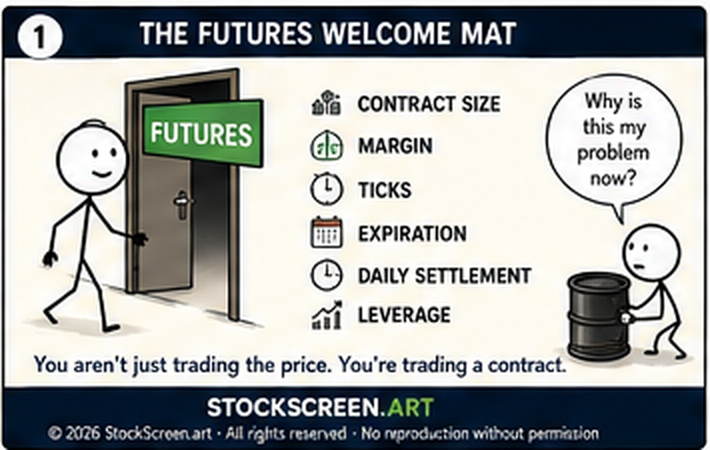
Futures trading works through standardized exchange-traded contracts whose value is tied to an underlying market such as a stock index, commodity, currency or interest-rate instrument. Instead of buying the underlying asset itself, the trader takes a long or short position in a contract with defined specifications, including a multiplier, minimum price movement, expiration date and settlement method.
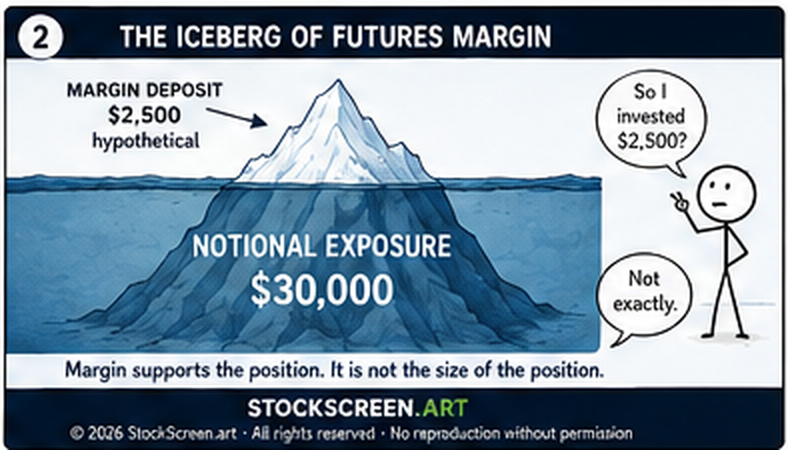
The key number is the contract's notional exposure, not simply the cash posted as margin. Futures margin supports the position but is generally much smaller than the economic value controlled by the contract. That creates leverage: relatively small moves in the underlying market can produce much larger percentage changes in the capital supporting the position.
Futures positions are also marked to market, so gains and losses affect account equity as the market moves. Contracts expire, may need to be rolled to later months, and can settle financially or through physical-delivery procedures depending on the product.
A useful beginner framework is: Underlying market → Contract specification → Notional exposure → Margin → Tick value → Expiration → Settlement → Risk. If any of those pieces is unclear, the futures position is not yet fully understood.
What Is a Futures Contract?
At its core, a futures contract is a standardized agreement involving the purchase or sale of something at a specified future time under terms established by an exchange.
The “something” can be very different depending on the contract.
It might represent:
- the S&P 500
- crude oil
- gold
- natural gas
- wheat or corn
- Treasury securities
- currencies
- other financial or commodity markets
Some futures are financially settled. Others contemplate physical delivery. In practice, many positions are closed or offset before delivery becomes relevant.
When you buy Apple stock, you own shares of Apple.
When you buy an S&P 500 futures contract, you do not suddenly become the proud owner of tiny pieces of 500 companies.
You hold a futures position whose economics are tied to the value of an index.
When you trade crude-oil futures, you haven't purchased barrels sitting somewhere with your name written on them in Sharpie.
You have entered into a standardized financial contract whose economics are tied to crude oil.
That sounds like a subtle distinction.
It isn't.
It's the whole game.
Let's Abuse Another Hypothetical Example
Our options article had XYZ.
Futures deserve something bigger.
Suppose the S&P 500 index is hypothetically trading at:
6,000
One commonly traded smaller futures product is the Micro E-mini S&P 500 futures contract, symbol MES.
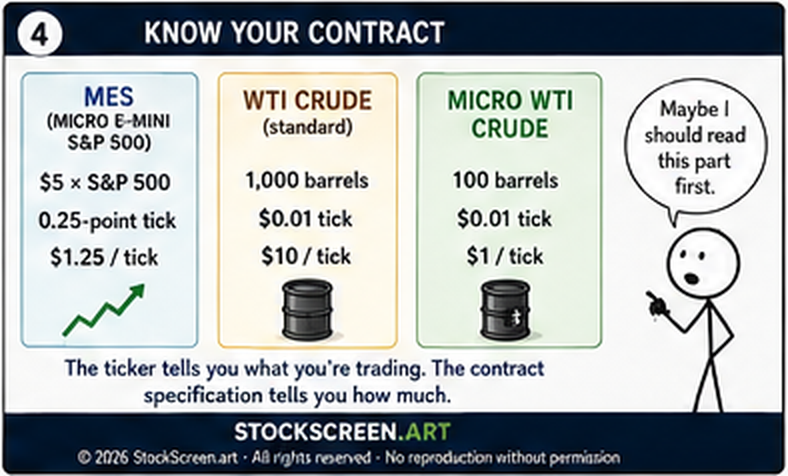
CME Group specifies the MES multiplier as $5 × the S&P 500 Index. Its minimum outright movement is 0.25 index points, worth $1.25 per contract.
At an index level of 6,000, one MES contract therefore represents approximately:
6,000 × $5 = $30,000 of notional exposure
That's our first important number.
$30,000.
But here's where futures begin behaving differently from buying $30,000 worth of an ETF.
You generally don't hand over $30,000 to establish that futures position.
Instead, you post margin.
And futures margin is where innocent-looking numbers begin acquiring sharp edges.
How Futures Margin and Leverage Work
This concept causes a great deal of confusion because the word margin is also used in stock investing.
Futures margin is different.
In futures markets, margin functions as a financial performance bond supporting the position. Futures positions are then marked to market as prices change.
Suppose—purely for illustration—that a broker required $2,500 to support our hypothetical MES position. Actual exchange and broker margin requirements vary and can change.
That does not mean you bought $2,500 worth of the S&P 500.
You're still economically exposed to approximately $30,000 of index value in our example.
The $2,500 is supporting that exposure.
This is leverage.
And this is roughly the moment when a futures trader looks at the account balance and says:
“Excellent. Very capital efficient.”
Risk, sitting quietly across the table, says:
“Yes. Capital efficient. That's one way of putting it.”
Now Move the Market 1%
Our hypothetical MES contract is based on an S&P 500 level of 6,000.
A 1% move is:
60 index points
MES is worth $5 per index point.
So:
60 × $5 = $300
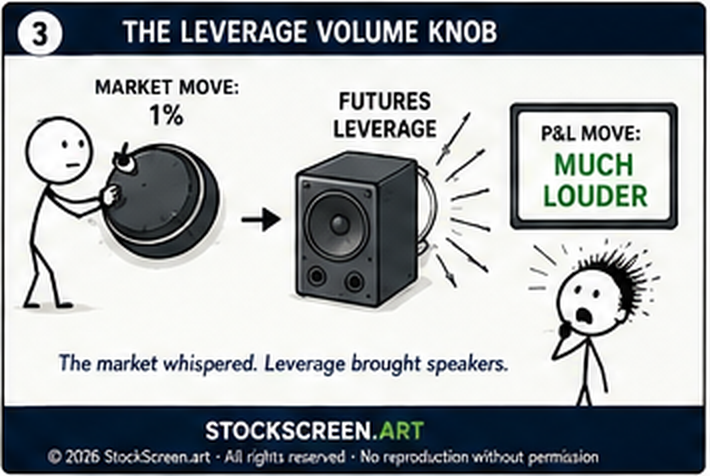
A 1% move in the index creates approximately a $300 gain or loss per MES contract.
Relative to $30,000 of underlying notional exposure, that makes perfect sense.
But compare $300 with our purely hypothetical $2,500 margin amount:
$300 ÷ $2,500 = 12%
The underlying index moved 1%.
The amount supporting the position changed in value by an amount equivalent to about 12% of that hypothetical margin.
Now imagine:
2%.
3%.
5%.
The math does not develop empathy as the numbers become larger.
This is why futures leverage can be extremely useful and extremely dangerous.
Leveraged futures positions can amplify both profits and losses, and losses can exceed the money initially deposited.
Long and Short Are Surprisingly Symmetrical
Stocks naturally train investors to think:
Buy first. Sell later.
Futures are more symmetrical.
If you believe the market will rise, you can go long a futures contract.
If you believe it will fall, you can go short.
You don't necessarily need to borrow an asset first in the way people commonly associate with shorting stock. You are entering the opposite side of the futures contract.
Suppose MES is at 6,000.
You go long.
It rises to 6,020.
Twenty points × $5 = approximately $100 profit.
If instead you went short at 6,000 and it fell to 5,980, the same 20-point move would produce approximately $100 profit.
If the market moves the other way, you lose.
Futures are wonderfully impartial that way.
They don't care whether your economic worldview is bullish, bearish, inflationary, deflationary or based entirely on something somebody said on television five minutes ago.
The contract only cares about the price difference.
Futures Contract Size and Tick Value
Stocks have a wonderfully intuitive unit.
One share is one share.
Futures looked at this simplicity and apparently decided it needed improvement.
Every futures product has its own contract specification.
That includes the contract size, minimum price movement, monetary value of that movement, expiration schedule and settlement method.
Consider crude oil.
The standard CME WTI crude-oil futures contract represents:
1,000 barrels of oil.
Its minimum tick is $0.01 per barrel, making one tick worth $10 per contract.
Suppose crude oil trades at $70 per barrel.
The notional value is roughly:
1,000 × $70 = $70,000
Now oil rises $1.
That doesn't produce a $1 gain.
It produces:
$1 × 1,000 barrels = $1,000
This is why looking at a futures quote without knowing the contract multiplier is a little like reading the speedometer without knowing whether the vehicle is a bicycle or a fighter jet.
Futures Come in Different Sizes
Fortunately, exchanges have introduced smaller contracts for many markets.
CME's Micro WTI crude-oil futures represent 100 barrels, compared with 1,000 barrels for the standard contract. The micro contract's $0.01 minimum price increment is worth $1 rather than $10.
Likewise, Micro E-mini equity-index futures are smaller versions of their E-mini counterparts.
This can make position sizing more practical. The Foundation lesson on Leverage and Position Sizing develops the broader principle that smaller margin requirements do not make the underlying exposure small.
But “micro” is a relative term.
A smaller chainsaw remains a chainsaw.
Before trading any futures contract, the relevant question isn't:
“How much margin does this require?”
It is:
“What is the actual notional exposure and how much money changes hands when this market moves?”
Those are much better questions.
How Mark-to-Market Works in Futures Trading
Stocks can fall while you continue holding them.
You may dislike what the account screen says, but unless leverage or other circumstances intervene, there isn't necessarily a futures-style daily cash settlement between you and the market.
Futures are different.
Futures positions are marked to market.
Gains and losses are calculated using settlement prices and credited or debited from the account.
Suppose you have $4,000 in the futures account.
Your position loses $500.
The account doesn't merely display an interesting theoretical number.
That loss affects your account equity.
Lose enough and you can fall below required maintenance margin.
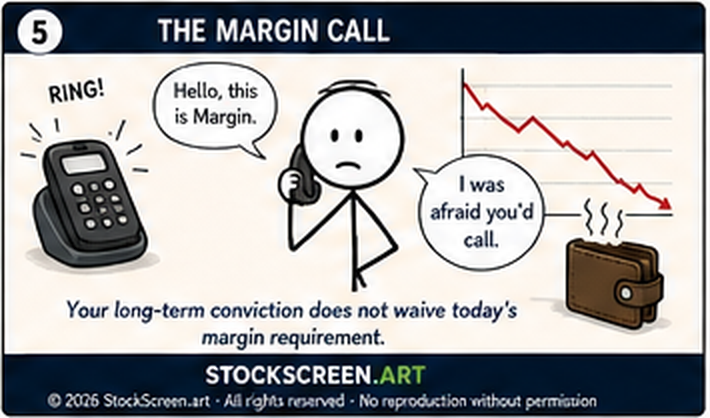
Then Comes the Margin Call
A margin call is not the broker calling to ask whether you're having a nice afternoon.
It means:
More capital may be required to support the position.
Depending on the broker, exchange requirements and circumstances, insufficient margin can also lead to positions being reduced or liquidated.
This matters because futures losses don't politely wait until your long-term thesis eventually works.
Your thesis may be:
“I still believe the market will recover next month.”
Your margin account may reply:
“Fascinating. We were discussing this afternoon.”
Timing matters.
Capital matters.
Position size matters enormously.
Futures Expire
This should sound familiar after our options leverage guide.
Futures contracts have expiration months.
There isn't simply “the S&P 500 future.”
There are contracts expiring at different times.
Micro E-mini S&P 500 futures follow the familiar quarterly cycle with March, June, September and December expirations.
If you want to maintain exposure beyond the current contract, you normally need to roll the position.
That means closing the expiring contract and establishing a position in a later-dated contract.
Simple concept.
But the two contracts may not trade at exactly the same price.
Which leads us to another futures concept with names that sound suspiciously like exotic Italian desserts.
Contango and Backwardation
Different futures expirations can trade at different prices.
If later-dated contracts trade above nearer contracts, the market structure is generally called contango.
If later contracts trade below nearer contracts, that's generally called backwardation.
We'll explore this much more deeply in Why Oil, Gold and Wheat Do Not Trade Like Stocks, because this becomes especially important in markets such as oil and natural gas.
For now, understand the bigger point:
The futures price isn't necessarily the same across every expiration month.
So rolling a futures position can have economic consequences of its own.
This becomes particularly important for investors who wonder why a commodity futures-based fund didn't exactly match the spot-price move they saw on television.
There is usually more machinery underneath the hood.
Finance enjoys machinery.
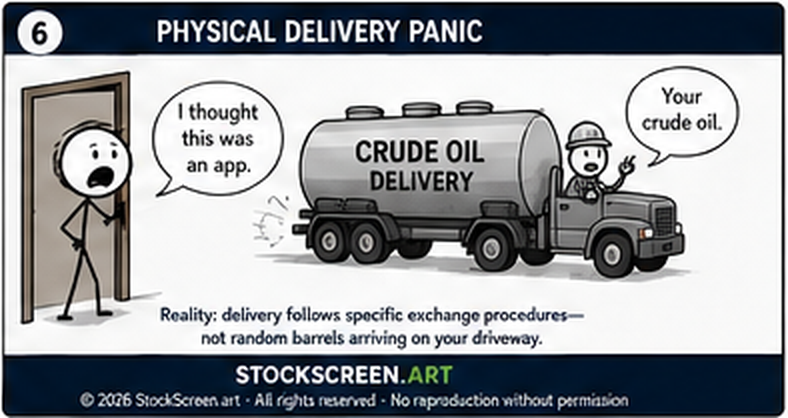
Do I Actually Have to Take Delivery of 1,000 Barrels of Oil?
This is the question everyone secretly wants answered.
Some futures contracts are physically deliverable.
Others settle financially.
Standard WTI crude-oil futures are physically deliverable under exchange procedures tied to Cushing, Oklahoma.
That does not mean someone casually drops 1,000 barrels at your house.
Which is fortunate.
The homeowners' association would have questions.
But physical-delivery obligations are real contractual mechanics, and traders need to understand the contract they hold and when they intend to exit or roll it.
Many speculative traders close positions before delivery becomes relevant.
But “I assumed my broker would handle it” is not a risk-management strategy.
It's a sentence people say immediately before learning a great deal.
If Futures Are So Risky, Why Does Anyone Use Them?
Because futures solve genuine economic problems.
Imagine a farmer growing wheat.
The harvest isn't ready yet.
The farmer is worried wheat prices could collapse before it is sold.
A futures position can potentially hedge part of that price risk.
Now imagine a company whose business depends heavily on a commodity.
Its concern may be the opposite: prices might rise dramatically.
Again, futures can help transfer some of that risk.
Futures markets bring together hedgers, who use contracts to manage existing price exposure, and speculators, who willingly accept price risk in an attempt to profit from market movement.
This is one of the elegant things about derivatives markets.
One participant may desperately want to get rid of a risk.
Another voluntarily says:
“I'll take that.”
For a price, naturally.
Civilization proceeds.
A Futures Hedge Isn't the Same as a Futures Bet
Suppose a portfolio manager owns a substantial portfolio of U.S. stocks and becomes concerned about a short-term market decline.
Selling hundreds of individual positions might be expensive, tax-inefficient or operationally difficult.
Equity-index futures can potentially provide a temporary hedge against broad-market exposure.
That's very different from opening a leveraged futures position because somebody on social media drew a triangle on a five-minute chart.
The financial instrument is the same.
The purpose is completely different.
Understanding why the position exists matters as much as understanding whether it is long or short.
Futures vs. Options: Same Family, Different Personalities
Our previous guide, What Happens When You Add Leverage to a Good Stock Idea?, explored options.
Options and futures are both derivatives, but their payoff structures differ substantially.
With a purchased call or put, the buyer pays a premium and generally has a maximum loss limited to that premium.
A standard outright futures position doesn't work that way.
A long futures position gains as the futures price rises and loses as it falls.
A short position does the opposite.
There isn't an option premium serving as the same predefined maximum loss for the outright futures position.
That means futures exposure can be wonderfully straightforward mathematically while simultaneously being considerably less forgiving financially.
Options say:
“You must understand direction, time, volatility and strike.”
Futures say:
“Fine. Mostly just tell me where price is going.”
Trader:
“That sounds easier.”
Futures:
“Excellent. Here is leverage.”
And Futures vs. Stocks?
Suppose you want roughly $30,000 of broad-market exposure.
One approach is owning approximately $30,000 of an index fund.
Another might involve a futures contract representing roughly $30,000 of notional exposure while posting substantially less capital as margin.
The underlying economic exposure may look similar.
The account mechanics absolutely do not.
The stock or ETF investor generally commits substantially more capital and does not face futures-contract expiration or futures-style daily margin settlement.
The futures trader receives greater capital efficiency but also leverage, contract expiration, margin requirements and potentially much faster consequences.
Neither structure is automatically “better.”
The important question is whether the instrument fits the objective and whether the investor understands what they actually control.
Now Bring StockScreen.art Back Into the Picture
StockScreen.art currently screens and analyzes stocks, not futures contracts.
That distinction should be explicit.
But futures markets can provide useful context for equity research.
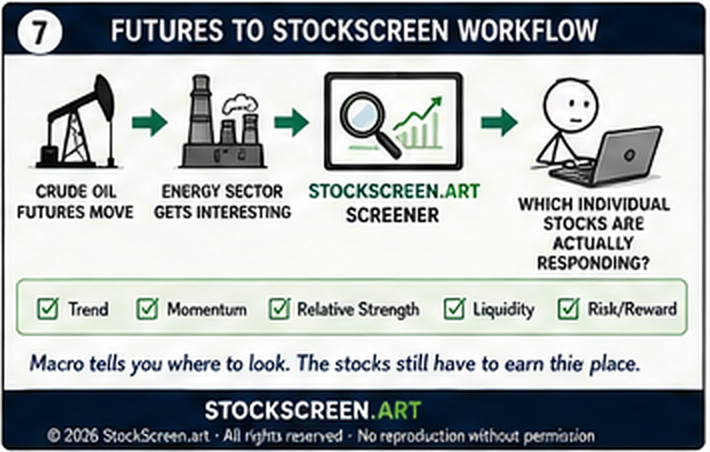
Consider energy.
Suppose crude oil begins moving strongly higher.
That doesn't automatically mean:
BUY EVERY OIL STOCK
Markets are rarely generous enough to make investing that easy.
Different energy companies have different production economics, balance sheets, hedging programs, geographic exposure, capital structures and operating performance.
But the commodity move may create an environment worth investigating.
Now StockScreen.art enters the workflow.
You might ask:
- Which energy stocks are actually showing improving momentum?
- Which are outperforming the broader market?
- Which have constructive technical trends?
- Which are liquid enough to research further?
- Which are failing to respond despite the supposedly favorable commodity backdrop?
On StockScreen.art, the free U.S. stock screener can help narrow that equity universe, while MarketEngine™ AI stock analysis provides the deeper ticker-level research view. StockScreen.art does not analyze the futures contracts themselves.
That last group may be particularly interesting.
Because sometimes what isn't responding tells you as much as what is.
Index Futures Can Also Provide Market Context
Equity-index futures trade through much more of the day than the regular U.S. cash-stock session, with scheduled maintenance breaks.
That is why financial television spends so much time saying things like:
“S&P futures are down 0.7% this morning.”
Futures can reflect how market participants are repricing broad-market expectations before the cash stock market opens.
But don't turn that into:
“Futures are green, therefore my stock will rise.”
A broad-market futures contract reflects the market.
Your individual company may release terrible earnings five minutes later.
The market does not provide warranties.
Instead, think:
Futures provide context.
Stock-specific analysis provides another layer.
Sector behavior provides another.
Momentum provides another.
Risk management provides another.
Good research is usually several imperfect pieces pointing in roughly the same direction.
The Small-Move Trap
One psychological danger of futures is that the quoted market move can look tiny.
Crude oil moves from:
$70.00 to $69.50
Only fifty cents.
It barely looks worth discussing.
But with a standard contract representing 1,000 barrels:
$0.50 × 1,000 = $500
That's a $500 move per contract.
Crude drops $3?
Approximately:
$3 × 1,000 = $3,000
The visual size of the quote is irrelevant.
The contract multiplier converts that quote into money.
This is perhaps the single habit a futures beginner should develop:
Never look at the price move without mentally translating it into the contract's dollar P&L.
“Oil moved 80 cents” is trivia.
“What does an 80-cent move mean for the contract I'm holding?” is risk management.
The Margin Number Can Be Psychologically Dangerous
Suppose your trading platform tells you that a position requires $3,000 of margin.
Human brains tend to anchor on visible numbers.
So the investor thinks:
“This is a $3,000 trade.”
It isn't.
Margin is the amount required to support the position.
The contract may represent substantially more notional exposure.
This is the futures equivalent of judging the size of an iceberg by what is above the water.
The correct mental model is:
POSITION SIZE = NOTIONAL EXPOSURE
not:
POSITION SIZE = CASH CURRENTLY TIED UP
That distinction can save a great deal of pain.
The Market Can Move While You're Sleeping
Many major futures markets trade for long sessions extending well outside ordinary U.S. stock-market hours.
That provides flexibility.
It also means geopolitical events, economic reports and other developments can alter your position while you are making coffee, eating dinner or doing the historically underrated activity known as sleeping.
Nearly around-the-clock trading does not mean:
“Wonderful, I can trade all the time.”
It can also mean:
“Wonderful, the market can trade without me.”
Liquidity can also vary during different sessions.
Just because a market is technically open doesn't mean every hour behaves the same way.
A Practical Futures Trading Checklist
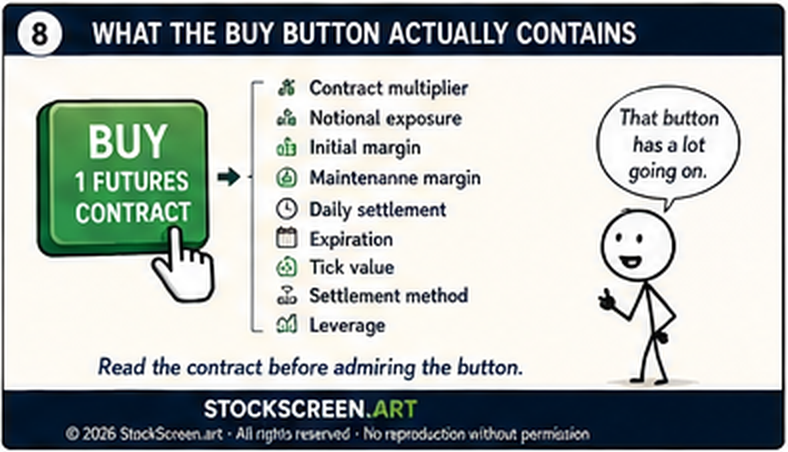
Before touching a futures contract, an investor should be able to answer a handful of questions without consulting the Buy button for assistance.
- What exactly is the underlying market?
- What does one contract represent?
- What is the multiplier?
- What is one tick worth?
- What is the total notional exposure?
- How much can a normal daily move change the account?
- What margin is required?
- What is the maintenance requirement?
- When does the contract expire?
- Is settlement cash or physical?
- If you're holding near expiration, what exactly is your plan?
- How would you exit?
- How would you roll?
- If the market makes a move that is entirely ordinary for that market, can your account survive it?
If you don't know those answers, the problem isn't that futures are inherently bad.
The problem is that you haven't finished reading the contract yet.
Futures Are Not “Advanced Stocks”
This is an important distinction.
A futures contract isn't simply a faster version of owning shares.
It has different mechanics.
Different economics.
Different cash flows.
Different expiration considerations.
Different margin treatment.
And often much greater leverage relative to capital deposited.
Treating futures like turbocharged stocks is a good way to discover that the turbocharger wasn't the only thing that changed.
So Why Are Futures So Important?
Because markets need ways to transfer risk.
An agricultural producer may want price certainty.
An airline may care deeply about energy costs.
A portfolio manager may want broad-market exposure or a hedge.
An asset manager may need to adjust exposure efficiently.
A trader may want to speculate on the future direction of an index, commodity, currency or interest-rate market.
Futures give all of those participants a standardized marketplace in which to meet.
The exchange standardizes the contract.
The clearing system stands between buyers and sellers.
Margin supports performance.
Daily settlement continually reconciles gains and losses.
It's a remarkably sophisticated system.
It just happens to be presented to retail traders through a button labelled:
BUY
which somewhat understates the machinery underneath it.
Futures Trading Questions
How does futures trading work for beginners?
A beginner should first identify the underlying market, then read the contract specification to understand the multiplier, tick value, notional exposure, margin requirement, expiration and settlement method. Profit and loss are determined by the contract's dollar sensitivity to price changes, not by the quoted price alone.
What is margin in futures trading?
Futures margin is capital required to support a leveraged contract position. It is not the purchase price of the underlying exposure. The contract may control substantially more notional value than the margin deposited, which is why gains and losses can be large relative to the cash supporting the trade.
Can you lose more than your futures margin deposit?
Yes. Futures are leveraged instruments, and adverse market moves can produce losses greater than the amount initially deposited. Margin requirements can also change, and insufficient account equity can lead to additional funding requirements or liquidation.
What happens when a futures contract expires?
The outcome depends on the contract. Some futures settle financially and others have physical-delivery procedures. Traders who want to maintain exposure beyond the current contract generally close or offset the expiring position and establish a position in a later-dated contract, commonly called rolling.
What is the difference between futures and buying the underlying asset?
Buying an asset gives you ownership of that asset or security. A futures position is a standardized derivative contract whose economics are linked to the underlying market. It adds contract specifications, leverage, margin, expiration and settlement mechanics that ordinary share ownership does not have.
Final Thoughts: The Contract Is the Product
The central lesson with futures is surprisingly simple.
Don't confuse the quoted price with the size of the position.
A futures price might move a few points.
A commodity might move a few cents.
The account result is determined by the contract specification attached to that movement.
That's where futures become powerful.
And that's where they become dangerous.
Our hypothetical MES example showed how an index position representing around $30,000 of exposure could be supported by much less capital.
That capital efficiency is one of the major attractions of futures.
It is also leverage.
And leverage doesn't know whether you're a sophisticated portfolio manager or someone who discovered futures twelve minutes ago.
It performs the same multiplication.
So the proper sequence is:
Understand the market.
Then understand the contract.
Then understand the notional exposure.
Then understand the margin.
Then understand the expiration and settlement rules.
And only then decide whether leverage belongs anywhere near the idea.
Because the most dangerous futures trade isn't necessarily the one where you predicted the market incorrectly.
It may be the one where you correctly predicted the market...
but never understood what one contract actually meant.
Primary Sources & Contract Specifications
Futures specifications can change, and margin requirements are especially variable. Readers should verify current terms before relying on any contract detail. The factual contract examples in this article were checked against official educational and specification materials from the U.S. Commodity Futures Trading Commission and CME Group.
- CFTC — Economic Purpose of Futures Markets and How They Work
- CME Group — S&P 500 and Nasdaq-100 Futures
- CME Group — Micro E-mini Equity Index Futures FAQ
- CME Group — Futures Contract Specifications
- CME Group — Micro WTI Crude Oil Futures FAQ