A stock chart and an oil chart can look almost identical.
Both have prices.
Both move up and down.
Both can ruin someone's perfectly good lunch.
But economically, they are very different animals.
Commodity Trading Basics: How Commodities Trade
Commodity trading begins with a physical market. Oil, gold, wheat and other commodities are influenced by real-world supply, demand, inventories, storage, transportation, weather, production cycles and expectations. Traders may gain exposure through spot markets, futures contracts, exchange-traded products or shares of companies connected to the commodity, but those instruments are not economically identical.
Futures are especially important because they allow market participants to trade standardized contracts for specific delivery months rather than buying the physical commodity outright. That introduces contract size, margin, leverage, expiration, settlement and the shape of the futures curve into the analysis.
The most useful beginner framework is: Physical market → Supply and demand → Inventories → Spot versus futures → Contract month → Futures curve → Risk. Before interpreting a commodity chart, know exactly which market and instrument the chart represents.
That distinction changes almost everything.
A company can grow earnings, launch products, reduce debt and improve margins.
A barrel of oil cannot hold an earnings call.
A bushel of wheat cannot announce a share buyback.
Gold has never once issued upbeat forward guidance.
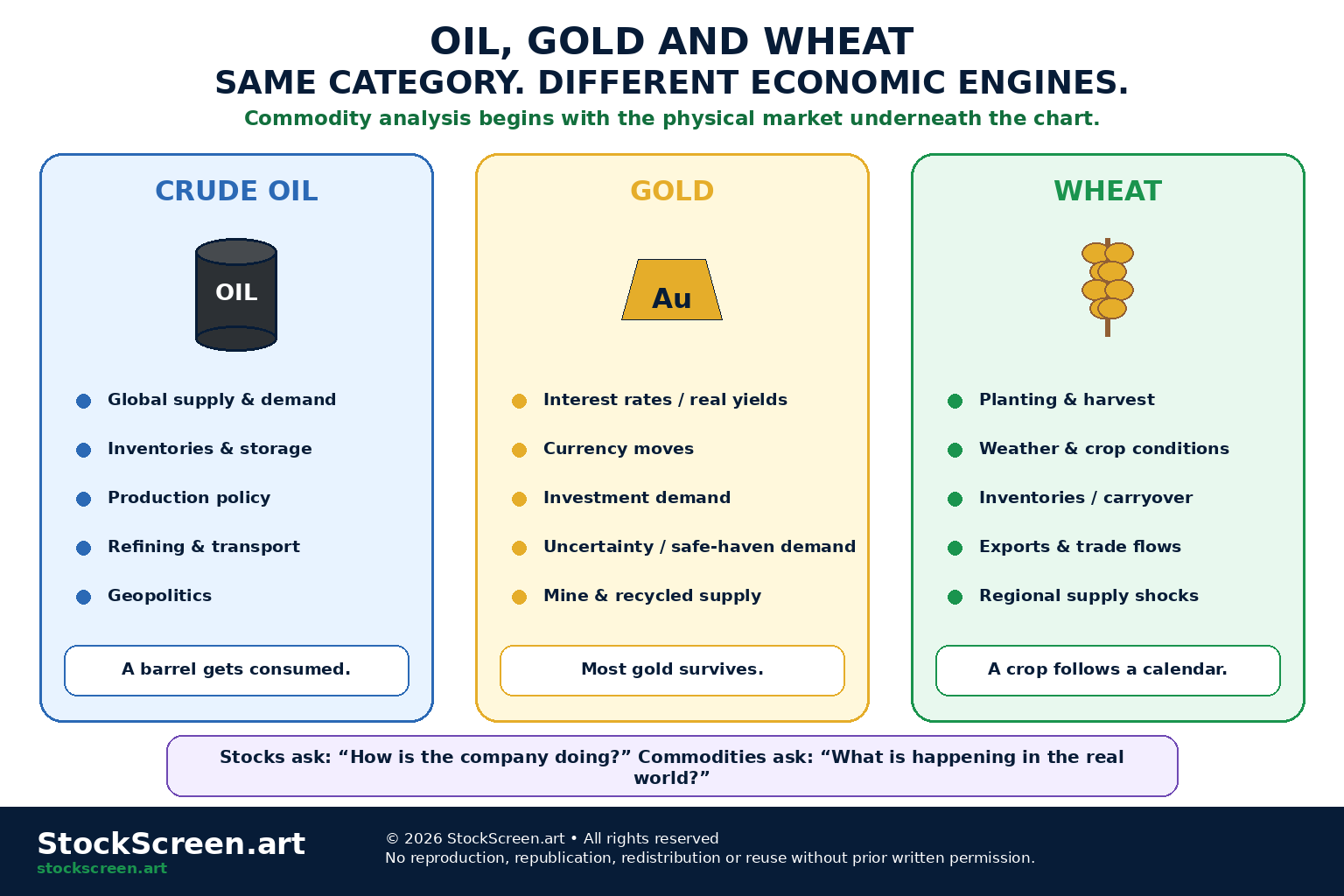
Commodities are driven by the economics of production, consumption, inventories, storage, transportation, weather, geopolitics and time.
1. Start with the simplest distinction: company versus thing
When you buy common stock, you buy an ownership interest in a business.
The business can:
- earn profits;
- reinvest capital;
- pay dividends;
- issue or repurchase shares;
- gain or lose competitive advantage;
- grow for decades.
A physical commodity is different.
It is a standardized or grade-defined good used, consumed, processed or stored in the real economy.
Oil gets refined and burned.
Wheat gets milled and eaten.
Gold gets stored, fabricated, worn, held by investors and used in industry.
The commodity itself does not generate operating cash flow.
2. “Commodity” does not mean “everything behaves the same”
It is tempting to lump oil, gold, wheat, copper and natural gas into one giant bucket labelled:
Stuff that comes out of the ground.
That is not a useful analytical framework.
Different commodities have different:
- production cycles;
- storage economics;
- transportation constraints;
- consumption patterns;
- seasonality;
- substitutes;
- geopolitical exposure;
- contract specifications.
Oil is an energy input.
Gold behaves partly like a monetary and investment asset.
Wheat is an agricultural crop with a biological production cycle.
Same category.
Very different plumbing.
3. Commodity Spot Markets vs. Futures Markets
Commodity analysis becomes confusing if we use the word “price” without asking:
Which price?
A spot or cash price refers broadly to a price for the physical commodity in the current market.
A futures price refers to a standardized exchange-traded contract for a specified delivery month.
The two are connected.
They are not identical.
4. A futures contract is a time-specific instrument
The previous Foundation article, How Futures Trading Works, explains the contract mechanics in more detail.
Futures contracts specify things such as:
- the commodity;
- contract unit;
- quality or grade;
- delivery month;
- delivery location or settlement procedure;
- minimum price movement.
For example, benchmark contracts for crude oil, gold and wheat each have different contract sizes and different physical-market conventions.
That is another reason not to treat “one futures contract” as a generic object.
5. Commodity futures are not warehouse receipts with a chart attached
Futures markets exist partly so producers, processors, merchants and consumers can manage price risk.
They are also used by speculators and investors.
Most market participants are interested in price exposure, hedging or trading rather than personally receiving the physical commodity.
But delivery and settlement rules still matter because they anchor the contract to the real market.
Ignoring expiration because “I only care about the chart” is the futures-market equivalent of ignoring the engine because you like the paint color.
6. Why oil moves: global supply and demand
Crude oil is a globally traded energy commodity.
Major drivers include:
- global economic activity;
- oil production;
- consumption of petroleum products;
- refinery demand;
- exports and imports;
- inventories;
- production policy;
- geopolitical disruptions.
When demand changes faster than supply can respond, prices may move sharply.
7. Oil supply can be slow to adjust
Oil production cannot always increase instantly when prices rise.
Wells, pipelines, shipping, refining and export infrastructure create physical constraints.
At the same time, consumers cannot always reduce fuel use immediately when prices rise.
That combination can make oil prices highly sensitive to relatively small changes in market balance.
8. Oil inventories are the market's pantry
Inventories help bridge the gap between current production and current consumption.
If supply exceeds immediate demand, inventories can build.
If demand exceeds current supply, inventories can be drawn down.
Traders therefore pay close attention to inventory data.
9. Storage has limits
Physical oil needs somewhere to go.
Storage capacity is not infinite.
Tank farms, pipelines, terminals and caverns have operational limits.
When storage becomes unusually scarce or unusually abundant, the economics of nearby and deferred futures contracts can change dramatically.
10. Geography matters in oil
“Crude oil” is not one perfectly interchangeable liquid sitting in one giant global bathtub.
Benchmarks differ by:
- quality;
- location;
- transportation access;
- refinery compatibility;
- regional supply and demand.
A pipeline outage in one region can matter even if total global oil production has not changed.
Physical markets care about where the barrels are.
11. Geopolitics can become a supply-chain variable
Oil production and transportation are exposed to:
- wars;
- sanctions;
- shipping disruptions;
- political instability;
- production agreements;
- trade restrictions.
Markets often react not only to actual lost supply, but also to the probability that supply could be disrupted.
12. Gold is a very different commodity
Gold is physically mined like other commodities.
But economically, it behaves differently from oil and wheat.
Large quantities of previously mined gold still exist above ground.
Gold is also held as:
- jewelry;
- investment assets;
- official-sector reserves;
- fabricated industrial products.
That means today's mine production is only one piece of the market.
13. Gold does not get “used up” like oil
Most crude oil is consumed when refined products are burned.
Gold is durable.
A gold bar stored years ago can return to the market.
That makes the stock of existing gold economically important.
The market is not simply:
New mines versus this year's jewelry demand.
14. Interest rates and monetary expectations matter for gold
Gold does not pay interest.
So changes in interest rates and real yields can change the opportunity cost of holding it.
Monetary-policy expectations can therefore matter to gold prices.
This relationship is not mechanical every day, but it is an important macroeconomic lens.
15. Currency moves can matter for gold
International gold prices are commonly quoted in U.S. dollars.
Changes in the dollar can affect affordability and investor behavior across countries.
As with most macro relationships, the sign and strength of the relationship can vary through time.
Avoid turning “dollar down = gold up” into a law of physics.
16. Uncertainty and safe-haven demand can matter
Gold often attracts investor attention during periods of financial or geopolitical uncertainty.
That does not mean gold rises during every crisis.
Liquidity needs, currency moves, interest rates and positioning can all complicate the response.
“Safe haven” is a market behavior, not a contractual promise.
17. Wheat begins with biology
Wheat is produced through a crop cycle.
Farmers:
- choose acreage;
- plant;
- wait through a growing season;
- face weather;
- harvest;
- store or sell the crop.
You cannot react to a surprise wheat shortage by opening a software menu and selecting:
Produce 15% more wheat by Friday.
18. Seasonality is built into agricultural markets
Agricultural supply arrives according to biological and regional calendars.
Planting and harvest periods matter.
So do seasonal patterns in:
- inventories;
- exports;
- weather risk;
- crop conditions;
- demand.
Seasonality does not guarantee a particular price direction.
It tells you that the physical market has a calendar.
19. Weather is not “noise” in wheat
Weather can directly affect:
- planting progress;
- yield;
- quality;
- harvest timing;
- transportation.
Drought, excessive rain, heat, frost and storms can all change expected supply.
For a software company, rain is mostly an inconvenience.
For wheat, rain can be part of the income statement Mother Nature forgot to file.
20. Agricultural prices are global too
U.S. wheat does not exist in isolation.
Global prices can reflect:
- production in other exporting countries;
- import demand;
- exchange rates;
- freight costs;
- trade policy;
- war and transportation disruptions.
A crop problem thousands of kilometres away can affect local price expectations.
21. Different grades and locations matter
Agricultural contracts specify grades, delivery terms and locations.
Wheat itself comes in different classes with different uses and market characteristics.
This is another recurring commodity lesson:
22. Inventories connect one season to the next
Carryover stocks can soften the effect of a weak harvest.
Tight stocks can make the market more sensitive to a new crop problem.
The same production shock can have very different price effects depending on how much inventory already exists.
Context matters.
23. How Commodity Futures Curves Work
A commodity does not have one futures price.
It can have many futures contracts trading at the same time:
- nearby delivery;
- next month or quarter;
- later delivery months.
Plot those prices by delivery date and you get a futures curve.
24. Contango
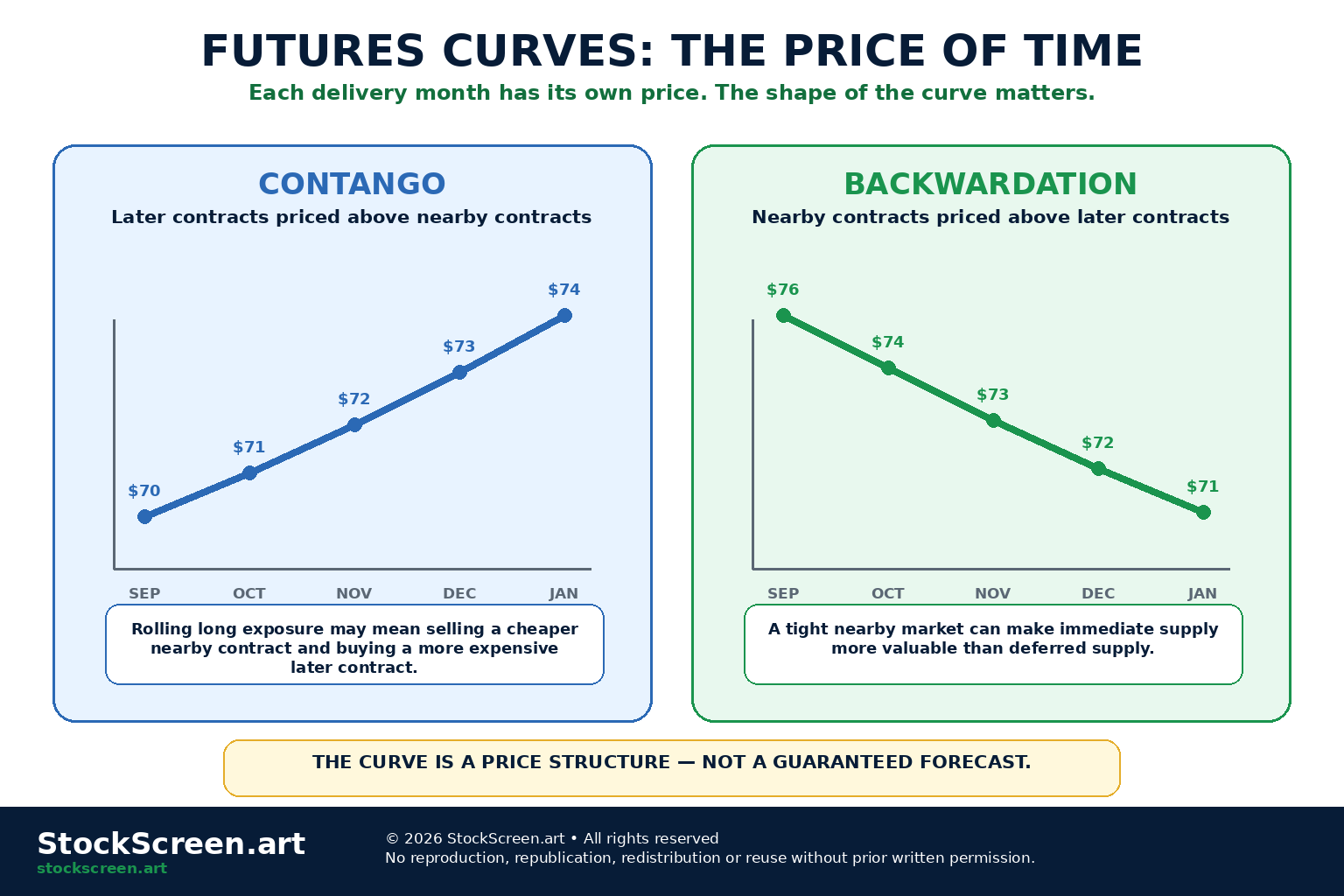
Contango generally describes a market in which later-delivery futures prices are higher than nearby prices.
A simple fictional curve might look like:
| Delivery | Futures Price |
|---|---|
| September | $70 |
| October | $71 |
| November | $72 |
| December | $73 |
Storage, financing, insurance and expectations about future availability can contribute to this shape in storable commodities.
25. Backwardation
Backwardation describes the opposite shape: nearby prices are higher than later-delivery prices.
| Delivery | Futures Price |
|---|---|
| September | $76 |
| October | $74 |
| November | $72 |
| December | $71 |
Backwardation can be associated with strong demand for immediate supply or limited nearby availability.
But do not reduce every backwardated curve to one universal cause.
26. The curve is not a simple prediction chart
A December futures price above a September futures price does not necessarily mean:
“The market predicts spot prices will definitely rise by December.”
Futures prices can reflect:
- storage economics;
- financing costs;
- convenience of holding physical inventory;
- expected supply and demand;
- hedging pressure;
- risk premia.
The curve is a market price structure.
It is not a weather forecast wearing a tie.
27. Futures converge toward the cash market near expiration
As a deliverable futures contract approaches expiration, the futures price and relevant cash-market price are linked by the delivery mechanism.
If they became wildly disconnected at expiration, arbitrage and delivery economics would create strong incentives to close the gap.
This convergence is central to the relationship between futures and the physical market.
28. Rolling a futures position
A futures contract expires.
An investor who wants continuous exposure may close an expiring contract and open a later-dated contract.
This is called rolling.
The price difference between contracts matters.
29. Why Commodity Futures Returns Can Differ From Spot Prices
Suppose the nearby contract is $70 and the next contract is $73.
If a long position is rolled from the lower-priced contract into the higher-priced contract, the investor changes the price level of the contract being held.
Over repeated rolls, this can materially affect performance.
The reverse structure can work differently.
30. Contract size turns small price moves into real dollars
Futures contracts represent defined quantities.
Benchmark contracts can be large.
For example, major exchange contracts exist for quantities measured in:
- hundreds or thousands of barrels of crude oil;
- troy ounces of gold;
- thousands of bushels of wheat.
A tiny quoted price move can therefore create a meaningful dollar gain or loss at the contract level.
Contract specifications must be read before position size is considered.
31. Margin is not the same thing as the value of the commodity
Futures positions are generally entered with margin rather than by paying the full notional value of the underlying commodity.
That creates leverage.
A trader might control a contract representing far more economic value than the cash initially posted as margin.
This is useful for hedging.
It can also turn modest market moves into large account moves.
We return to that subject in Leverage and Position Sizing.
32. Daily settlement matters
Futures accounts are marked to market.
Gains and losses are credited or debited as prices move.
A thesis can therefore face cash-flow pressure before its final horizon arrives.
Being “right eventually” does not solve a margin problem today.
33. Expiration is operational, not decorative
Every futures contract has an expiration cycle.
Depending on the contract, settlement may be physical or financial.
Traders need to know:
- last trading dates;
- delivery or settlement procedures;
- broker rules;
- when a position should be rolled or closed.
Nobody wants to learn contract logistics because a calendar notification failed.
34. A commodity research calendar
Commodity traders often watch recurring information that would look strange on a stock analyst's desk.
Depending on the market, that can include:
- inventory reports;
- crop-condition reports;
- planting and harvest progress;
- weather forecasts;
- export data;
- production announcements;
- central-bank decisions;
- shipping disruptions;
- contract expiration dates.
35. Why a stock-style valuation model does not transfer cleanly
A stock can be analyzed with:
- revenue;
- earnings;
- cash flow;
- margins;
- return on capital;
- valuation multiples;
- discounted cash flow.
A barrel of oil has no earnings-per-share forecast.
Commodity valuation relies more heavily on:
- supply-demand balance;
- cost curves;
- inventories;
- replacement economics;
- storage and transportation;
- futures-curve structure;
- macroeconomic conditions.
36. Technical analysis still has a role
Commodity charts can still show:
- trend;
- momentum;
- support and resistance;
- volatility;
- breakouts;
- relative strength.
But the chart should be connected to the physical story.
A wheat breakout during a major crop-weather scare is not the same informational event as a software stock breaking resistance after an earnings beat.
37. Commodity correlations can change
Investors often repeat relationships such as:
- gold rises when the dollar falls;
- oil rises when inflation rises;
- agriculture rises during bad weather.
These can be useful hypotheses.
They are not permanent laws.
Multiple forces can push a commodity in opposite directions at the same time.
38. The physical market usually wins the argument eventually
Sentiment, positioning and macro narratives can dominate for periods of time.
But commodity contracts remain tied to actual goods, contract terms and delivery economics.
Supply has to exist somewhere.
Demand has to consume or store it somewhere.
Transportation has to connect the two.
That physical constraint is what makes commodities both fascinating and occasionally rude.
39. A Practical Commodity Trading and Analysis Checklist
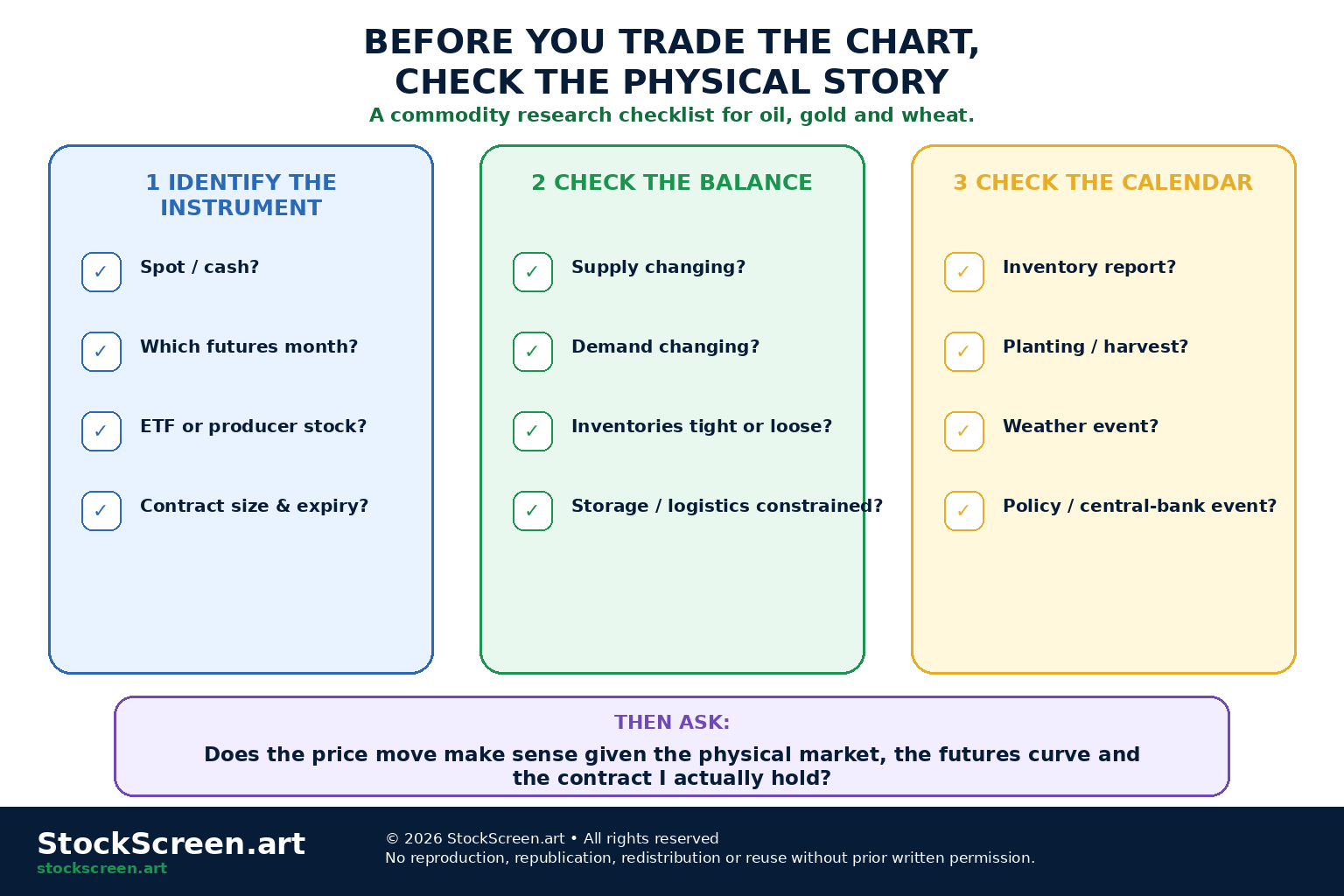
Before interpreting a commodity move, ask:
- What exactly is the instrument? Spot, futures, ETF, producer stock or something else?
- Which commodity and grade?
- Which delivery month?
- What is happening to supply?
- What is happening to demand?
- Are inventories tight, normal or abundant?
- Is seasonality relevant?
- Are weather, geopolitics or logistics creating unusual risk?
- What shape is the futures curve?
- What are the contract size, margin and expiration risks?
40. Nine mental models worth keeping
- Stocks are businesses; commodities are physical markets.
- Oil, gold and wheat have different economic engines.
- Spot and futures are related but different.
- Inventories connect today's supply with today's demand.
- Seasonality matters when production follows a calendar.
- Physical constraints can make small surprises matter a lot.
- The futures curve is a price structure across time.
- Rolling contracts can change investment returns.
- Always know the contract before admiring the chart.
Commodity Trading Questions
What are the basics of commodity trading?
Start by identifying the physical commodity, the instrument being traded and the forces affecting supply and demand. For futures, also understand the contract month, contract size, tick value, margin, expiration, settlement method and futures-curve structure before evaluating the trade.
How is commodity trading different from stock trading?
A stock represents ownership in a business that can generate earnings and cash flow. A commodity is a physical good whose price depends more directly on supply, demand, inventories, production, logistics and macroeconomic conditions. Commodity futures also add expiration, leverage and contract-specific mechanics.
What is the difference between spot commodities and commodity futures?
A spot or cash price relates to the current physical market. A futures price belongs to a standardized contract for a specified delivery month. The two are connected, but they can differ because of storage, financing, availability, expectations and other market forces.
Why do oil, gold and wheat trade differently?
Their economic drivers are different. Oil is heavily influenced by energy supply, demand, inventories and geopolitics; gold is also shaped by monetary conditions, real yields, currencies and investment demand; wheat follows biological production cycles, weather, inventories, exports and seasonal crop conditions.
Quick knowledge check
Ten questions. No wheat futures delivery truck will be dispatched based on your score.
1. What is the biggest economic difference between a stock and a commodity?
A stock is an ownership claim on a business that can generate cash flow. A commodity is a physical good whose price is driven by supply, demand, inventories, logistics, expectations and other market-specific forces.
2. Are a spot commodity price and a futures price the same thing?
No. A spot or cash price refers to the current physical market, while a futures price belongs to a standardized contract for a specific delivery month.
3. Why are crude-oil inventories important?
They help balance differences between current supply and demand and can signal how tight or loose the physical market is.
4. Why does gold behave differently from oil?
Gold is durable and large above-ground stocks exist. Investment demand, monetary expectations, interest rates, currencies and uncertainty can therefore matter alongside mine supply and physical demand.
5. Why is weather especially important for wheat?
Weather can directly affect planting, crop development, yield, quality, harvest and transportation.
6. What is contango?
A futures-curve structure in which later-delivery contracts are priced above nearby contracts.
7. What is backwardation?
A futures-curve structure in which nearby contracts are priced above later-delivery contracts.
8. Why can a futures-based investment perform differently from a spot-price chart?
Futures expire and must often be rolled. Differences between expiring and later-dated contract prices can materially affect returns.
9. Why does contract size matter?
A futures contract represents a defined physical quantity, so even a small quoted price change can translate into a significant dollar gain or loss.
10. What should you identify before analyzing a commodity chart?
The exact instrument, commodity, contract month and underlying physical-market context.
Where we go next
Commodities taught us that price can be anchored to barrels, ounces and bushels.
Next we move to a market where the “asset” is always quoted against another asset: Forex and Currency Pairs.
FND-DER-04 — Forex and Currency Pairs.
Because saying “the dollar went up” is incomplete until someone asks:
“Against what?”
Primary sources & further reading
- U.S. Commodity Futures Trading Commission — Futures Glossary
- U.S. Energy Information Administration — What Drives Crude Oil Prices: Balance
- U.S. Energy Information Administration — Oil Prices and Outlook
- USDA Economic Research Service — Wheat Data Documentation
- CME Group — What Is Contango and Backwardation?
- CME Group — WTI Crude Oil Futures Contract Specifications
- CME Group — Gold Futures Contract Specifications
- CME Group — Chicago SRW Wheat Futures Contract Specifications