Someone says:
“The dollar is up.”
The correct response is:
“Against what?”
That one question is the doorway into foreign exchange.
Stocks usually ask:
“How much is one share worth in dollars?”
Forex asks:
“How much of Currency B does it take to buy one unit of Currency A?”
That is why currencies trade in pairs.
1. What is foreign exchange?
Foreign exchange, or FX/forex, is the market in which currencies are exchanged.
Businesses use it to:
- pay overseas suppliers;
- receive foreign revenue;
- hedge currency exposure;
- move capital between countries.
Banks and institutional investors use FX for:
- market making;
- hedging;
- portfolio management;
- funding;
- speculation.
Retail traders may also access currency markets through regulated brokers, dealers, futures exchanges or other products.
2. FX is enormous and mostly over-the-counter
The foreign-exchange market is global and largely decentralized.
Unlike a single stock exchange with one central order book, much FX trading occurs over-the-counter through dealer networks and electronic venues.
The Bank for International Settlements reported average OTC FX turnover of about $9.6 trillion per day in April 2025 across spot transactions and FX derivatives.
That enormous number does not mean every currency pair is equally liquid.
Liquidity varies by:
- currency;
- time of day;
- market conditions;
- trading venue;
- position size.
3. Why currencies come in pairs
If you buy euros with U.S. dollars, you are simultaneously:
- buying euros;
- selling dollars.
The transaction cannot be described with only one currency.
Therefore:
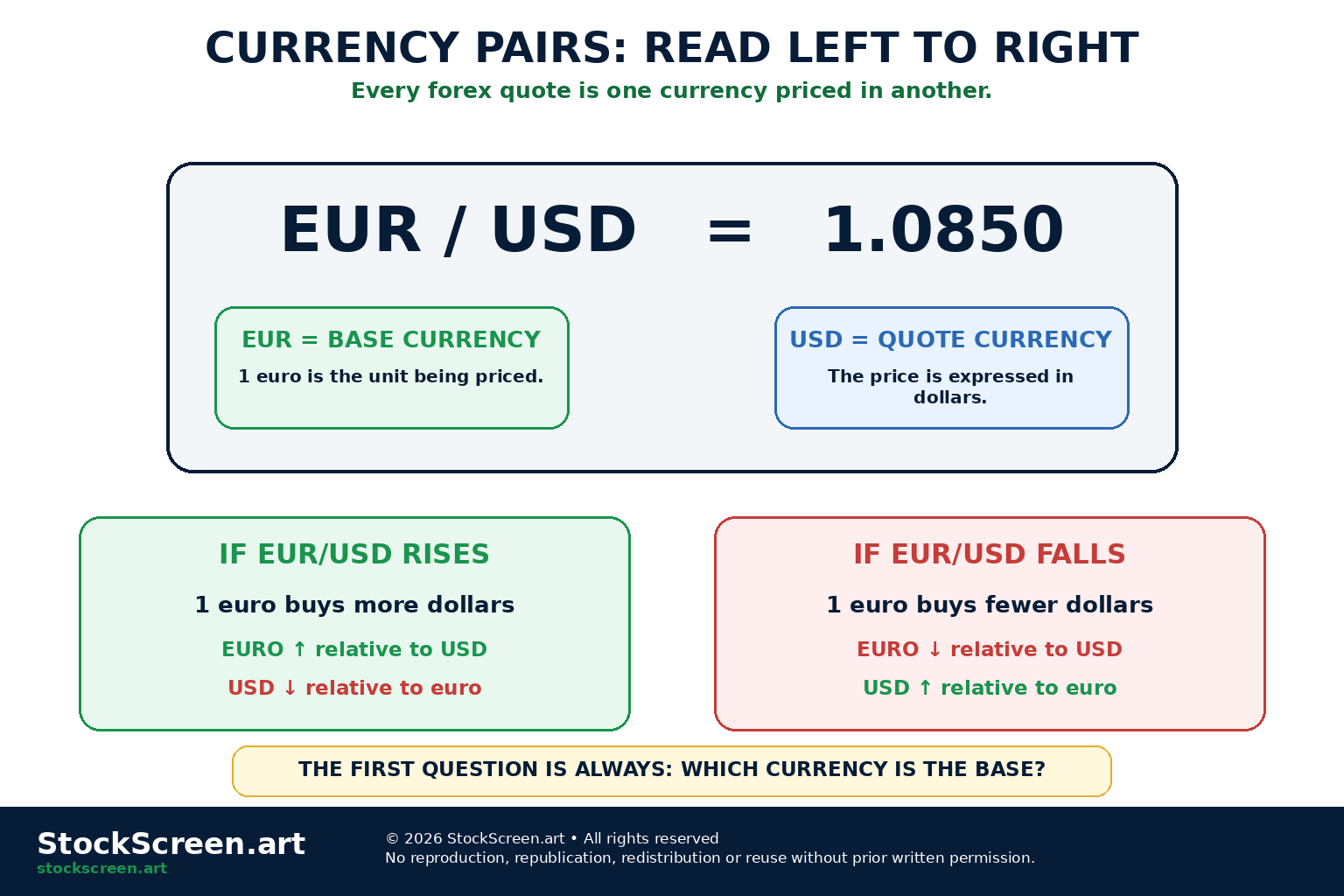
EUR/USD
is not “the price of the euro.”
It is the price of the euro in U.S. dollars.
4. Base currency
The first currency in a pair is the base currency.
In:
EUR/USD
EUR is the base currency.
The quote answers:
“How many U.S. dollars buy one euro?”
5. Quote currency
The second currency is the quote currency, sometimes called the counter currency.
In EUR/USD:
- EUR = base;
- USD = quote.
If EUR/USD = 1.0850, then one euro is worth approximately 1.0850 U.S. dollars.
6. What a rising EUR/USD quote means
Suppose EUR/USD rises from:
1.0850 → 1.1000
One euro now buys more dollars.
Therefore:
- the euro strengthened relative to the dollar;
- the dollar weakened relative to the euro.
Both statements describe the same move.
7. What a falling EUR/USD quote means
Suppose EUR/USD falls from:
1.0850 → 1.0600
One euro now buys fewer dollars.
Therefore:
- the euro weakened relative to the dollar;
- the dollar strengthened relative to the euro.
8. The pair prevents lazy thinking
Saying:
“I am bullish on the euro.”
is incomplete.
Bullish against what?
A currency can strengthen against one currency while weakening against another.
Relative value is the whole game.
9. Direct and indirect quotes depend on perspective
Exchange-rate conventions can look different depending on the domestic currency and market convention being used.
For a beginner, the safest habit is:
Do not rely on memory phrases such as “dollars per euro” until you have identified which currency is first.
10. Major pairs
The most actively traded currency pairs generally involve the U.S. dollar and another heavily traded currency.
Common examples include:
- EUR/USD;
- USD/JPY;
- GBP/USD;
- USD/CHF;
- AUD/USD;
- USD/CAD.
These are examples, not recommendations.
Trading volume and liquidity can change over time.
11. Cross-currency pairs
A cross is a currency pair that does not include the U.S. dollar.
Examples include:
- EUR/GBP;
- EUR/JPY;
- GBP/JPY.
The same base/quote logic still applies.
12. “Exotic” pairs
The term exotic pair is often used for a major currency paired with a less heavily traded or emerging-market currency.
These markets may have:
- wider spreads;
- lower liquidity;
- greater gap risk;
- capital controls or market-access complications;
- larger sensitivity to political events.
“Exotic” is not a synonym for “more exciting and therefore better.”
13. A currency pair compares two economies
Stock analysis often starts with one company.
Currency analysis compares two monetary and economic systems.
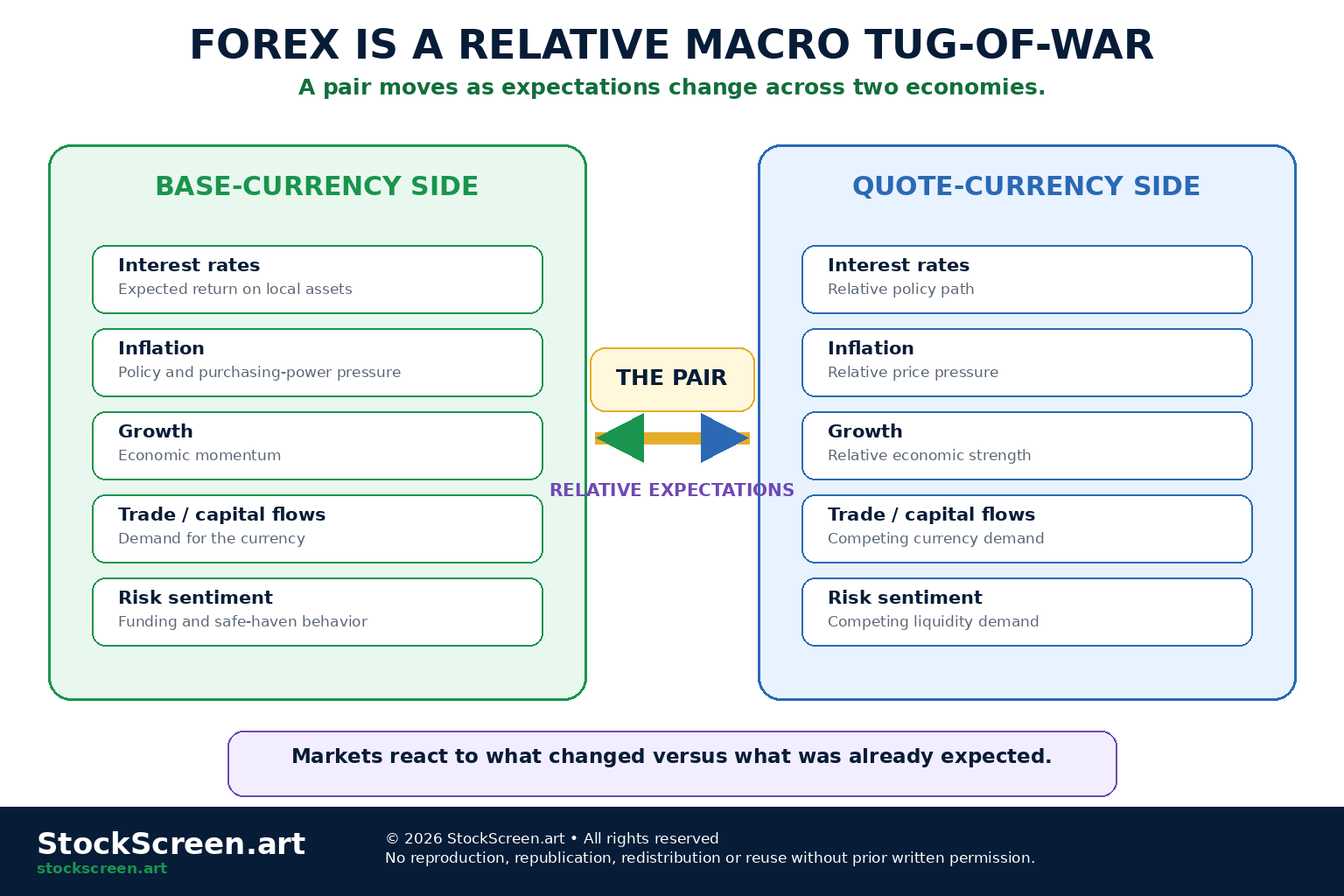
For EUR/USD, you may care about:
- euro-area growth versus U.S. growth;
- European Central Bank policy versus Federal Reserve policy;
- relative inflation;
- relative bond yields;
- trade and capital flows;
- risk sentiment.
14. Interest-rate expectations matter
Currencies are connected to financial assets denominated in those currencies.
If market participants expect interest rates in one economy to rise relative to another, that can change the relative attractiveness of holding assets in those currencies.
The word relative matters.
A central bank can raise rates and its currency can still fall if the market expected an even larger increase.
15. Markets trade expectations, not press-release headlines
Suppose a central bank raises its policy rate.
Beginner conclusion:
“Rates up. Currency up.”
Market conclusion:
“Was the move expected? What did policymakers signal next? How does this compare with the other central bank?”
The second version is less catchy.
It is also more useful.
16. Central banks matter—but they are not joystick operators
Central banks influence:
- short-term interest rates;
- liquidity conditions;
- market expectations;
- financial conditions.
Those channels can affect exchange rates.
But major floating exchange rates are determined in markets.
A central bank does not normally type:
EUR/USD = 1.0837
into a control panel before lunch.
17. Inflation matters through several channels
Inflation can affect currencies through:
- central-bank policy expectations;
- real interest rates;
- purchasing power;
- trade competitiveness;
- investor confidence.
Again, the effect is comparative.
High inflation in both economies may create a different market response than high inflation in only one.
18. Economic growth matters
Strong growth can attract investment and support expectations for tighter monetary policy.
But strong growth can also:
- widen imports;
- increase inflation pressure;
- change government borrowing;
- alter market positioning.
There is rarely one-variable causality in FX.
19. Trade flows matter
International trade creates demand to exchange currencies.
Importers and exporters may need to buy or sell foreign currencies to settle transactions.
Persistent trade imbalances can therefore be part of the long-run currency story.
But capital flows can be much larger and faster than trade flows.
20. Capital flows matter
Investors constantly allocate capital across countries.
They buy:
- bonds;
- stocks;
- real estate;
- businesses;
- bank deposits;
- other financial assets.
Those transactions can create currency demand and supply.
21. Risk sentiment can rearrange the board
During periods of market stress, investors may shift toward assets they view as more liquid, defensive or safe.
Currency reactions depend on:
- funding structures;
- liquidity demand;
- interest-rate expectations;
- country exposure;
- positioning.
“Risk-off” is a useful description.
It is not a complete model.
22. Political and fiscal expectations can matter
Currency markets also watch:
- elections;
- fiscal policy;
- government debt;
- trade policy;
- capital controls;
- geopolitical risk.
These issues can influence both expected growth and expected returns on local assets.
23. The bid and ask still exist
Forex quotes have two sides:
- bid;
- ask.
The spread is part of the trading cost.
Tight spreads are usually associated with more liquid conditions.
Spreads can widen sharply around:
- major economic releases;
- central-bank announcements;
- market stress;
- thin trading hours.
24. What is a pip?
A pip is a conventional small unit used to describe exchange-rate movement.
For many currency pairs, one pip is:
0.0001
So a move in EUR/USD from:
1.0850 → 1.0851
is one pip.
For many yen pairs, one pip is commonly:
0.01
25. Pipettes and extra decimal places
Many trading platforms quote fractions of a pip.
For EUR/USD you might see:
1.08503
The extra decimal allows more precise pricing.
Do not confuse the final decimal with a full pip.
26. Pip value depends on position size
A one-pip move does not have one universal dollar value.
It depends on:
- the currency pair;
- position size;
- account currency;
- current exchange rates.
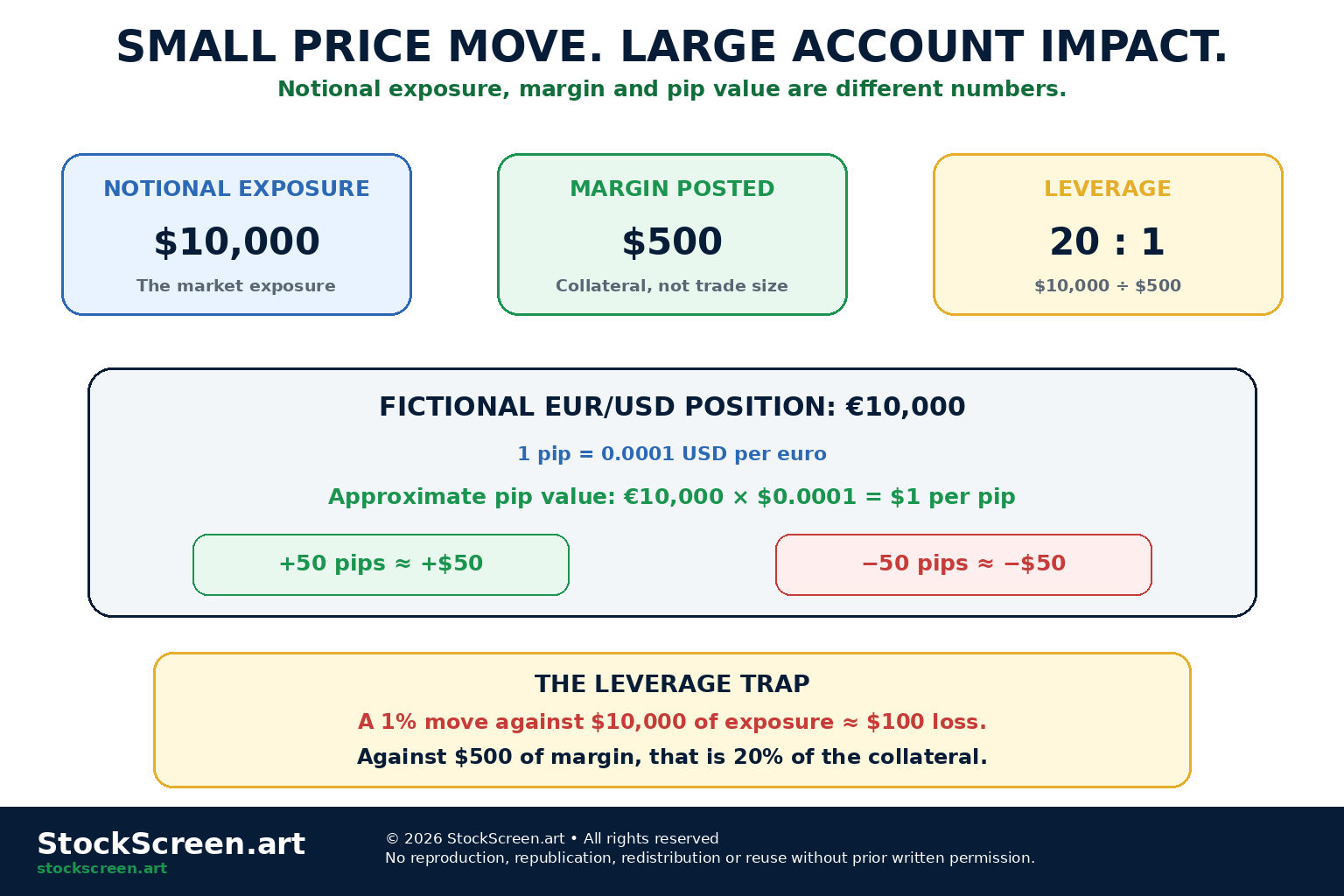
Simple fictional example:
- EUR/USD position size = €10,000;
- one pip = 0.0001 USD per euro;
Approximate pip value:
€10,000 × $0.0001 = $1 per pip
A 50-pip move would therefore be approximately $50 before transaction costs in this simplified example.
27. Lots are position-size conventions
Retail platforms often describe forex position sizes using terms such as:
- standard lot;
- mini lot;
- micro lot.
Exact platform conventions should be verified before trading.
The important lesson is not the nickname.
It is the underlying notional currency amount.
28. Notional exposure is the real economic size
Suppose you control:
€10,000 of EUR/USD exposure
That €10,000 is the position's base-currency notional.
If the broker requires only a fraction of that amount as margin, the economic exposure is still €10,000.
29. Margin is not a discount
Imagine a fictional $10,000 equivalent forex position opened with $500 of margin.
The leverage ratio is:
$10,000 ÷ $500 = 20:1
You did not purchase $10,000 of exposure for $500.
You posted $500 of collateral to support a $10,000 position.
Those are very different statements.
30. Leverage magnifies small currency moves
Currency pairs often move by relatively small percentages compared with individual stocks.
Leverage can make those small changes financially significant.
Suppose a $10,000 notional position moves 1% against you.
Simplified market loss:
$100
Relative to $500 of posted margin, that is already 20%.
The currency barely moved.
The account felt it immediately.
31. Losses are measured against exposure, not optimism
Traders sometimes think:
“I only put $500 into the trade.”
The market thinks:
“You control $10,000 of exposure.”
The market wins this argument.
32. Retail OTC forex has counterparty structure
In retail off-exchange forex, a customer may trade against a dealer rather than on a centralized exchange order book.
That creates considerations involving:
- dealer registration;
- pricing;
- execution;
- withdrawals;
- counterparty credit;
- regulatory protections.
The CFTC repeatedly warns retail customers to verify registration and understand the dealer relationship before depositing funds.
33. Fraud risk deserves its own paragraph
Retail forex has attracted fraudulent operators because:
- leverage sounds exciting;
- the market is global;
- online platforms can look professional;
- returns can be fabricated on a screen;
- withdrawal problems may appear only after money is deposited.
A polished website is not regulatory due diligence.
34. Rollover and financing
Currency positions held beyond a trading day may involve financing adjustments often called:
- rollover;
- swap;
- financing;
- tom-next adjustment.
The exact calculation depends on the product and provider.
These adjustments reflect the interest-rate relationship between the two currencies plus dealer or broker terms.
35. Carry is not free yield
Traders may describe a position that earns positive financing as a carry trade.
But a favorable interest-rate differential does not remove exchange-rate risk.
A currency move can overwhelm months of financing income very quickly.
Yield does not cancel price risk.
36. Spot forex, forwards and futures are different instruments
Currency exposure can be created through several structures.
Spot / retail OTC
Exposure tied to current exchange rates, often with rolling settlement conventions through a dealer.
Forwards
Agreements to exchange currencies at a future date using a rate agreed today.
Currency futures
Standardized exchange-traded futures contracts with defined contract terms.
Same currency theme.
Different legal and operational structure.
37. The trading day is global, not literally continuous
FX activity follows the business day across major financial centres.
Liquidity and spreads vary as:
- Asia opens;
- Europe becomes active;
- North America joins;
- sessions overlap;
- markets approach weekends or holidays.
Saying “forex trades 24 hours” is shorthand.
Market depth at 3:00 a.m. is not automatically identical to market depth during a major London-New York overlap.
38. Economic releases can create sudden repricing
Currency markets react to information such as:
- inflation;
- employment;
- GDP;
- retail sales;
- central-bank decisions;
- policy speeches.
The important variable is often:
Actual result − market expectation
not simply whether the number looked “good” or “bad.”
39. Technical analysis still matters—but the macro story matters too
Currency charts can show:
- trend;
- momentum;
- support and resistance;
- breakouts;
- volatility;
- relative strength.
But the price is still a relative macroeconomic relationship.
A technical setup can be disrupted instantly by a policy surprise.
40. A practical forex-analysis workflow
Before interpreting or trading a currency pair, ask:
- What is the exact pair?
- Which currency is the base and which is the quote?
- What does a rising quote mean?
- What is the relative interest-rate outlook?
- What is happening to inflation and growth in both economies?
- Are major central-bank decisions approaching?
- Are trade, fiscal or political risks changing?
- What is the spread and liquidity?
- What is the notional exposure and pip value?
- What leverage, margin and financing risks exist?
41. Nine mental models worth keeping
- Every currency price is relative.
- Base first. Quote second.
- A rising pair strengthens the base relative to the quote.
- Forex compares two economies and two policy paths.
- Markets trade expectations, not headlines.
- Pips describe price movement; position size turns pips into money.
- Notional exposure is larger than margin when leverage is used.
- Carry income does not eliminate currency risk.
- Know the dealer, product and regulatory structure before funding an account.
Quick knowledge check
Ten questions. No central bank meeting required.
1. In EUR/USD, which currency is the base currency?
EUR, the euro.
2. If EUR/USD rises, what happened?
The euro strengthened relative to the U.S. dollar, which is equivalent to saying the dollar weakened relative to the euro.
3. Can the U.S. dollar strengthen against one currency and weaken against another at the same time?
Yes. Currency performance is relative to the specific comparison currency.
4. Why do interest-rate expectations matter to currencies?
They affect the relative expected returns and financial conditions associated with assets denominated in the two currencies.
5. For many non-yen currency pairs, how large is one pip?
Typically 0.0001 of the quoted exchange rate.
6. Does one pip always equal the same dollar amount?
No. Pip value depends on the pair, position size, account currency and exchange rate.
7. What is the difference between notional exposure and margin?
Notional exposure is the economic size of the position. Margin is the collateral posted to support that exposure.
8. Why is leverage dangerous in forex?
It allows a relatively small amount of collateral to control a much larger position, magnifying both gains and losses.
9. What is rollover or financing?
An adjustment associated with holding certain currency positions over time, reflecting interest-rate differences and provider-specific terms.
10. What is the first question after someone says “the dollar is rising”?
“Against what?” A currency move is always relative to another currency or a defined basket.
Where we go next
Forex made leverage impossible to ignore.
A small cash deposit can control a much larger currency position.
So the next lesson goes directly at the issue:
FND-DER-05 — Leverage and Position Sizing.
Because the important number is not merely:
“How much cash did I put down?”
It is:
“How much market exposure did I create, and how much can that exposure move my account?”
Primary sources & further reading
- Investor.gov — Foreign Currency Exchange (Forex)
- CFTC — Eight Things You Should Know Before Trading Forex
- CFTC — Foreign Currency Trading
- National Futures Association — Registration and Investor Resources
- Bank for International Settlements — Triennial Central Bank Survey
- BIS — OTC Foreign Exchange Turnover in April 2025
- Federal Reserve — How the Foreign Exchange Value of the Dollar Is Determined