There is a peculiar day in financial markets when millions of otherwise independent adults stop what they are doing and stare at a few words from a committee in Washington.
The words may include:
“The Committee decided to maintain the target range...”
Television anchors begin speaking faster.
Bond yields move.
Stocks jump, fall, jump again, then spend the next hour arguing about whether one adjective sounded slightly more concerned than last time.
Welcome to interest rates, inflation and market expectations.
1. Interest is the price of money over time
If somebody lends you money today and waits to be repaid later, they usually want compensation.
That compensation is interest.
Interest can reflect several things:
- the time the lender gives up use of the money;
- the risk that the borrower will not repay;
- expected inflation;
- market supply and demand for credit;
- the length of time until repayment;
- broader monetary and economic conditions.
This is why there is no single universal number called:
“The Interest Rate.”
There are many rates:
- overnight interbank rates;
- Treasury yields;
- mortgage rates;
- corporate bond yields;
- credit-card rates;
- business-loan rates;
- deposit rates.
They are connected, but they are not identical.
2. What rate does the Federal Reserve actually control?
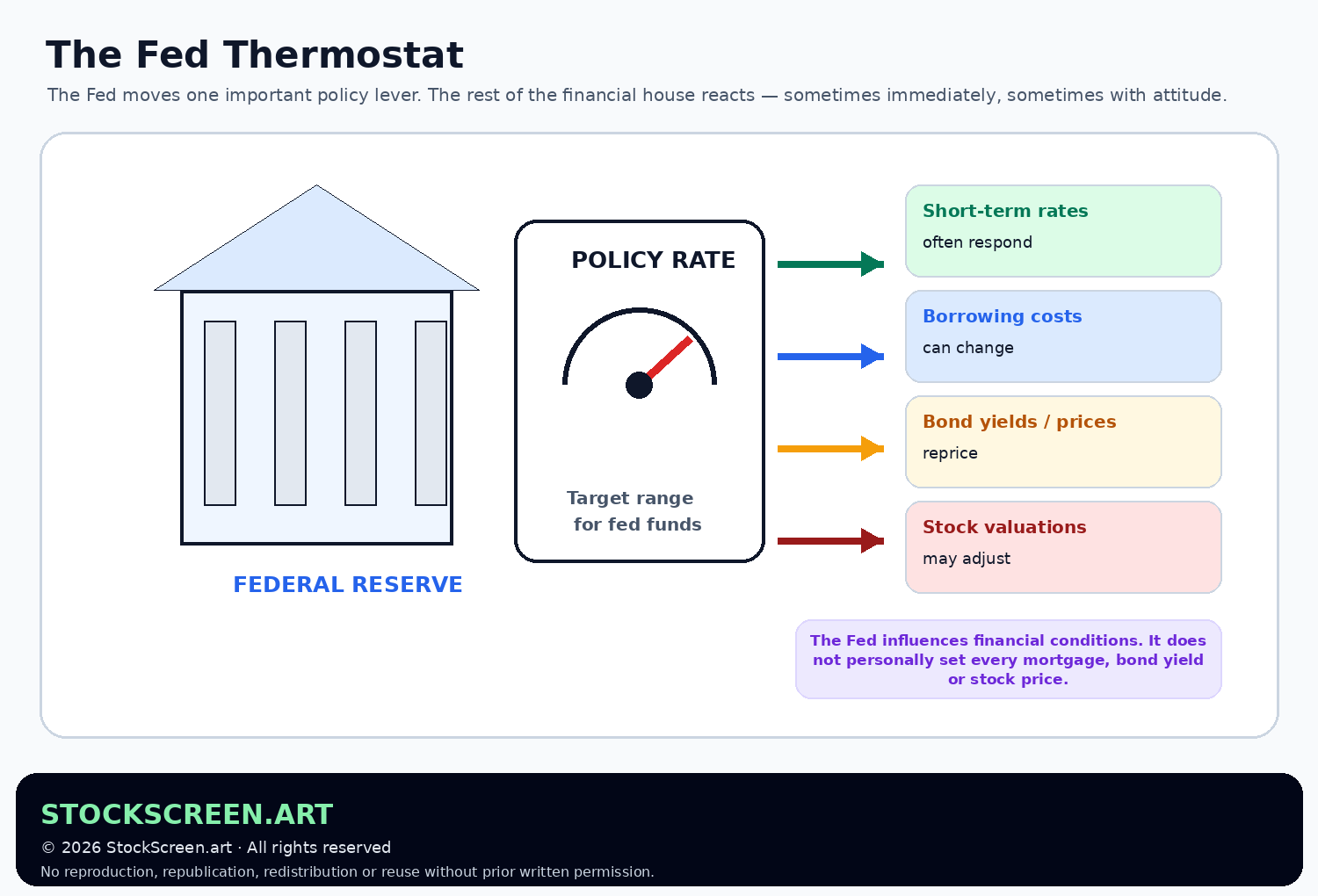
The Federal Reserve explains that its primary means of changing the stance of monetary policy is adjusting the target range for the federal funds rate.
The federal funds rate is an overnight rate associated with borrowing between banks.
The Federal Open Market Committee — the FOMC — sets a target range for that rate.
That is very different from saying:
“The Fed sets every interest rate in America.”
It does not.
Instead, changes in the policy rate influence short-term market rates and broader financial conditions, which then affect borrowing, spending, investment and eventually economic activity and inflation.
The transmission is powerful.
It is also not a single giant light switch.
3. Why raise interest rates?
The Federal Reserve has a dual mandate centered on maximum employment and stable prices.
When inflation is too high or the economy is running too hot, tighter monetary policy can help cool demand by making borrowing more expensive and financial conditions less easy.
Higher rates can influence:
- mortgage affordability;
- car loans;
- business borrowing;
- corporate investment;
- consumer spending;
- asset valuations.
The idea is not:
“People seem cheerful. Raise rates.”
It is to influence demand and financial conditions in pursuit of the Fed's policy objectives.
4. Why lower interest rates?
When economic activity weakens materially or inflation is too low, easier monetary policy can reduce borrowing costs and loosen financial conditions.
Lower rates can make some borrowing and investment more attractive.
But again, this is not mechanical.
A lower federal funds target does not guarantee:
- every mortgage rate falls by exactly the same amount;
- every company borrows more;
- every consumer spends more;
- stocks automatically rise;
- your uncle stops explaining monetary policy at dinner.
5. Inflation: when the same dollar buys less
The U.S. Bureau of Labor Statistics describes inflation as a broad upward movement in the prices of goods and services.
One widely followed measure is the Consumer Price Index, or CPI.
BLS describes CPI as measuring the average change over time in prices paid by consumers for a representative basket of goods and services.
Suppose something costs $100 today.
If its price rises to $105 a year later, that particular price rose 5%.
Inflation measures broader price behavior across many goods and services rather than one product.
6. Why inflation matters to investors
Imagine your investment earns 4%.
You feel reasonably pleased.
Then imagine the prices of the things you buy rise around 5%.
Your account balance is larger.
Your purchasing power may not be.
Investor.gov defines real return as the return on an investment after accounting for inflation and taxes.
A simplified before-tax intuition is:
Real return ≈ nominal return − inflation
So a 6% nominal return with 3% inflation is roughly a 3% real return before considering taxes and compounding details.
Real return asks what those dollars can actually buy.
7. Interest rates and bonds: the seesaw
Fixed-rate bonds give us one of the cleanest relationships in finance.
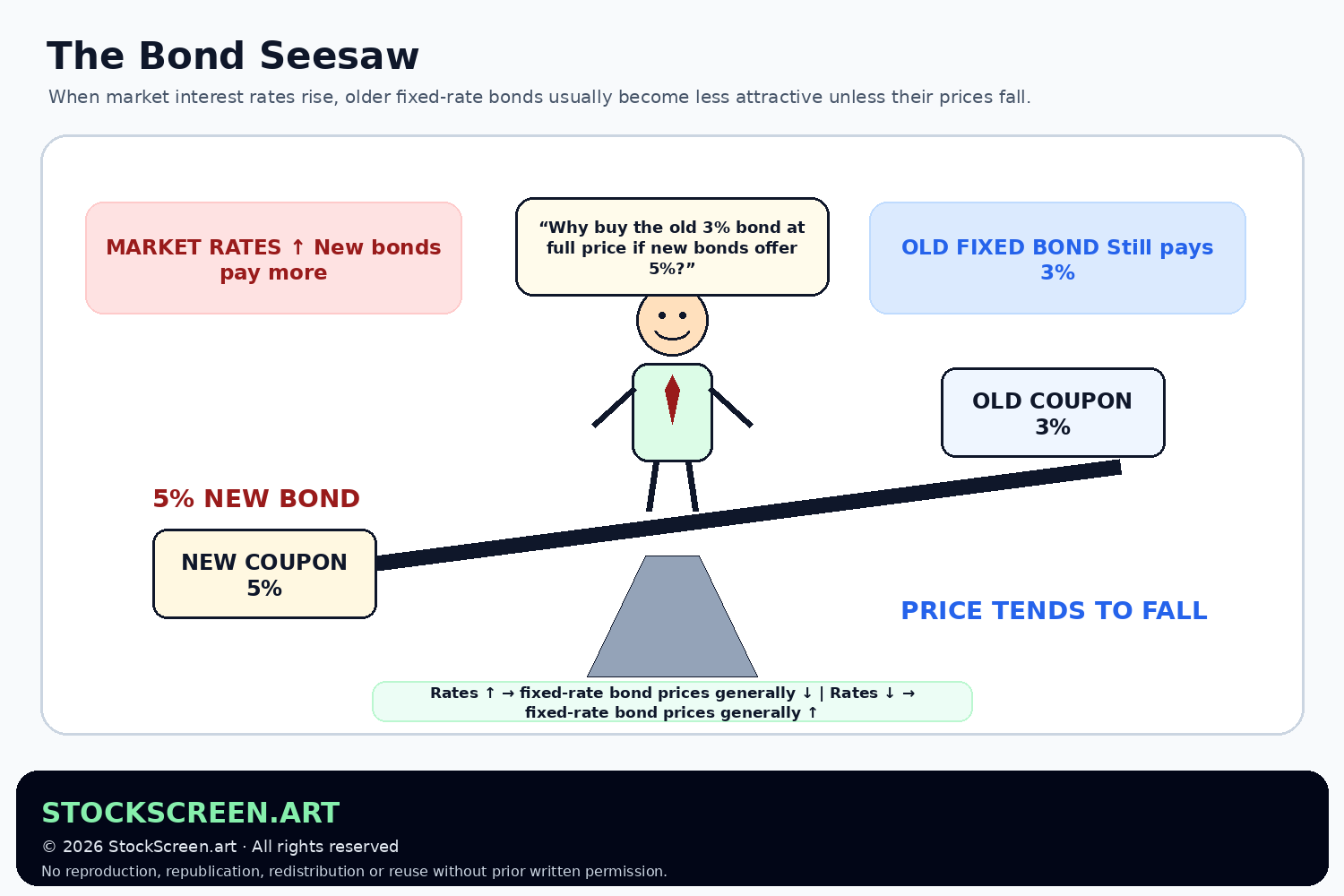
Investor.gov explains that market interest rates and fixed-rate bond prices generally move in opposite directions.
Suppose you own an older bond paying 3%.
Then newly issued comparable bonds begin paying 5%.
Which would a new investor prefer at the same price?
Usually the 5% bond.
To make your older 3% bond competitive in the secondary market, its price generally has to fall enough that the return available to a new buyer becomes more attractive.
Reverse the situation:
if new comparable bonds pay only 2%, your old 3% coupon looks much more appealing, and its market price may rise.
8. Why longer-term bonds often react more
A bond whose fixed payments stretch far into the future is generally more sensitive to changes in market interest rates than a similar bond that matures soon.
Why?
Because investors are locked into the old coupon relationship for longer.
The formal concept that captures much of this sensitivity is duration.
We do not need to calculate duration in this Foundation lesson.
Remember the intuition:
9. Why interest rates affect stocks too
Stocks do not have fixed coupons like ordinary bonds.
Yet interest rates still matter enormously.
There are several channels.
Borrowing costs
Companies borrow money.
Higher rates can make new debt more expensive and can increase interest expense as financing is renewed or repriced.
More interest expense can mean less profit available to shareholders.
Consumer demand
Higher borrowing costs can reduce spending on homes, cars and other financed purchases.
That can affect company revenues.
Alternative returns
When safer fixed-income investments offer higher yields, investors may demand more compensation before accepting equity risk.
Valuation
Perhaps most importantly, interest rates influence the rate investors use to value future cash flows.
10. The discount-rate idea without causing a spreadsheet emergency
Imagine somebody promises you $100:
- today;
- or ten years from now.
Those are not economically identical offers.
Money available today can be invested, spent or used to reduce debt.
Therefore future money is generally worth less in present-value terms.
The interest or discount rate helps translate future cash into today's value.
When discount rates rise, the present value of distant future cash flows generally falls.
That is one reason high-growth companies whose expected profits sit far in the future can be especially sensitive to changes in rates.
“All else equal” is doing heroic work in that sentence.
Company growth, profitability, margins, competitive position and investor sentiment are all moving too.
11. Why a healthy company can fall after a rate announcement
Imagine a company reports no bad news at all.
Its factories still work.
Customers still exist.
Nobody accidentally deleted accounting.
Yet the stock falls after investors conclude interest rates may stay higher for longer.
Possible reasons include:
- future earnings are being discounted at a higher rate;
- company borrowing may become more expensive;
- consumer demand may slow;
- fixed-income alternatives now offer more attractive yields;
- investors demand a lower stock price to compensate for greater uncertainty.
The business did not necessarily become worse overnight.
The price investors are willing to pay for its future may have changed.
12. Markets trade expectations
This is perhaps the most important concept in the lesson.
Financial markets are forward-looking.
Investors are constantly forming expectations about:
- future inflation;
- future interest rates;
- future economic growth;
- future earnings;
- future policy decisions.
Those expectations influence prices before the future arrives.
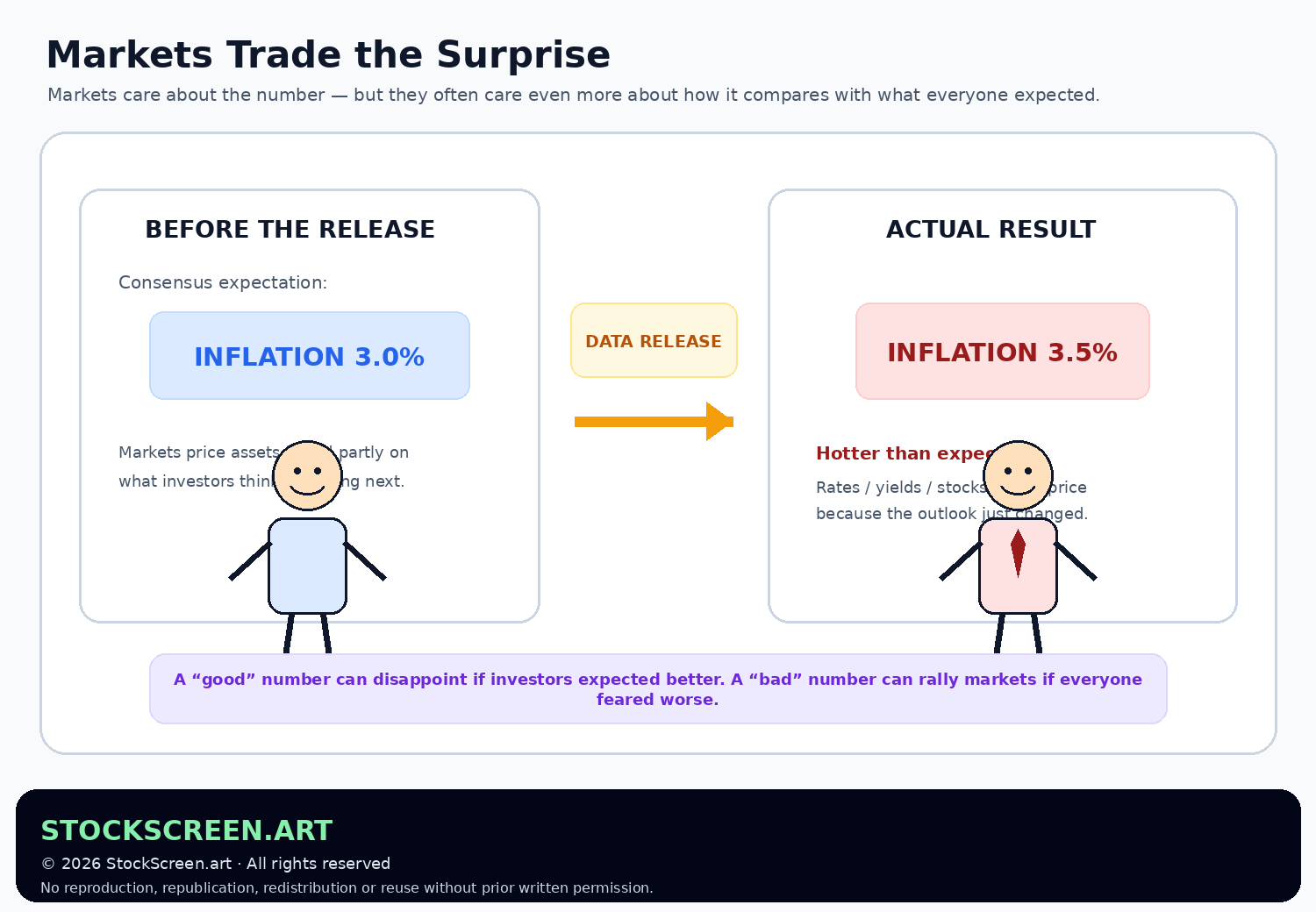
So when new data appears, the market asks two questions:
- What happened?
- How different was it from what we already expected?
13. A “good” number can make the market fall
Suppose analysts expect company earnings of $2.00 per share.
The company reports $2.05.
Earnings grew.
The number looks good.
But perhaps investors had quietly hoped for $2.20.
The stock can fall.
Similarly, suppose inflation is still high but comes in lower than feared.
Markets may rally because the surprise changes expectations for future policy.
14. Why markets sometimes move before the Fed does
Investors do not wait politely for the FOMC meeting before forming opinions.
Treasury yields and other market rates can move as incoming economic data changes expectations about future policy.
If inflation reports repeatedly come in hotter than expected, investors may begin expecting tighter policy or fewer future rate cuts.
Bond yields can respond before the Fed actually changes its target range.
This is why the sentence:
“The Fed hasn't changed rates, so interest rates haven't changed.”
is wrong.
Market interest rates are continuously repriced.
15. Inflation expectations can affect rates
Lenders care about what the money they receive in the future will be able to buy.
If investors expect higher inflation, they may demand higher yields to compensate for the expected loss of purchasing power.
This is one reason inflation expectations and bond yields are closely watched together.
It also explains why central-bank credibility matters: expectations about future inflation can influence current financial conditions.
16. Nominal rates and real rates
Just as returns can be nominal or real, interest rates can be thought about the same way.
A simplified relationship is:
Real interest rate ≈ nominal interest rate − expected inflation
If a bond yields 5% and expected inflation is 3%, the rough real yield is around 2%.
Again, this is a simplified approximation.
But it helps explain why a 5% yield can look generous in one inflation environment and rather ordinary in another.
17. Rates do not affect every company the same way
A rate change can produce very different effects across industries and companies.
Banks and financial companies
Interest rates affect borrowing, lending margins, credit demand, deposit costs and asset values. The net effect can be positive or negative depending on the company and rate environment.
Highly leveraged companies
Businesses carrying substantial debt may face greater pressure when borrowing costs rise.
High-growth companies
Companies valued heavily on profits expected far in the future can be more sensitive to higher discount rates.
Rate-sensitive consumers
Housing, autos and other financed purchases can respond strongly to borrowing costs.
Cash-rich businesses
Companies holding large amounts of cash may earn more interest income when short-term rates rise.
This is why:
“Rates went up, therefore stocks go down”
is far too crude.
Markets contain thousands of different balance sheets and business models.
18. Inflation can help some companies and hurt others
Inflation also affects companies unevenly.
A business with strong pricing power may be able to raise prices enough to protect margins.
Another company may see wages, transportation and input costs rise faster than it can raise prices.
Commodity producers may benefit from higher selling prices while commodity-consuming industries face higher costs.
A restaurant and an oil producer can experience the same inflation report very differently.
This is one reason broad economic headlines eventually have to be translated into company-level analysis.
19. Why this matters for StockScreen.art
StockScreen.art screens individual equities.
It does not attempt to predict every Federal Reserve decision or turn every CPI release into a macroeconomic prophecy.
But market context still matters.
Changes in rates and inflation can influence:
- sector leadership;
- market volatility;
- valuation multiples;
- momentum;
- relative strength;
- risk/reward;
- which companies actually respond well to the environment.
This is where screening becomes useful.
Rather than assuming:
“Oil is up, therefore every energy stock is attractive”
or:
“Rates are falling, therefore every growth stock is a buy,”
investors can look for the individual equities actually demonstrating trend, momentum, liquidity and relative strength.
20. Six mental models worth keeping
- Interest is the price of money over time.
- The Fed influences rates; it does not directly set every rate in the economy.
- Inflation reduces purchasing power, so nominal return and real return are different.
- Fixed-rate bond prices generally move opposite market interest rates.
- Higher discount rates can reduce what investors are willing to pay today for distant future cash flows.
- Markets trade expectations, so the surprise often matters more than the headline.
Quick knowledge check
Eight questions. No press conference follows.
1. Does the Federal Reserve directly set every interest rate in the economy?
No. The FOMC primarily sets a target range for the federal funds rate. That policy influences other interest rates and broader financial conditions, but market rates are set across many markets and institutions.
2. What does CPI broadly measure?
The average change over time in prices paid by consumers for a representative basket of goods and services.
3. What is the difference between nominal return and real return?
Nominal return is the stated investment return in dollars or percentage terms. Real return adjusts that result for inflation; Investor.gov's definition also accounts for taxes.
4. What generally happens to the price of an existing fixed-rate bond when market interest rates rise?
Its market price generally falls, because newly issued comparable bonds can offer more attractive yields.
5. Why can higher interest rates pressure stock valuations?
They can raise borrowing costs, create more attractive alternatives to stocks, slow economic demand and increase the discount rate applied to future corporate cash flows.
6. If inflation is reported at 3.5% but markets expected 4.0%, can markets respond positively even though inflation is still high?
Yes. Markets often respond to the difference between the actual result and expectations because that surprise changes the outlook for future policy and economic conditions.
7. Can Treasury yields move before the Federal Reserve changes its policy rate?
Yes. Market yields continuously incorporate expectations about future inflation, growth and monetary policy.
8. Does the same rate environment affect every company identically?
No. Debt levels, industry economics, pricing power, cash balances, customer financing needs and the timing of expected profits can all change a company's sensitivity to rates and inflation.
Module complete: where we go next
You have now finished the six lessons in the Markets & Investing Foundations module.
We started with what happens after you click Buy.
Then we covered:
- what stocks, bonds and ETFs actually represent;
- bids, asks, spreads and liquidity;
- market and limit orders;
- risk, return, volatility and compounding;
- and finally the rates, inflation and expectations that influence the entire system.
The next Foundation module moves from the market itself to the businesses trading inside it:
Understanding Companies & Valuation.
We begin with Revenue, Earnings and Cash Flow — three numbers that occasionally agree with one another just to keep investors suspicious.
Primary sources & further reading
- Federal Reserve — The Fed Explained: Monetary Policy
- Federal Reserve — Economy at a Glance: Policy Rate
- U.S. Bureau of Labor Statistics — Consumer Price Index FAQs
- U.S. Bureau of Labor Statistics — Inflation and Prices
- Investor.gov — When Interest Rates Go Up, Prices of Fixed-Rate Bonds Fall
- Investor.gov — Real Return