Companies have an impressive ability to make money sound complicated.
They have revenue.
Net revenue.
Gross profit.
Operating income.
Net income.
Adjusted earnings.
Operating cash flow.
Free cash flow.
And somewhere, presumably, an actual bank account.
Before we get anywhere near valuation multiples or discounted cash-flow models, we need to understand three basic questions:
Earnings: After recognized costs and expenses, what profit did accounting report?
Cash flow: What actually happened to the company's cash?
They are connected.
They are not the same thing.
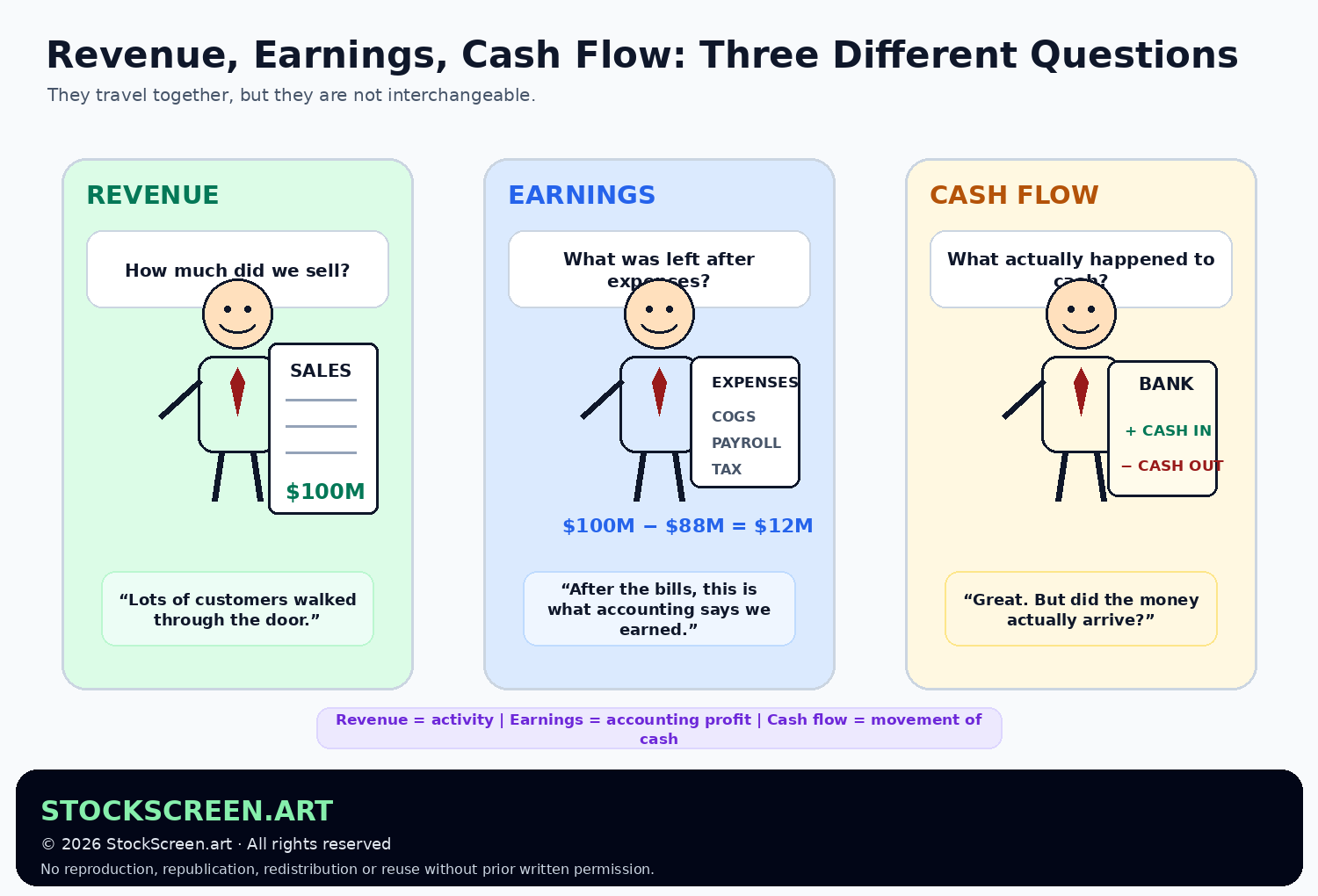
1. Revenue: the top line
The SEC describes an income statement as beginning with the amount of sales generated during the reporting period. This top portion is commonly called revenue, sales or net revenue, depending on the company and industry.
Revenue is the economic activity generated from selling the company's products or services.
If a fictional company sells $100 million of products during the year, approximately $100 million may appear as revenue under the applicable accounting rules.
That tells us something important:
Customers were willing to buy a lot of stuff.
It does not yet tell us whether the company made money doing it.
The restaurant version
Imagine a restaurant serves $10,000 of meals tonight.
Revenue starts with the $10,000 of sales.
It has not yet considered:
- food costs;
- staff wages;
- rent;
- utilities;
- insurance;
- marketing;
- interest;
- taxes;
- the mysterious annual disappearance of twelve dozen forks.
Revenue tells you how much was sold.
Profitability comes later.
2. Why investors care about revenue growth
Revenue growth can indicate that:
- more customers are buying;
- existing customers are buying more;
- prices have increased;
- the company has entered new markets;
- an acquisition added additional sales;
- some combination of the above is occurring.
Growing revenue can be a sign of business momentum.
But the obvious follow-up question is:
“What did it cost to produce that growth?”
A company can double revenue while losing increasingly heroic amounts of money.
Bigger and better are not synonyms.
3. Earnings: the bottom line
The SEC describes the income statement like a staircase.
Revenue begins at the top.
Then the company deducts different categories of costs and expenses.
By the time you reach the bottom, you arrive at net income, also called net earnings or net profit.
In simplified form:
Revenue − recognized costs and expenses = Earnings
Suppose fictional WidgetWorks reports:
| Item | Amount |
|---|---|
| Revenue | $100 million |
| Cost of products sold | −$55 million |
| Operating expenses | −$25 million |
| Interest and taxes | −$8 million |
| Net income | $12 million |
WidgetWorks sold $100 million.
It did not earn $100 million.
After the recognized costs of operating the business, $12 million remained as accounting profit.
Earnings tell you what the accounting system says remained after expenses.
4. Profit margins connect revenue and earnings
One of the simplest ways to connect the top line and the bottom line is the net profit margin.
In our simplified WidgetWorks example:
$12 million net income ÷ $100 million revenue = 12% net margin
That means roughly twelve cents of every revenue dollar became net income.
Compare that with another company:
- Revenue: $100 million
- Net income: $2 million
Same revenue.
Very different economics.
One company keeps twelve cents per dollar.
The other keeps two.
This is why investors should resist being hypnotized by large revenue numbers.
5. Earnings are accounting, not a cash register
Here comes the important complication.
Public-company financial statements use accounting rules designed to match economic activity to the periods in which it occurs.
That means revenue and expenses do not always occur at exactly the same time as cash receipts and payments.
Suppose WidgetWorks sells $100,000 of equipment to a business customer today.
The customer receives an invoice and agrees to pay in 60 days.
If the applicable revenue-recognition requirements are met, WidgetWorks may report the revenue before the cash has actually arrived.
Accounting says:
“A sale occurred.”
The bank account says:
“Wonderful. Please let me know when the customer pays.”

6. Accounts receivable: revenue waiting to become cash
When customers owe the company money for sales already recognized, that amount can appear as accounts receivable on the balance sheet.
We will explore balance sheets properly in the next lesson.
For now, the concept is enough:
Growing receivables are not automatically bad.
A rapidly growing company may naturally extend more customer credit as sales expand.
But if receivables grow much faster than revenue for a long period, an investor may reasonably ask whether customers are taking longer to pay or whether revenue quality deserves closer inspection.
7. Cash flow: follow the actual money
The SEC explains that the statement of cash flows reports a company's inflows and outflows of cash.
This matters because businesses ultimately need cash to:
- pay employees;
- pay suppliers;
- make interest payments;
- pay taxes;
- buy equipment;
- repay debt;
- fund expansion;
- return capital to shareholders.
You can report accounting profit and still run into trouble if cash does not arrive in time to meet obligations.
Businesses cannot normally tell payroll:
“Good news. Our accrual earnings are excellent. Would everyone accept a PDF until Tuesday?”
8. Why earnings and operating cash flow differ
The SEC notes that the operating section of the cash flow statement typically begins with net income and then adjusts it for non-cash items and changes in operating assets and liabilities.
Common reasons for differences include:
Customer payment timing
Revenue may be recognized before cash is collected.
Supplier payment timing
A company may record an expense while paying the related bill later.
Depreciation and amortization
These accounting expenses can reduce earnings without requiring an equivalent cash payment in that same period.
Inventory
Cash can be spent building inventory before those goods are sold and reflected in cost of sales.
Other working-capital changes
Timing differences in receivables, payables and other operating balances can move cash flow independently of net income.
Operating cash flow asks how much cash the operating business generated or consumed after cash-timing adjustments.
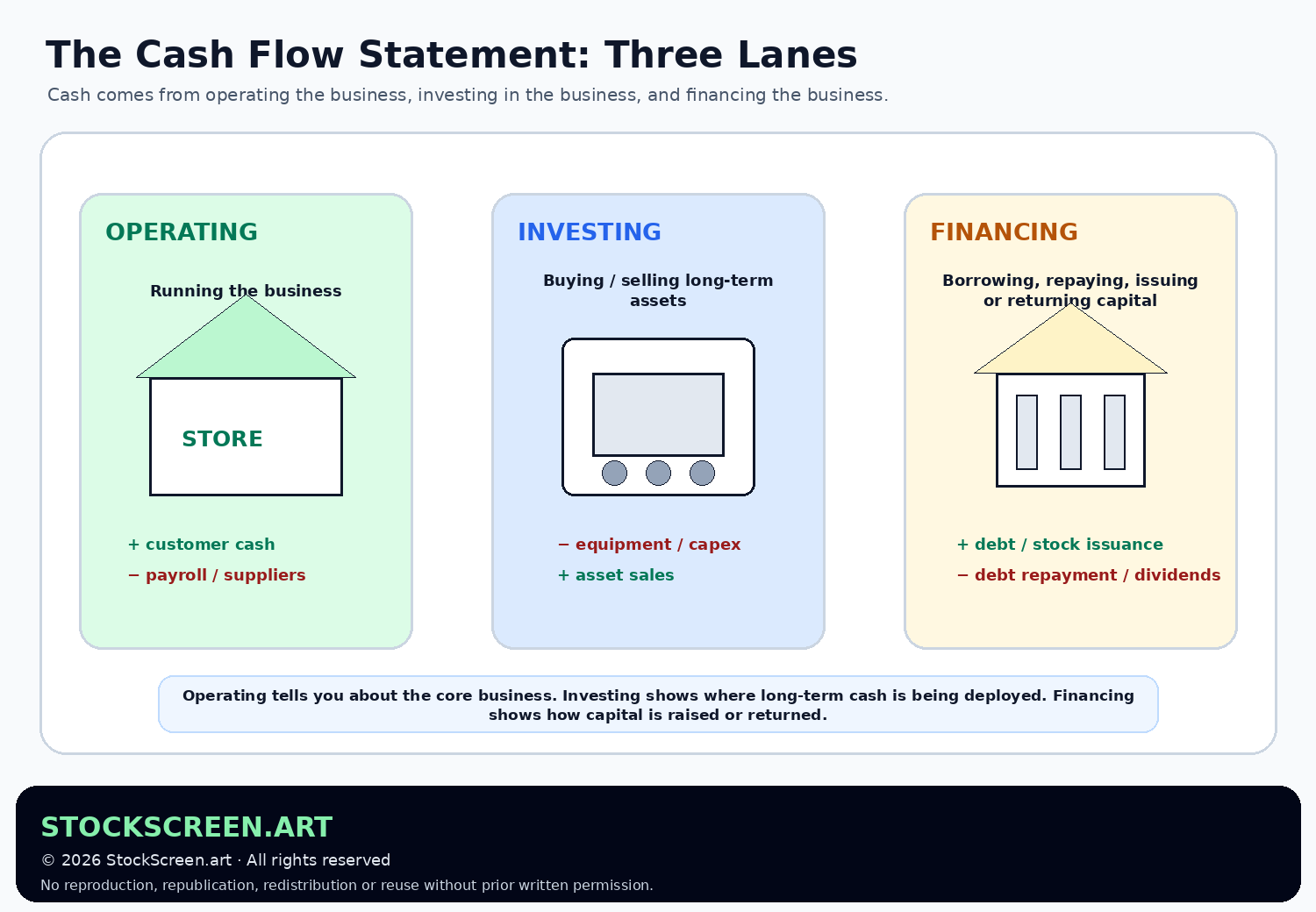
9. The cash flow statement has three lanes
The SEC divides the cash flow statement into three major sections:
Operating activities
Cash generated or consumed by the company's core operating activities.
Depending on the business, this may reflect customer collections, employee payments, supplier payments and other operating cash movements.
Investing activities
Cash used for or generated by long-term investments.
Examples can include:
- buying equipment;
- building facilities;
- purchasing or selling investments;
- acquisitions and asset sales.
Financing activities
Cash associated with how the company raises or returns capital.
Examples can include:
- borrowing money;
- repaying debt;
- issuing shares;
- repurchasing shares;
- paying dividends.
10. Positive cash flow can still deserve questions
Imagine a company begins the year with $10 million of cash.
During the year:
- Operating activities consume $5 million.
- The company borrows $20 million.
- Cash therefore increases substantially.
The bank balance went up.
Does that mean the business was healthy?
Not necessarily.
The core operation consumed cash.
The company simply raised more financing than it burned.
Borrowing $20 million is a perfectly legitimate source of cash.
It is not the same thing as generating $20 million from customers.
11. Negative investing cash flow can be perfectly healthy
The reverse mistake also happens.
Suppose a highly profitable manufacturer spends $50 million building a new factory.
Investing cash flow may be strongly negative.
That does not automatically mean trouble.
The company may be deploying cash into a productive asset expected to support future growth.
The question is not:
“Is investing cash flow negative?”
The better question is:
“Why is cash being invested, and is the expected economic return sensible?”
12. A company can grow revenue and shrink earnings
Consider:
| Year 1 | Year 2 | |
|---|---|---|
| Revenue | $100M | $130M |
| Net income | $10M | $6M |
| Net margin | 10% | 4.6% |
Revenue grew 30%.
Net income fell 40%.
Possible explanations might include:
- aggressive discounting;
- higher input costs;
- rapid hiring;
- increased marketing;
- launch expenses;
- lower-margin acquisitions;
- temporary investment intended to support later growth.
The numbers tell you what changed.
Management discussion and financial-statement notes help you investigate why.
13. Earnings can improve while cash flow weakens
Suppose earnings rise from $10 million to $15 million.
Sounds good.
But operating cash flow falls from $14 million to $4 million.
That does not prove something is wrong.
It does justify a question.
Perhaps customers have not paid yet.
Perhaps inventory increased sharply.
Perhaps the company prepaid major expenses.
Perhaps the timing difference is temporary.
The important habit is:
14. Cash flow can improve while earnings look weak
The relationship can work the other way too.
Imagine the company has a large depreciation expense.
Depreciation reduces accounting earnings.
But depreciation itself is not a new cash payment in that period, so it is added back in the operating cash-flow reconciliation.
That can cause operating cash flow to exceed net income.
Again:
not automatically good, not automatically bad.
You are trying to understand the economic reason.
15. “Cash is reality” is useful — but incomplete
You may hear investors say:
“Cash is reality. Earnings are opinion.”
There is a useful warning inside that phrase.
Cash is difficult to argue with.
But the slogan can go too far.
Cash flow itself can be temporarily boosted by:
- borrowing;
- selling assets;
- delaying supplier payments;
- collecting customers earlier;
- reducing inventory;
- issuing stock.
Those actions are not equivalent to durable operating profitability.
That is why the cash flow statement has categories.
16. Revenue quality matters too
Even revenue deserves more than one glance.
Investors may ask:
- Is revenue recurring or one-time?
- Is growth organic or mostly from acquisitions?
- Is growth coming from higher prices or more units sold?
- Are customers concentrated?
- Are returns, refunds or incentives increasing?
- Are receivables growing unusually fast?
$1 billion of revenue can describe many different businesses.
The number is the beginning of the investigation.
Not the graduation ceremony.
17. Earnings quality matters too
Earnings can be affected by:
- one-time gains or losses;
- asset write-downs;
- restructuring charges;
- stock-based compensation;
- tax items;
- changes in accounting estimates;
- acquisition-related charges;
- other non-recurring items.
This is why investors often examine both GAAP earnings and management's explanations of unusual items.
“Adjusted” measures can sometimes provide useful context.
They can also become remarkably athletic when companies remove enough expenses.
The investor's job is to understand what was adjusted and why.
18. Free cash flow: a preview
You will frequently hear investors discuss free cash flow.
At a high level, one common approach begins with operating cash flow and subtracts spending on long-term productive assets such as property and equipment.
It attempts to answer:
“After running the business and making necessary capital investments, how much cash remains available for other purposes?”
Free cash flow deserves its own lesson because:
- there is more than one definition in practice;
- capital spending can be lumpy;
- companies may present non-GAAP versions;
- the distinction between maintenance and growth investment can matter.
That will be FND-VAL-03.
For now, do not casually substitute free cash flow for operating cash flow.
19. One fictional company, three very different stories
Consider these simplified companies:
| Company | Revenue Trend | Earnings Trend | Operating Cash Flow Trend | First Question |
|---|---|---|---|---|
| A | Strong growth | Strong growth | Strong growth | Can the economics remain this strong? |
| B | Strong growth | Falling | Falling | What is making growth less profitable? |
| C | Moderate growth | Rising | Rising faster | Are margins and cash conversion improving? |
| D | Flat | Rising | Rising | Is efficiency improving, and how much runway remains? |
None of these rows gives you an automatic Buy or Sell answer.
They give you a better next question.
That is what financial statements are for.
20. Why trends matter more than one quarter
A single quarter can be distorted by timing.
Revenue can shift because a large contract closed a week earlier or later.
Expenses can spike because of a launch.
Cash flow can move because customers paid invoices before or after quarter-end.
Investors therefore often compare:
- year over year;
- several consecutive quarters;
- multi-year trends;
- margins and cash conversion over time.
Trends help distinguish:
“Something changed”
from:
“Accounting Tuesday happened.”
21. Where to find these numbers
Investor.gov explains that U.S. public companies generally provide detailed financial information in annual reports on Form 10-K and quarterly reports on Form 10-Q.
The audited financial statements in the 10-K include:
- income statements;
- balance sheets;
- cash flow statements;
- statements of stockholders' equity;
- related notes.
The numbers are only part of the package.
The notes and Management's Discussion and Analysis — usually called MD&A — can explain what drove changes in revenue, expenses, profitability, liquidity and capital requirements.
Reading the statements without the notes is a little like reading a mystery novel while skipping every page containing the motive.
22. A practical first-pass checklist
When reviewing a company, start with these questions:
- Is revenue growing? If yes, what is driving the growth?
- Are earnings growing faster or slower than revenue? What does that say about margins?
- Does operating cash flow broadly support the earnings story over time?
- Are receivables, inventory or payables changing unusually?
- Is the company generating cash from operations or mainly from financing?
- What is management spending investing cash on?
- Are unusual accounting items distorting one period?
You are not trying to become the company's auditor.
You are trying to understand whether the business story and the financial story appear to be describing the same company.
23. Why this matters for StockScreen.art
StockScreen.art currently focuses heavily on market and technical evidence: trend, momentum, relative strength, volatility, upside and risk/reward.
Those tools can help answer:
“What is the market doing with this stock?”
Fundamental analysis adds another question:
“What is the underlying business actually doing?”
A strong chart can exist beside:
- rapidly improving fundamentals;
- stable fundamentals;
- deteriorating fundamentals;
- or a business whose current economics do not obviously justify the market enthusiasm.
Learning to read revenue, earnings and cash flow gives you a better foundation for deciding whether price momentum is being supported by a strengthening business or simply outrunning it.
24. Seven mental models worth keeping
- Revenue is the top line, not the take-home pay.
- Earnings are accounting profit, not the current bank balance.
- Operating cash flow and net income should be compared, not assumed equal.
- Cash from borrowing is cash — but it is not operating success.
- Negative investing cash flow can represent productive investment rather than distress.
- When earnings and cash diverge sharply, investigate the reason.
- Look at trends and relationships, not one heroic quarter.
Quick knowledge check
Eight questions. The answers are recognized immediately; cash settlement may take longer.
1. If a company reports $500 million of revenue, did it necessarily earn $500 million of profit?
No. Revenue is the top-line amount from sales before the related costs and expenses are deducted.
2. What does net income broadly represent?
The company's accounting profit or loss after recognized costs, expenses, interest and taxes for the reporting period.
3. Can a company recognize revenue before the customer has actually paid cash?
Yes, when the applicable accounting recognition requirements have been met. The unpaid amount may appear as a receivable until collected.
4. Why can operating cash flow be higher than net income?
Among other reasons, non-cash expenses such as depreciation may reduce net income without consuming equivalent cash in that period, and working-capital changes can also increase cash flow.
5. What are the three main sections of a cash flow statement?
Operating activities, investing activities and financing activities.
6. If a company borrows $50 million, can its cash balance rise even while the core business consumes cash?
Yes. Borrowing creates financing cash inflow. That is why investors separate financing cash from operating cash flow.
7. Is negative investing cash flow automatically bad?
No. It may reflect productive long-term investments such as equipment, facilities or acquisitions. The purpose and expected return on that spending matter.
8. What should you do when earnings rise but operating cash flow deteriorates sharply?
Investigate the reconciliation and the underlying reason — for example receivables, inventory, payables, non-cash items or other timing effects — rather than assuming either number alone tells the whole story.
Where we go next
Revenue, earnings and cash flow tell us what moved during a period.
Next we add the financial snapshot that tells us what the company owns, owes and has left for shareholders.
The next lesson is:
FND-VAL-02 — Income Statements and Balance Sheets.
That is where assets meet liabilities, equity tries to keep everyone balanced, and the accounting equation quietly insists that both sides of the page stop arguing.
Primary sources & further reading
- U.S. Securities and Exchange Commission — Beginner's Guide to Financial Statements
- Investor.gov — How to Read a 10-K
- Investor.gov — How to Read a 10-K/10-Q