“Free cash flow” is one of finance’s more misleading names.
The cash is not free.
Nobody left it unattended near the loading dock.
The company had to sell products, collect from customers, pay employees, pay suppliers, deal with taxes and then spend money on the long-lived assets required to keep operating.
Only after all of that do analysts begin using the word free.
Free Cash Flow ≈ Operating Cash Flow − Capital Expenditures
Simple formula. Very useful idea. Several important traps.

1. Start with operating cash flow
The cash flow statement separates cash movements into operating, investing and financing activities. Operating cash flow — often called cash from operations or CFO — focuses on cash generated or consumed by the operating business after reconciling accounting earnings for non-cash items and changes in operating assets and liabilities.
In plain English:
“How much cash did running the business generate?”
Suppose fictional CoffeeRobot Corp. reports:
- Net income: $60M
- Operating cash flow: $100M
The difference can arise from depreciation, receivables, inventory, payables and other items we introduced in VAL-01 and VAL-02. Free cash flow usually starts from operating cash flow rather than from net income.
2. Then subtract capital expenditures
Capital expenditures, commonly shortened to capex, are cash expenditures for long-lived productive assets.
Depending on the company, those might include factories, manufacturing equipment, stores, warehouses, servers, data centers, network infrastructure, vehicles, property or certain capitalized software.
Suppose CoffeeRobot reports:
- Operating cash flow: $100M
- Purchases of property and equipment: $30M
Under the common simple convention:
Free Cash Flow = $100M − $30M = $70M
That $70M is the cash left after the operating business generated cash and after this definition’s long-term capital spending was deducted.
3. Why not just use net income?
Net income is enormously important, but accounting profit and cash generation are not identical. Free cash flow can help answer:
- Does accounting profit turn into cash?
- How capital-intensive is the business?
- How much cash remains after major reinvestment?
- Can the company internally fund growth?
- Does the company have room to reduce debt or return capital?
Consider two fictional companies:
| Company A | Company B | |
|---|---|---|
| Net income | $100M | $100M |
| Operating cash flow | $120M | $120M |
| Capital expenditures | $20M | $100M |
| Simple FCF | $100M | $20M |
Same earnings. Same operating cash flow. Very different cash remaining after capital spending.
4. Capital intensity changes the economics
Some businesses require substantial ongoing investment merely to remain competitive. A railroad needs track and equipment. A semiconductor manufacturer may need enormously expensive fabrication facilities. A telecom company needs network infrastructure.
Other business models can require less physical capital.
This is one reason two companies with similar accounting earnings can have very different economics: the amount of cash that has to be put back into the business matters.
5. Maintenance capex vs. growth capex
Analysts often make a useful conceptual distinction.
Maintenance capex
Spending required to maintain existing productive capacity and competitive position: replacing worn equipment, refreshing existing stores, maintaining servers or replacing vehicles needed for current operations.
Growth capex
Spending intended to expand the business or create additional capacity: new locations, additional factories, expanded data centers or new production lines.
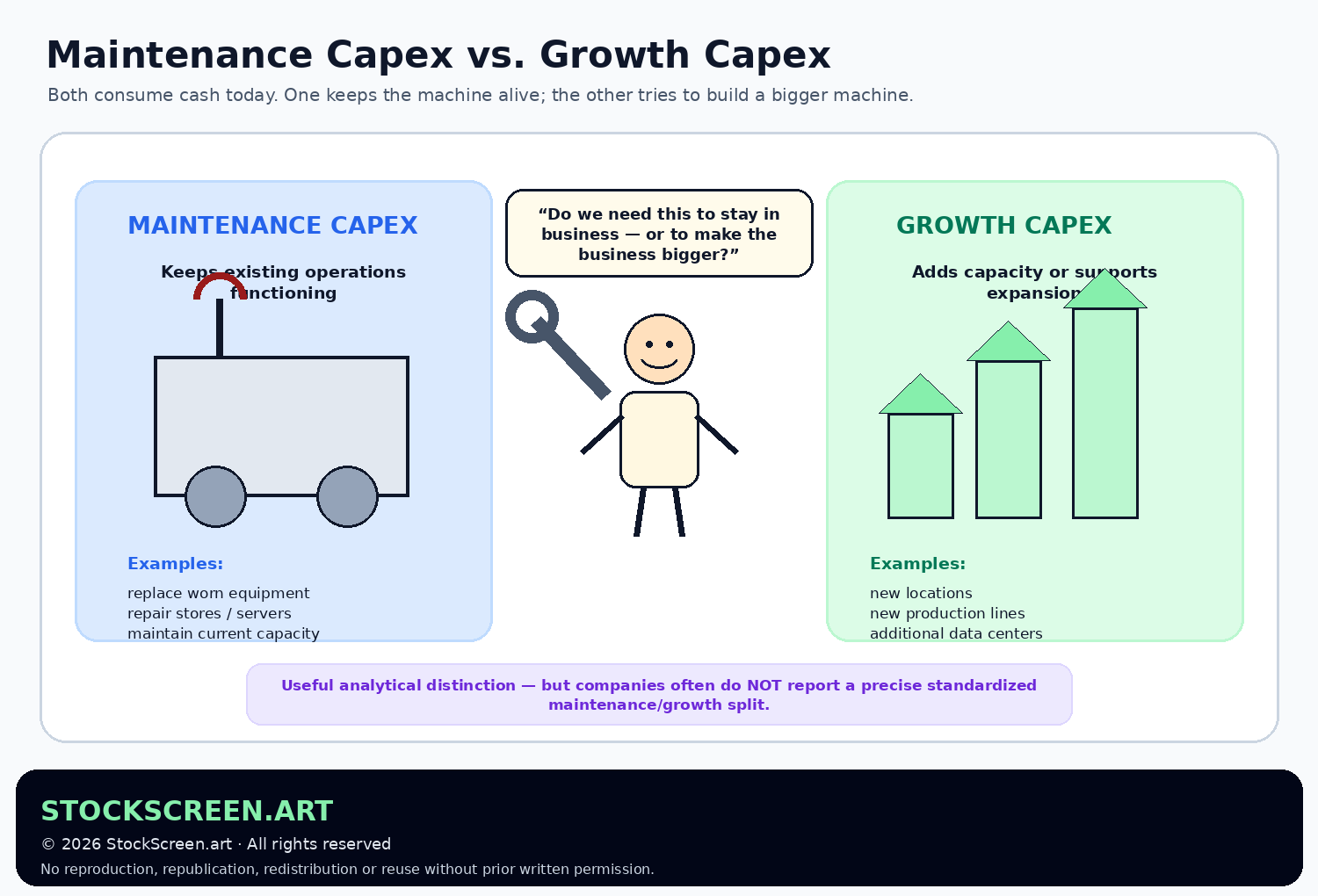
6. Important: companies often do not report that split cleanly
Maintenance versus growth capex is economically useful but often an analytical estimate, not a neatly standardized pair of financial-statement lines.
A new server can replace old capacity and add new capacity simultaneously. A renovated store can maintain the brand and increase sales. A factory expansion can include replacement equipment.
An estimate with six decimal places remains an estimate wearing a very confident tie.
7. Free cash flow is not a standardized GAAP line item
This is the nuance introductory explanations often skip.
Free cash flow is generally presented as a non-GAAP financial measure. Non-GAAP measures do not conform to GAAP, and companies that present them provide a definition and reconciliation to a comparable GAAP measure under applicable disclosure rules.
As a result, two companies can both report “Free Cash Flow” and calculate it differently.
One might use:
Operating cash flow − purchases of property and equipment
Another might also deduct purchases of intangible assets.
Another might present an adjusted free-cash-flow measure with additional changes.
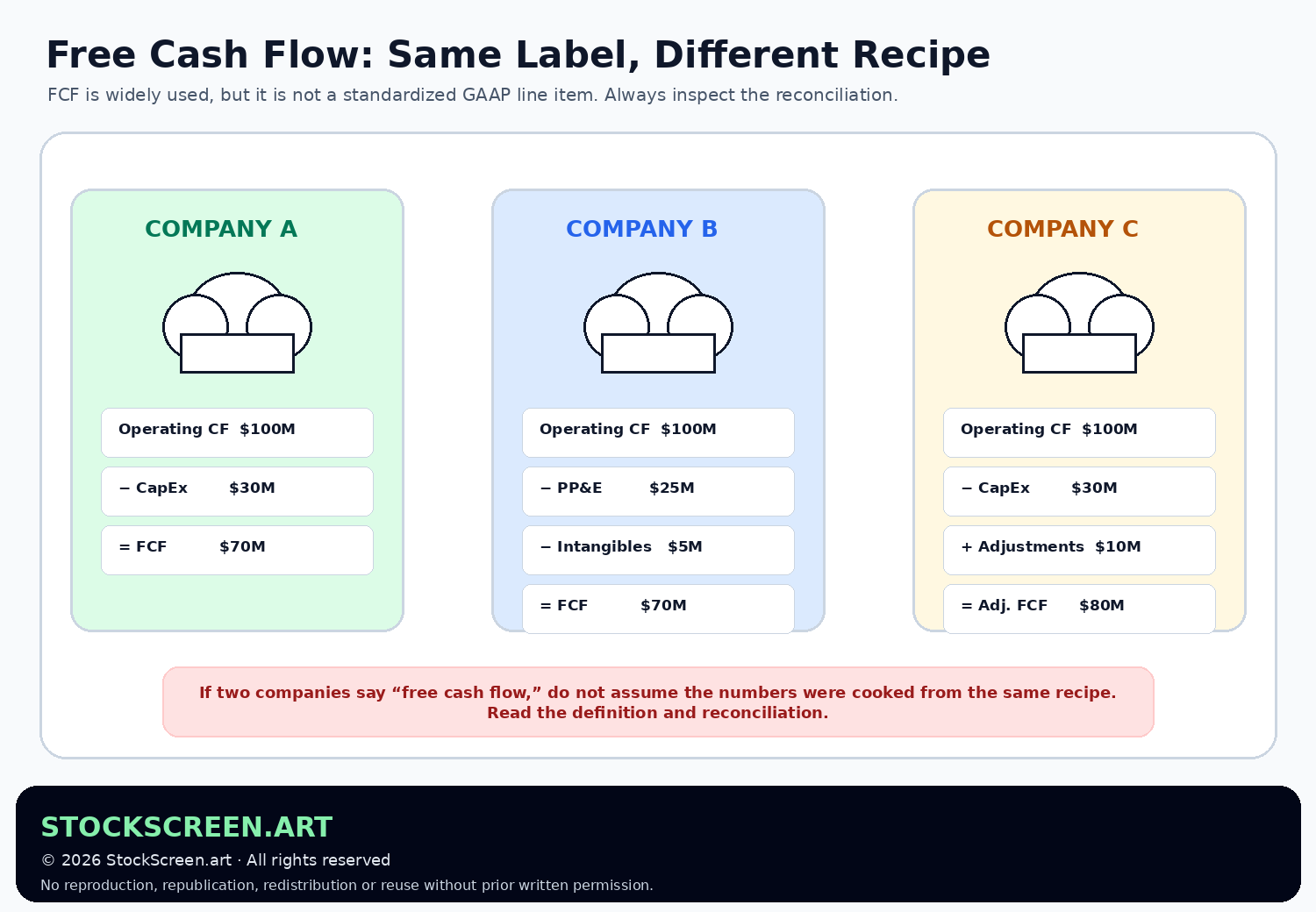
8. So which formula should you use?
For Foundation-level analysis, a useful starting convention is:
Operating Cash Flow − Capital Expenditures
For a real company:
- Start with the GAAP cash-flow statement.
- Identify operating cash flow.
- Identify the capital expenditures included in the company’s definition.
- Read the company’s non-GAAP reconciliation if it publishes FCF.
- Check whether unusual adjustments materially change the number.
- Use the same definition consistently across periods and peers.
Consistency is more useful than finding the most flattering formula.
9. Free cash flow can exceed net income
Suppose:
- Net income: $80M
- Operating cash flow: $130M
- Capex: $25M
- FCF: $105M
Possible reasons include non-cash depreciation or amortization, favorable working-capital changes, or other non-cash items affecting earnings.
That can be perfectly healthy. The important habit is understanding the bridge.
10. Free cash flow can be lower than net income
Suppose:
- Net income: $80M
- Operating cash flow: $70M
- Capex: $40M
- FCF: $30M
Customers may be taking longer to pay. Inventory may be building. The company may be investing heavily. Lower FCF does not automatically mean poor accounting quality; it means less cash remained after those demands.
11. Negative FCF is not automatically bad
Imagine a profitable retailer generates $200M of operating cash flow and spends $260M opening carefully selected new stores with excellent expected economics.
$200M − $260M = −$60M FCF
Negative.
Yet the company may be deliberately converting today’s cash into productive assets expected to generate more cash later.
Ask whether the investment is sensible, affordable and likely to earn an attractive return.
12. Negative FCF can also be very bad
Now imagine revenue is falling, operating cash flow is negative, the company must still spend heavily just to maintain aging equipment, and the gap is repeatedly funded with debt or new shares.
Same sign. Completely different story.
13. Positive FCF is not automatically good either
A company can temporarily improve FCF by delaying supplier payments, running down inventory, postponing maintenance or cutting capital investment below a sustainable level.
The current cash number can improve while the future business quietly develops a problem.
An airline could improve cash flow by postponing maintenance. Your valuation model should not send a thank-you card.
14. Working capital can make FCF lumpy
Operating cash flow includes changes in receivables, inventory, payables and other operating balances. Customers may pay early in one quarter, inventory may rebuild in the next, and supplier-payment timing can move cash between periods.
This is why multi-year and trailing-period trends are often more informative than one heroic quarter.
15. What can a company do with sustainable free cash flow?
Free cash flow creates choice.
Management can potentially:
- reinvest in research, products or capacity;
- make acquisitions;
- reduce debt;
- pay dividends;
- repurchase shares;
- build cash reserves.
Free cash flow tells you the company has fuel. Capital allocation tells you where management drives.
Occasionally it drives directly toward an acquisition priced at 47 times EBITDA because “strategic synergies.”
16. Free-cash-flow margin
A useful analytical ratio is:
FCF Margin = Free Cash Flow ÷ Revenue
If revenue is $1B and FCF is $150M, FCF margin is 15%.
Tracking the ratio over time can help show whether growth is becoming more or less cash-generative.
17. Free-cash-flow conversion
Analysts may also compare FCF with accounting earnings.
FCF Conversion = Free Cash Flow ÷ Net Income
If net income is $100M and FCF is $90M, conversion is 90%.
But capital intensity, business cycles, working capital and accounting treatment matter. There is no universal rule that every excellent company must convert exactly 100% every year.
18. Free-cash-flow yield: a valuation preview
One common equity-oriented valuation ratio is:
Free Cash Flow Yield = Free Cash Flow ÷ Market Capitalization
$500M of FCF against a $10B market capitalization produces a 5% FCF yield under that definition.
We will handle valuation ratios properly in FND-VAL-04. For now, remember that different FCF definitions can make careless yield comparisons misleading.
19. A high FCF yield can be attractive — or a warning
A high yield might mean the stock is inexpensive relative to current cash generation.
It might also mean the market expects FCF to fall, the business is near a cyclical peak, the company faces unusual risk, working capital temporarily boosted cash, or the business is underinvesting.
Ratios mostly make it easier to identify which question to ask next.
20. Why depreciation does not automatically equal maintenance capex
Depreciation is an accounting allocation of historical asset cost. Replacement costs change, technology changes, assets last longer or shorter than expected, and growth spending may be mixed with replacement spending.
Treating depreciation as exact maintenance capex because the spreadsheet looks tidy is how spreadsheets become fan fiction.
21. Stock-based compensation still matters
Stock-based compensation is generally a non-cash expense in the operating cash-flow reconciliation, which can increase the difference between net income and operating cash flow.
But issuing shares to employees can dilute existing shareholders.
“No cash left the bank” does not mean the economic cost vanished.
22. Acquisitions complicate the picture
A common FCF formula may subtract capex but not cash spent acquiring another company. If acquisitions are a recurring requirement for maintaining growth, investors may reasonably treat that cash use as economically important.
The formula is the start of analysis, not permission to stop thinking.
23. A practical FCF checklist
- What exact definition is being used?
- Does operating cash flow broadly support the earnings trend?
- How much capital spending does the business require?
- Is capex maintaining current capacity or supporting attractive growth?
- Are working-capital changes temporarily boosting or depressing cash?
- Is FCF durable across a cycle?
- What does management do with the cash?
- Are share count and debt improving or deteriorating despite reported FCF?
24. Why this matters for StockScreen.art
A stock can have strong momentum while the underlying company is producing growing FCF, burning cash to fund attractive expansion, burning cash because the business is deteriorating, or reporting strong cash flow because investment was temporarily postponed.
The chart cannot tell you which explanation is true.
Fundamental cash-flow analysis can help.
Price tells you what the market is rewarding. Cash flow helps tell you what the business can fund.
25. Eight mental models worth keeping
- Free cash flow is widely used, but it is not a standardized GAAP line item.
- Start with the company’s GAAP cash-flow statement.
- OCF minus capex is a useful common convention, not a universal law.
- Negative FCF can represent attractive investment or financial distress.
- Positive FCF can reflect strength or temporary underinvestment/timing.
- Maintenance and growth capex are useful concepts but often judgment calls.
- Cash generation matters; capital allocation determines what management does with it.
- Compare definitions consistently across companies and time.
Quick knowledge check
Nine questions. Unlike the cash, they are genuinely free.
1. What is a common simple formula for free cash flow?
Operating cash flow minus capital expenditures.
2. Is free cash flow a standardized GAAP line item?
No. It is generally a non-GAAP analytical measure, so definitions can differ and should be checked against the company’s reconciliation.
3. Why are capital expenditures subtracted?
Because acquiring and maintaining long-lived productive assets consumes cash that is not available for other uses during the period.
4. Is negative FCF always bad?
No. A financially strong company may deliberately invest heavily in attractive expansion.
5. Is positive FCF always good?
No. It can be temporarily boosted by working-capital timing or by underinvesting in the business.
6. Are maintenance and growth capex always reported separately?
No. The distinction is often analytical and may require judgment from disclosures and business context.
7. Name three possible uses of sustainable FCF.
Examples include reinvestment, debt reduction, acquisitions, dividends, share repurchases or building cash reserves.
8. Why compare a company’s FCF definition over time?
Because changing definitions or adjustments can make trend comparisons misleading.
9. Why can stock-based compensation matter even when it is non-cash?
Because issuing shares can dilute existing shareholders, so the economic cost does not disappear.
Where we go next
We now understand the operating business, the balance sheet and the cash left after major reinvestment.
Next comes the dangerous part:
putting a price on all of it.
The next lesson is:
FND-VAL-04 — P/E, P/S, EV/EBITDA and Price-to-Book.
Four ratios. Four useful shortcuts. And approximately fourteen ways to use them without understanding what the denominator means.
Primary sources & further reading
- U.S. Securities and Exchange Commission — Beginner's Guide to Financial Statements
- Investor.gov — How to Read a 10-K/10-Q
- U.S. Securities and Exchange Commission — Non-GAAP Financial Measures Compliance & Disclosure Interpretations
- U.S. Securities and Exchange Commission — The Statement of Cash Flows: Improving the Quality of Cash Flow Information