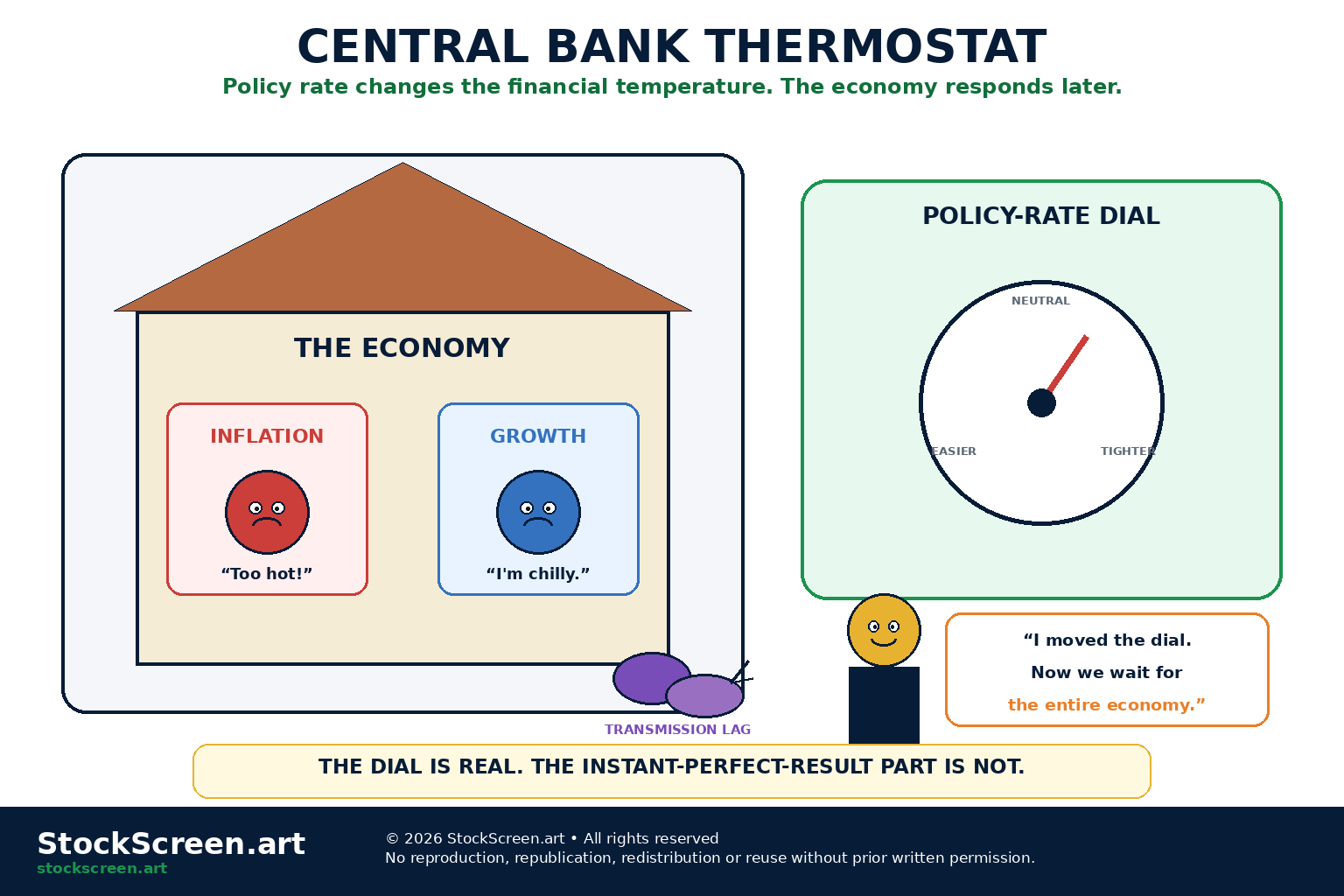
Central banks are often discussed as though they operate a giant economic thermostat.
Inflation too hot?
Turn the rate dial up.
Economy too cold?
Turn it down.
Everyone waits three seconds.
Perfect temperature.
Unfortunately, the real economy did not come with that thermostat.
How Do Central Banks and Interest Rates Affect Markets?
Central banks influence financial markets mainly through monetary policy: policy interest rates, communication, liquidity facilities and balance-sheet tools. A change in the policy stance can affect short-term market rates, longer-term yields, borrowing costs, exchange rates, asset valuations, credit conditions and investor expectations.
The important point is that a central bank does not directly set every mortgage rate, bond yield or stock valuation. Policy moves through a transmission chain, and each link can respond differently depending on inflation, growth, market expectations, credit conditions and the structure of the economy.
A useful beginner framework is: Policy decision → Market expectations → Interest rates and financial conditions → Borrowing and saving → Spending and investment → Employment and inflation → Asset prices. Markets often react most strongly to what changed relative to expectations, not simply to whether a rate was raised or cut.
1. What Is a Central Bank?
A central bank is a public institution responsible for important parts of a country's or currency area's monetary and financial system.
Depending on the jurisdiction, responsibilities can include:
- conducting monetary policy;
- issuing currency;
- supporting payment systems;
- providing liquidity to the financial system;
- helping preserve financial stability;
- supervising or regulating certain financial institutions.
The exact mandate differs across central banks.
2. Monetary policy
Monetary policy is the use of central-bank tools and communication to influence financial conditions and help achieve the bank's economic objectives.
In the United States, the Federal Reserve conducts monetary policy to promote maximum employment and stable prices.
The Federal Reserve Act also refers to moderate long-term interest rates.
3. The Federal Reserve's dual mandate
The Federal Reserve's two commonly emphasized goals are:
- maximum employment;
- stable prices.
These goals can sometimes point in the same direction.
Sometimes they do not.
Central banking: where the easy multiple-choice question occasionally contains two correct answers and one policy rate.
4. The Bank of Canada framework
The Bank of Canada uses an inflation-control framework centered on:
2% inflation
which is the midpoint of a 1% to 3% control range.
The Bank normally implements monetary policy primarily through its target for the overnight rate, commonly called the policy interest rate.
5. The ECB framework
The European Central Bank also pursues price stability and defines its inflation objective around 2% over the medium term.
It uses several official interest rates as part of its monetary-policy implementation framework.
Different plumbing.
Similar basic question:
“How tight or easy should financial conditions be?”
6. Monetary policy is not fiscal policy
Monetary policy belongs primarily to the central bank.
Fiscal policy belongs to governments and legislatures.
Fiscal tools include:
- government spending;
- taxation;
- transfers;
- budget deficits and surpluses.
Monetary and fiscal policy can push in the same direction or opposite directions.
7. What Is a Central Bank Policy Interest Rate?
A central bank policy rate is a short-term interest rate or target used to implement the desired stance of monetary policy.
Examples include:
- the Federal Reserve's target range for the federal funds rate;
- the Bank of Canada's target for the overnight rate;
- the ECB's key policy interest rates.
These are not the rates printed on every mortgage, car loan and corporate bond.
8. The federal funds rate
In the United States, the federal funds rate is an overnight rate on transactions involving balances held at Federal Reserve Banks.
The Federal Open Market Committee sets a target range for this rate.
Federal Reserve implementation tools help keep the effective rate within that range.
9. The Bank of Canada's overnight rate
In Canada, the Bank's key policy interest rate is the target for the overnight rate.
The overnight market is where major financial institutions lend funds to one another for very short periods.
The Bank uses its operational framework to influence this rate and, through it, broader financial conditions.
10. Why start with overnight money?
Central banks have strong influence over the shortest end of the interest-rate system because they control key settlement assets and terms in their own monetary framework.
Changes at the short end can then transmit into:
- money-market rates;
- bank funding costs;
- deposit rates;
- loan rates;
- bond yields;
- asset prices;
- exchange rates.
11. Policy rate does not equal mortgage rate
A common mistake is:
“The central bank cut 0.25%, so my five-year mortgage rate must fall exactly 0.25%.”
Not necessarily.
Longer-term borrowing rates can depend on:
- expected future policy rates;
- inflation expectations;
- credit risk;
- term premiums;
- funding conditions;
- competition;
- market supply and demand.
12. What Are Basis Points in Interest Rates?
Financial markets often describe rate moves using basis points.
1 basis point = 0.01 percentage point
Therefore:
- 10 basis points = 0.10 percentage point;
- 25 basis points = 0.25 percentage point;
- 50 basis points = 0.50 percentage point;
- 100 basis points = 1.00 percentage point.
13. Why use basis points?
Basis points remove ambiguity.
If a rate rises from 4% to 5%, did it rise:
- 1 percentage point?
- 25% relative to its old level?
Both statements can be mathematically true.
Saying “100 basis points” tells the bond desk exactly what happened and lets everyone return to arguing about the forecast.
14. Tightening
Monetary tightening means policy is becoming more restrictive.
This can include:
- raising policy rates;
- reducing central-bank balance-sheet support;
- communication that leads markets to expect tighter future policy.
The purpose is generally to reduce excessive demand or inflation pressure, depending on the mandate and circumstances.
15. Easing
Monetary easing means policy is becoming less restrictive or more accommodative.
It can include:
- lowering policy rates;
- providing more balance-sheet accommodation;
- guidance that changes expected future policy.
Easing is generally intended to support economic activity and financial conditions.
16. “Higher” does not always mean “tight”
A 4% policy rate can be restrictive in one economic environment and less restrictive in another.
Why?
Because the stance depends partly on:
- inflation;
- inflation expectations;
- growth;
- productivity;
- financial conditions;
- the economy's estimated neutral interest rate.
17. Nominal vs. Real Interest Rates
The rate printed on a loan or bond is generally a nominal rate.
A simplified real-rate approximation adjusts for expected inflation:
Real Rate ≈ Nominal Rate − Expected Inflation
This is an approximation, but it is a useful foundation concept.
18. Real-rate example
Fictional example:
- nominal rate = 5%;
- expected inflation = 2%.
Approximate real rate:
5% − 2% = 3%
If expected inflation were 5% instead, the same 5% nominal rate would imply a very different real stance.
19. The neutral rate
Economists use concepts such as the neutral real interest rate, often nicknamed r-star, to describe a rate consistent with the economy operating around equilibrium without policy deliberately stimulating or restraining demand.
It is not directly observable.
That is inconvenient, because central banks would very much enjoy seeing it.
20. Neutral is an estimate, not a dashboard gauge
Estimates of neutral depend on:
- productivity;
- demographics;
- saving and investment;
- global capital flows;
- model assumptions.
Policymakers therefore cannot simply compare today's policy rate with a perfectly known neutral rate.
21. How Monetary Policy Transmits Through the Economy
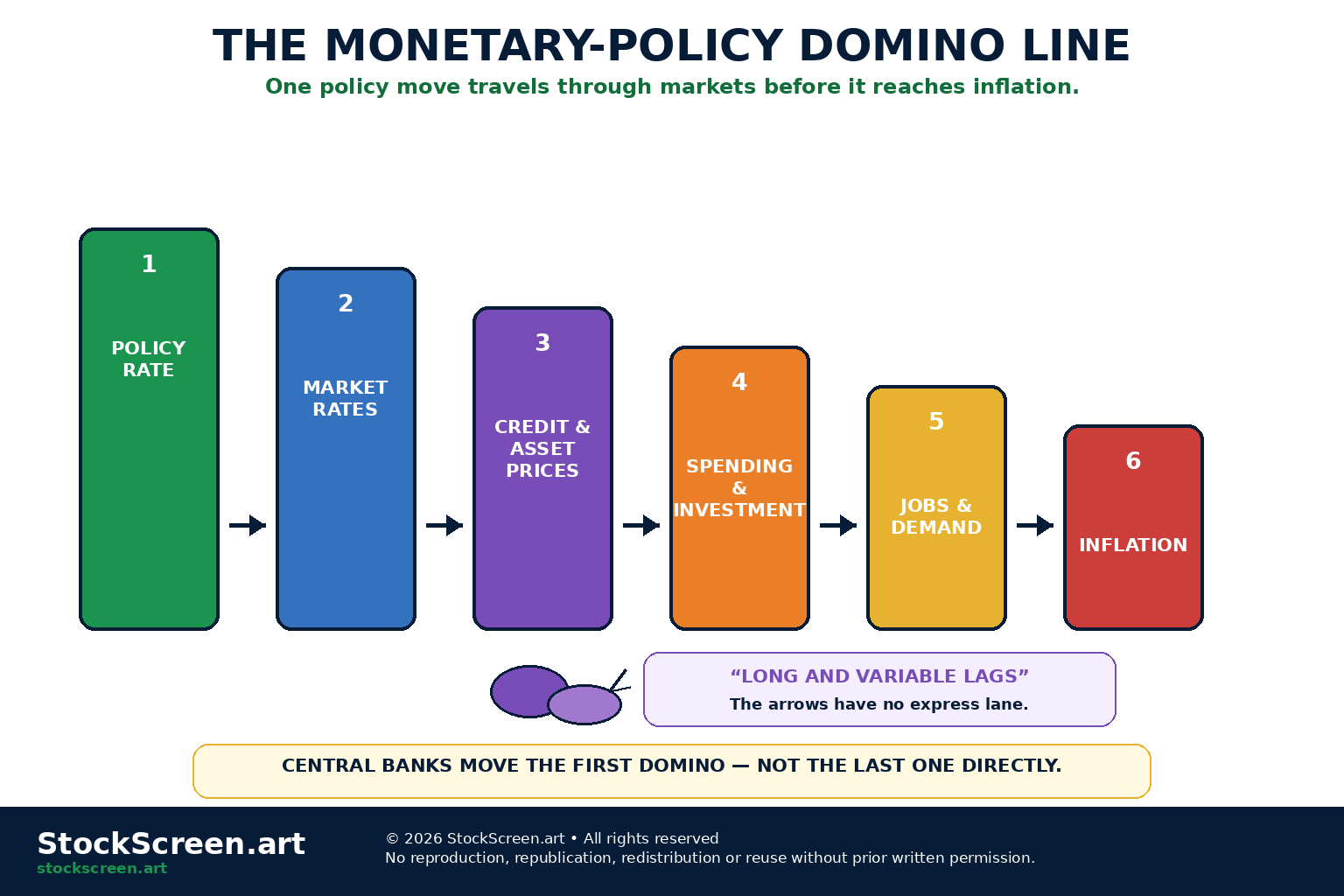
Monetary-policy transmission is the chain through which a central-bank decision affects the broader economy.
A simplified path is:
policy rate → market rates and financial conditions → borrowing, saving and asset prices → spending and investment → employment and inflation
The arrows are the important part.
They are also where most of the uncertainty lives.
22. Channel 1: market interest rates
A policy-rate change can influence:
- overnight rates;
- money-market rates;
- bank prime rates;
- deposit rates;
- bond yields.
The pass-through is not always one-for-one.
23. Channel 2: borrowing costs
Higher borrowing costs can reduce demand for:
- mortgages;
- consumer credit;
- business loans;
- new corporate debt.
Lower borrowing costs can work in the opposite direction.
24. Channel 3: saving incentives
Higher rates can make saving more attractive relative to immediate spending.
Lower rates can reduce the reward for holding some forms of cash and short-term savings.
Household responses vary widely.
Humans remain annoyingly heterogeneous.
25. Channel 4: asset prices
Interest rates influence the discounting of future cash flows.
Changes in yields can affect valuations for:
- stocks;
- bonds;
- real estate;
- other long-duration assets.
The effect depends on growth expectations, risk premiums and starting valuation. The prior Economic Cycles and Market Regimes lesson explains why the same rate move can matter differently across macro environments.
26. Channel 5: exchange rates
Interest-rate expectations can affect currencies because investors compare expected returns across currencies and countries.
Higher relative rates can support a currency under some conditions.
But growth expectations, risk sentiment, trade flows and policy credibility also matter.
Forex refuses simple slogans on principle. The Forex and Currency Pairs lesson explains how relative rate expectations can feed into exchange-rate pricing.
27. Channel 6: credit conditions
Monetary policy can affect:
- bank willingness to lend;
- credit spreads;
- refinancing conditions;
- borrower affordability;
- financial-system risk appetite.
The quantity of credit can matter as much as the advertised interest rate.
28. Channel 7: expectations
Central-bank communication can affect markets before any future rate move occurs.
If investors become convinced that rates will remain high for longer, longer-term yields and financial conditions can adjust immediately.
Markets are professional worriers about tomorrow.
29. Monetary policy works with lags
Rate changes do not fully affect inflation or employment immediately.
Households may have fixed-rate debt.
Companies may refinance months later.
Construction projects take time.
Wage negotiations take time.
Demand responds gradually.
30. The lag is variable
There is no universal timer that says:
rate hike + exactly 14 months = inflation solved
Transmission can differ with:
- mortgage structure;
- bank health;
- household debt;
- business financing;
- financial-market conditions;
- confidence;
- the nature of the original inflation shock.
31. Why central banks forecast
Because policy works with lags, central banks cannot simply react to today's inflation number and wait for immediate results.
They must form views about:
- future inflation;
- future demand;
- labour markets;
- financial conditions;
- risks around the forecast.
Monetary policy is partly steering by looking through the windshield while the dashboard data arrives late.
32. Demand shocks
If demand is running much faster than the economy's productive capacity, inflation pressure can build.
Higher rates can reduce demand by making borrowing more expensive and saving more attractive.
This is one of the cleaner textbook cases for monetary tightening.
33. Supply shocks
Supply shocks are harder.
Examples include:
- oil disruptions;
- war;
- crop failures;
- supply-chain breakdowns.
Higher interest rates cannot manufacture oil, wheat or shipping containers.
34. Why central banks may still respond to supply-driven inflation
Policymakers may worry that a temporary supply shock could spread into:
- wages;
- services prices;
- inflation expectations;
- broad pricing behavior.
The challenge is deciding whether inflation will fade or become persistent.
35. Inflation expectations
Inflation expectations matter because households, businesses and investors make decisions based partly on what they think prices will do.
Expectations can influence:
- wage demands;
- pricing decisions;
- bond yields;
- currency values;
- real interest rates.
36. Anchored expectations
Central banks generally prefer inflation expectations to remain anchored around the policy objective.
If everyone begins expecting persistently high inflation, the behavior needed to protect purchasing power can make inflation more difficult to reduce.
Credibility is therefore an economic asset.
37. Forward guidance
Forward guidance is communication about the likely future path or conditions for monetary policy.
It can influence:
- market expectations;
- bond yields;
- currencies;
- financial conditions.
The central bank can move markets without physically changing the policy rate that day.
38. Words are part of the tool kit
Financial markets analyze:
- policy statements;
- press conferences;
- meeting minutes;
- economic projections;
- speeches.
One changed adjective can create an afternoon of frantic highlighting.
39. Hawkish
Hawkish generally describes a policy stance or communication that places relatively more emphasis on controlling inflation or maintaining tighter policy.
It can imply:
- higher rates;
- rates staying high longer;
- less urgency to ease.
40. Dovish
Dovish generally describes a stance or communication more open to easier policy, often because inflation pressure is easing or growth and employment risks are increasing.
Hawks and doves are metaphors.
No actual birds vote at FOMC meetings.
41. How Interest-Rate Hikes Can Affect Stocks
Higher rates can pressure stocks through:
- higher discount rates;
- higher borrowing costs;
- slower demand;
- competition from higher bond yields.
But stocks can still rise during rate hikes if:
- growth is strong;
- earnings are improving;
- the hikes were expected;
- inflation credibility improves.
42. How Interest-Rate Cuts Can Affect Stocks
Lower rates can support valuations and financial conditions.
But a rate cut can also arrive because:
- growth is deteriorating;
- unemployment is rising;
- financial stress is increasing.
The market may therefore hear:
“Cheaper money!”
and:
“Wait. Why did they need to cut?”
at the same time.
43. Rate hikes and bonds
Bond prices and yields generally move in opposite directions.
When market yields rise, existing fixed-rate bonds can fall in price because newly issued bonds may offer more attractive yields.
Maturity and duration strongly affect sensitivity.
The next Foundation lesson, FND-RW-03 — The Yield Curve, explores that maturity structure in more detail.
44. Rate cuts and bonds
Falling market yields can support prices of existing fixed-rate bonds.
But credit bonds can behave differently if rate cuts coincide with worsening credit risk.
Treasury-style rate exposure and corporate default exposure are not the same thing.
45. Banks and interest rates
Banks earn and pay interest across different parts of their balance sheets.
Their results can depend on:
- loan rates;
- deposit costs;
- yield-curve shape;
- loan growth;
- credit losses;
- securities valuations.
“Higher rates are good for banks” remains too simple.
46. Housing and interest rates
Housing is especially rate-sensitive because purchases often involve large amounts of borrowing.
Higher mortgage rates can reduce affordability and demand.
Lower rates can improve affordability, but house prices, income, lending standards and supply also matter.
47. Currencies and rate differentials
Currency traders often compare expected policy paths across central banks.
A currency can respond not just to:
- the local rate;
but to:
- the local rate relative to foreign rates;
- expected future differences;
- inflation;
- growth;
- risk sentiment.
48. Emerging markets can be especially sensitive
Global interest-rate changes can affect:
- capital flows;
- currency pressure;
- foreign-currency debt burdens;
- financing conditions.
The effect differs widely by country and policy credibility.
49. Central-Bank Expectations vs. the Actual Rate Decision
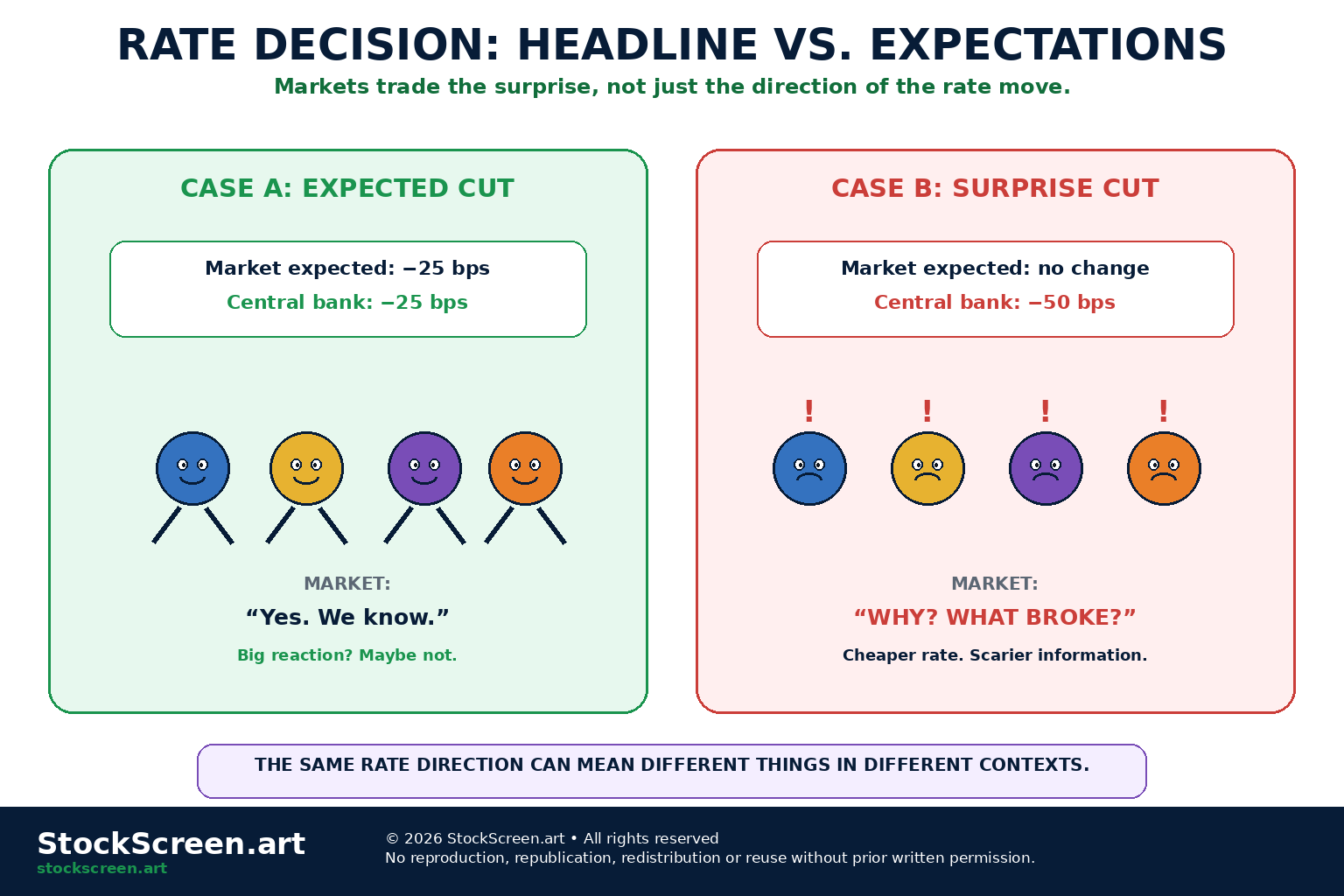
Markets usually form expectations before a central-bank meeting.
Suppose investors already expect a 25-basis-point cut.
If the bank cuts exactly 25 basis points, the decision may create only a modest reaction.
The surprise may live elsewhere:
- the statement;
- the forecast;
- future guidance;
- the vote;
- the press conference.
50. A surprise hike
If markets expected no change and the central bank unexpectedly hikes, short-term yields may rise sharply.
Other assets can respond through:
- changed growth expectations;
- currency movements;
- discount-rate changes;
- risk repricing.
51. A surprise cut
An unexpected cut can initially support some asset prices.
But investors may also ask whether policymakers know something unpleasant about:
- growth;
- employment;
- credit;
- financial stability.
The reason matters.
52. “Higher for longer”
A central bank can leave the current rate unchanged while markets become more restrictive if communication implies rates may stay high for longer than previously expected.
Longer-term yields can rise even without a same-day hike.
No rate move does not mean no monetary-policy news.
53. “Cuts sooner”
The reverse can happen when markets infer that easing may begin sooner or proceed faster than previously expected.
Asset prices can react before the first actual cut.
This is why a market can rally during a meeting where the policy rate was unchanged.
54. Quantitative easing
Quantitative easing, or QE, generally refers to large-scale central-bank asset purchases used to provide additional monetary accommodation, especially when short-term policy rates are near their effective lower bound.
The purchases can affect:
- longer-term yields;
- portfolio allocation;
- liquidity;
- financial conditions;
- expectations.
55. QE is not simply “the stock market button”
Asset purchases can influence financial conditions, but the effect depends on:
- market conditions;
- which assets are purchased;
- expectations;
- banking conditions;
- economic confidence.
Central-bank balance sheets are not remote controls for one equity index.
56. Quantitative tightening
Quantitative tightening, or QT, generally means reducing the size or accommodation of the central-bank balance sheet, often by allowing securities to mature without full reinvestment or through other balance-sheet operations.
QT can contribute to tighter financial conditions, but its effects depend on the operating framework and market environment.
57. The central-bank balance sheet
A central-bank balance sheet contains assets and liabilities like any balance sheet, but the components are distinctive.
Assets can include government securities and lending facilities.
Liabilities can include:
- currency in circulation;
- reserve balances held by banks.
The details matter enormously.
Foundation Path will resist turning this into Central Bank Accounting: The Musical.
58. Reserves are not household checking accounts
Bank reserves are balances financial institutions hold within the central-bank system.
They are part of the infrastructure of payments and monetary-policy implementation.
They should not be confused with ordinary household deposits.
59. Interest on reserve balances
In the Federal Reserve's current implementation framework, interest paid on reserve balances is an important tool used to help keep short-term rates consistent with the FOMC's target range.
Other administered facilities can also support rate control and market functioning.
The operational details evolve over time, so current settings should always be checked at the official source.
60. Open market operations
Open market operations involve central-bank transactions in financial markets used to support monetary-policy implementation.
Historically and operationally, their exact role depends on the central bank's framework and the amount of reserves in the system.
The concept is more important here than memorizing today's plumbing diagram.
61. Lender of last resort is related but different
Central banks may provide liquidity to solvent financial institutions or markets during stress under defined facilities and legal frameworks.
This financial-stability role is related to monetary policy, but it is not identical to changing the policy stance for inflation and employment objectives.
One tool kit can contain different wrenches.
62. Central-bank independence
Many modern central-bank frameworks provide a degree of operational independence so policymakers can pursue legislated objectives without having every rate decision dictated by short-term political pressure.
The exact legal structure differs by country.
Independence does not mean absence of accountability.
63. Communication and credibility
Monetary policy depends partly on whether households, businesses and markets believe the central bank will pursue its stated objectives.
Credible communication can influence expectations before the full economic effect of policy arrives.
This is why central-bank language is scrutinized so intensely.
64. Why central banks can be wrong
Policymakers operate under uncertainty.
They do not know perfectly:
- the neutral rate;
- future inflation;
- future productivity;
- how quickly policy will transmit;
- whether a shock is temporary or persistent.
Policy errors are possible.
65. Tightening too much
Excessive tightening can contribute to:
- weaker spending;
- rising unemployment;
- credit stress;
- recession risk;
- inflation falling below target.
The brake pedal can work too well.
66. Tightening too little
Insufficient tightening can allow:
- inflation to remain elevated;
- expectations to drift;
- demand to remain excessive;
- financial imbalances to grow.
The challenge is not simply:
brake or no brake
It is:
how much, for how long, under uncertain conditions?
67. Easing too early
If policy is eased before inflation pressure is sustainably controlled, demand can strengthen again and inflation may reaccelerate.
Markets often debate this risk long before the first cut.
68. Easing too late
If restrictive policy remains in place after demand and inflation pressure have weakened substantially, economic damage can become larger than necessary.
Again:
timing matters
69. The central bank cannot solve every problem
Monetary policy cannot directly:
- build more houses;
- produce more oil;
- repair ports;
- train workers overnight;
- solve fiscal deficits;
- fix company management.
It works mainly through financial conditions and aggregate demand.
70. A rate cut is not free growth
Lower rates can support activity, but excessive accommodation can also contribute to:
- inflation;
- financial leverage;
- asset-price excesses;
- currency pressure.
Every macro lever has a second side.
71. A rate hike is not guaranteed pain everywhere
Higher rates can benefit:
- some savers;
- holders of newly issued fixed-income instruments;
- certain financial businesses under some conditions.
Distribution matters.
There is no single household called “The Economy.”
72. Real-world transmission depends on debt structure
Countries with more variable-rate borrowing can feel rate changes faster.
Countries with more long-term fixed-rate borrowing may feel them more slowly as debt resets or refinances.
The same policy-rate move can therefore have different economic effects across jurisdictions.
73. Financial conditions can move ahead of the central bank
If markets expect future rate cuts:
- bond yields may fall;
- stocks may rise;
- credit spreads may tighten;
- currencies may move.
Financial conditions may ease before the policy rate changes.
74. Markets can fight the central bank
Policymakers may want conditions tighter, while markets become optimistic and push asset prices higher.
That easing in financial conditions can partially offset the intended restraint.
Monetary policy is sometimes a conversation with a market that keeps interrupting.
75. The next step: the yield curve
So far we have mostly talked about:
- short-term policy rates;
- how policy influences broader rates.
But interest rates differ by maturity.
A three-month rate can differ dramatically from a ten-year rate.
The shape of those rates across maturities is the yield curve.
That is our next lesson.
76. A Practical Central-Bank Meeting Checklist
- What did the central bank do with the policy rate?
- What did markets expect beforehand?
- What reason did policymakers give?
- What changed in the inflation outlook?
- What changed in the growth or employment outlook?
- Did the future guidance change?
- Did balance-sheet policy change?
- How did short-term and long-term yields respond?
- How did currencies, credit and equities respond?
- Was the market reaction about the decision—or the surprise?
77. Eight terrible central-bank conclusions
- “Rate cut = stocks go up. Always.”
- “Rate hike = recession tomorrow.”
- “The central bank cut 25 basis points, so every loan rate falls exactly 25 basis points.”
- “Inflation is above target, therefore policymakers must hike at the next meeting.”
- “No rate change means no policy news.”
- “QE means the central bank directly bought my favourite stock.”
- “The policy rate is high, therefore policy must be restrictive regardless of inflation.”
- “I read the press-release headline. The bond market can now stand down.”
78. Ten mental models worth keeping
- Central banks influence financial conditions; they do not control every market rate.
- Policy rates sit at the short end of a much larger interest-rate system.
- Monetary policy transmits through markets, credit, spending and expectations.
- Transmission takes time and varies across economies.
- Real rates depend on inflation expectations.
- Neutral policy is estimated, not observed.
- Words and expectations can move markets before the rate itself changes.
- QE and QT work through balance sheets and financial conditions, not a magic stock button.
- The reason for a hike or cut matters as much as the direction.
- Always compare the decision with what the market expected.
Central Banks and Interest Rates Questions
How do central banks affect interest rates?
Central banks influence the shortest-term rates directly through their policy framework and then affect broader market rates through expectations, liquidity, credit conditions and monetary-policy transmission. Longer-term borrowing rates are also shaped by inflation expectations, maturity, credit risk and market supply and demand.
How do higher interest rates affect stocks?
Higher rates can pressure stocks through higher discount rates, more expensive borrowing, weaker demand and greater competition from bonds. But stocks can still rise during a tightening cycle if growth and earnings remain strong or if the policy path was already expected.
Why can stocks fall after an interest-rate cut?
A rate cut may already be priced in, or investors may interpret the cut as evidence that growth, employment or financial stability is deteriorating. The reason for the cut and the surprise relative to expectations often matter more than the direction of the move alone.
What is the difference between a policy rate and a mortgage rate?
A policy rate is a short-term rate or target used by a central bank to implement monetary policy. Mortgage rates depend on additional factors such as expected future policy rates, bond yields, inflation expectations, funding costs, credit risk, competition and loan structure.
What is monetary-policy transmission?
Monetary-policy transmission is the process through which central-bank decisions affect market rates, credit, asset prices, borrowing, saving, spending, investment, employment and inflation. The process takes time and does not operate with a fixed lag.
Quick knowledge check
Ten questions. The committee voted unanimously to keep the quiz rate unchanged.
1. What is a policy interest rate?
A short-term interest rate or target used by a central bank to implement the desired stance of monetary policy.
2. Is the policy rate the same as every mortgage or corporate borrowing rate?
No. It influences broader rates, but those rates also depend on expectations, maturity, credit risk, funding conditions and market supply and demand.
3. How much is 25 basis points?
0.25 percentage point.
4. What is a simplified approximation for a real interest rate?
Nominal interest rate minus expected inflation.
5. Why does monetary policy work with a lag?
Because borrowing contracts, refinancing, spending decisions, investment, employment and price-setting all adjust over time rather than instantly.
6. What is forward guidance?
Central-bank communication intended to shape expectations about the future policy path or the conditions that may influence future decisions.
7. Why can stocks fall after a rate cut?
The cut may have been expected already, or investors may interpret it as evidence that growth, employment or financial conditions are deteriorating.
8. What is quantitative easing?
Large-scale central-bank asset purchases intended to provide additional monetary accommodation and influence broader financial conditions, particularly when conventional policy rates have limited room to fall.
9. What is quantitative tightening?
A reduction in central-bank balance-sheet accommodation, often through securities maturing without full reinvestment or other balance-sheet operations.
10. What is the most useful first question after a central-bank announcement?
What changed relative to what markets already expected?
Where we go next
Central banks strongly influence short-term rates.
Markets then build an entire structure of interest rates across different maturities.
Next:
FND-RW-03 — The Yield Curve.
We will look at normal, flat and inverted curves, what different maturities are pricing, and why one line on a chart can send economists sprinting toward television studios.
Primary sources & further reading
- Federal Reserve — The Fed Explained: Monetary Policy
- Federal Reserve — Monetary Policy: What Are Its Goals? How Does It Work?
- Federal Reserve — Open Market Operations
- Federal Reserve — Interest on Reserve Balances
- Bank of Canada — Monetary Policy
- Bank of Canada — Understanding Our Policy Interest Rate
- European Central Bank — Transmission Mechanism of Monetary Policy