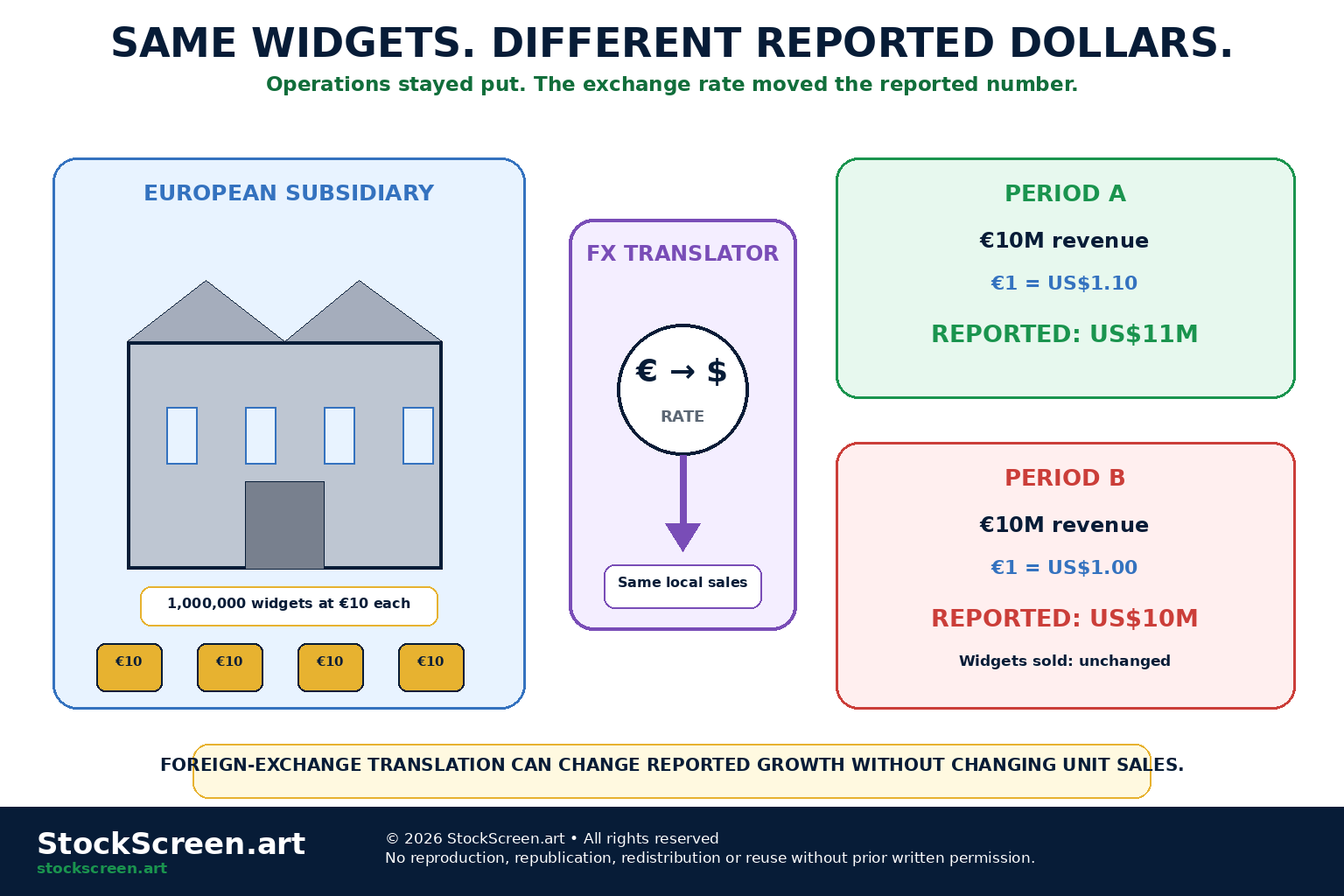
Imagine a company sells exactly:
1,000,000 widgets in Europe
at exactly:
€10 per widget
Nothing changed operationally.
Same customers.
Same widgets.
Same euro revenue.
Yet the company reports less revenue in U.S. dollars this quarter.
The accounting department did not lose a warehouse.
The exchange rate moved.
What Is Currency Risk for Companies?
Currency risk for companies is the possibility that exchange-rate changes alter reported revenue, costs, profit margins, asset values, debt burdens or competitive position. A company can have meaningful foreign-exchange exposure even when it is not speculating in currencies.
Corporate FX risk usually appears in three broad forms: transaction exposure from specific foreign-currency receivables, payables or debt; translation exposure from converting foreign operations into the reporting currency; and economic exposure from longer-term changes in competitiveness, pricing and cash flow.
A useful company-level framework is: Revenue currencies → Cost currencies → Debt and assets → Transaction exposure → Translation exposure → Economic exposure → Natural hedges → Derivative hedges → Net FX sensitivity. The important question is not simply whether a currency rose or fell, but which parts of the business are exposed to that move.
1. Exchange rates are relative prices
Investor.gov defines a foreign-exchange rate as the price of one country's currency in terms of another country's currency.
A currency does not simply become “strong.”
It strengthens relative to another currency.
The Canadian dollar can strengthen against the U.S. dollar while weakening against another currency.
Currency needs a comparison partner.
2. Quote conventions matter
Consider:
USD/CAD = 1.35
In that quotation, one U.S. dollar costs 1.35 Canadian dollars.
If USD/CAD rises to 1.40, the U.S. dollar strengthened relative to the Canadian dollar.
If USD/CAD falls to 1.25, the Canadian dollar strengthened relative to the U.S. dollar.
3. Always name both currencies
Saying:
“The dollar went up.”
can be dangerously incomplete.
Better:
“The U.S. dollar strengthened against the Canadian dollar.”
Foreign exchange rewards specificity and punishes vague nouns.
4. Corporate FX Exposure Is Not Forex Trading
A multinational company can have major currency exposure even if management never makes a speculative currency trade. The earlier Forex and Currency Pairs lesson explains how exchange-rate quotations work; this lesson focuses on the corporate consequences of those currency moves.
Currency exposure can arise naturally from:
- foreign customers;
- foreign suppliers;
- foreign subsidiaries;
- foreign debt;
- foreign assets;
- cross-border contracts.
The business created the exposure by doing business.
5. How Currency Moves Affect Foreign Revenue
Suppose a U.S.-reporting company earns revenue in euros.
When it reports consolidated results in U.S. dollars, those euro results must be converted into dollars.
A stronger dollar can reduce the dollar value of unchanged euro revenue.
6. Fictional foreign-revenue example
Company EuroWidget earns:
€10 million
If:
€1 = US$1.10
then translated revenue is approximately:
US$11 million
7. Same operations, different exchange rate
Next period the company again earns:
€10 million
But now:
€1 = US$1.00
translated revenue is approximately:
US$10 million
Local-currency revenue:
unchanged
reported U.S.-dollar revenue:
down about 9.1%
Nothing happened to widget demand.
The currency changed the translation.
8. Translation can affect growth rates
Suppose last year's reported foreign revenue was US$11 million and this year's is US$10 million solely because of exchange rates.
Reported growth looks negative.
Local-currency growth is zero.
Both statements can be correct.
9. How Currency Moves Affect Company Costs
Now reverse the company.
A Canadian company buys U.S.-dollar components.
Its product is sold mainly in Canada.
A weaker Canadian dollar can raise the Canadian-dollar cost of those U.S.-dollar inputs.
10. Fictional import-cost example
Suppose a Canadian manufacturer owes a U.S. supplier:
US$10 million
At:
USD/CAD = 1.25
the Canadian-dollar cost is:
C$12.5 million
11. Domestic currency weakens
If USD/CAD rises to:
1.35
the same US$10 million invoice costs:
C$13.5 million
Same supplier.
Same number of components.
One million additional Canadian dollars of cost.
12. The exporter/importer seesaw
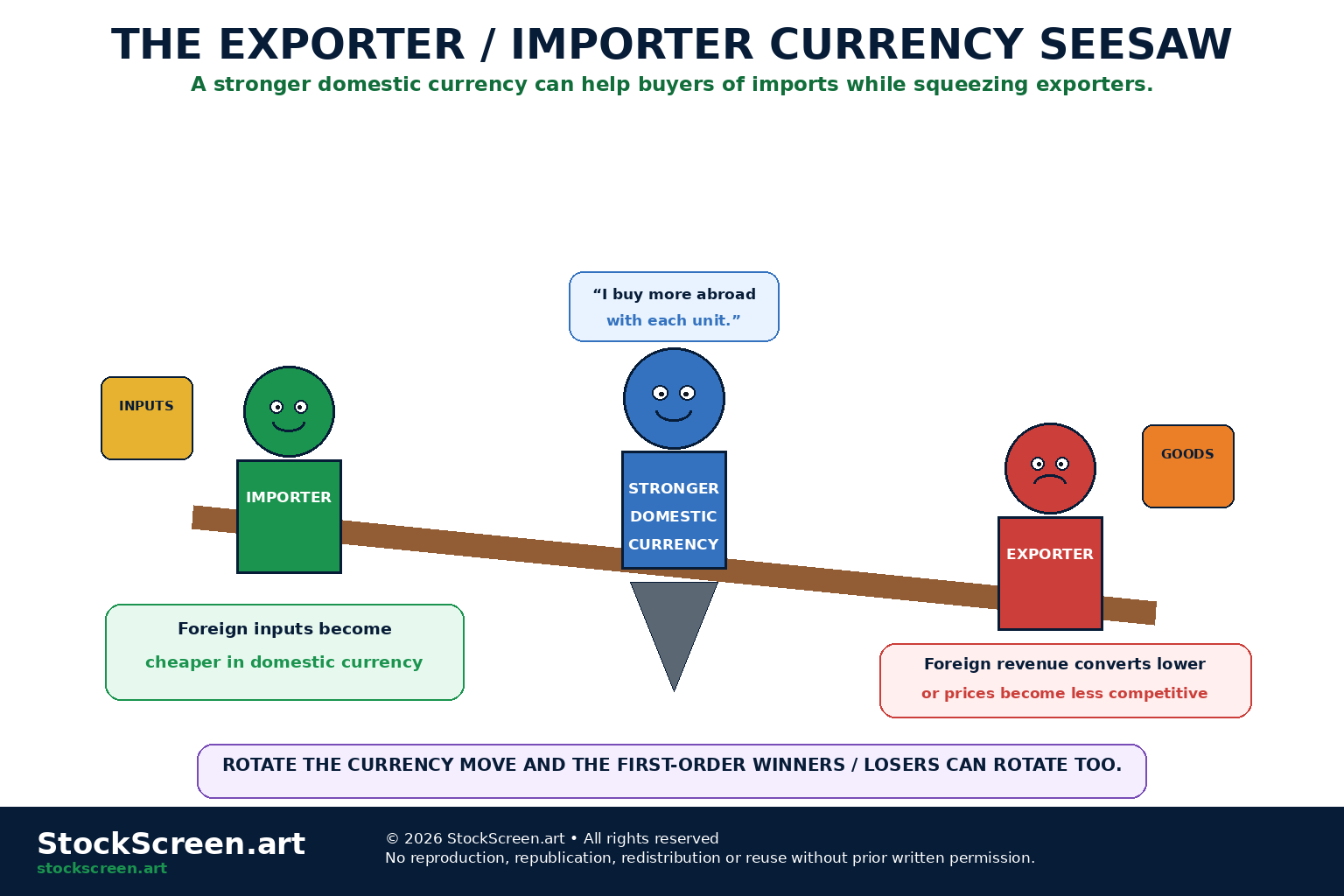
Bank of Canada educational material captures the intuition cleanly: a stronger Canadian dollar can help businesses that rely heavily on imports, while creating challenges for businesses that depend heavily on exports.
A weaker Canadian dollar can reverse that first-order relationship.
13. Why exporters can dislike a stronger domestic currency
Suppose a Canadian exporter sells a product in the United States.
If the Canadian dollar strengthens, the company can face a choice:
- raise the U.S.-dollar price to preserve Canadian-dollar margin;
- keep the U.S.-dollar price stable and accept fewer Canadian dollars per sale;
- reduce costs;
- hedge;
- accept lower margin temporarily.
Currency becomes a competitiveness problem, not merely an accounting problem.
14. Why importers can like a stronger domestic currency
If a domestic company buys foreign components, a stronger domestic currency can reduce the domestic-currency cost of those imports.
That can support:
- gross margins;
- lower selling prices;
- more capital spending;
- higher purchasing power.
Whether the benefit reaches shareholders depends on competition and pricing.
15. Revenue and costs can both be foreign
A multinational may:
- sell in euros;
- manufacture in euros;
- borrow in euros;
- report in U.S. dollars.
The company is not simply “long euros.”
We need the full map.
16. What Is Transaction Currency Exposure?
Transaction exposure comes from specific contractual or monetary amounts denominated in a foreign currency.
Examples:
- a foreign-currency receivable;
- a foreign-currency payable;
- a foreign-currency loan;
- a committed purchase;
- a committed sale.
17. Receivable example
A Canadian company invoices a U.S. customer:
US$1 million due in 90 days
The company now has exposure to the USD/CAD rate until:
- the customer pays;
- the company hedges;
- the exposure is otherwise offset.
18. Payable example
A U.S. company owes a European supplier:
€5 million in 60 days
If the euro strengthens against the dollar, the U.S.-dollar cost of that payable can rise.
The company can be profitable operationally and still dislike Tuesday's currency market.
19. What Is Translation Currency Exposure?
Translation exposure arises when a company converts the financial statements of foreign operations into its reporting currency for consolidated reporting.
Accounting standards contain detailed rules governing this process.
IFRS IAS 21, for example, addresses foreign-currency transactions and the translation of foreign operations.
20. Translation is not necessarily cash flow
A translation change can alter:
- reported revenue;
- reported profit;
- reported assets;
- reported equity measures
without creating an equal immediate cash receipt or payment.
This distinction matters when reading earnings reports.
21. Transaction versus translation
| Exposure | Core Question | Example |
|---|---|---|
| Transaction | What foreign-currency amount must actually be received or paid? | US$ receivable due in 90 days |
| Translation | How do foreign operations appear when converted into the reporting currency? | Euro subsidiary consolidated into U.S.-dollar statements |
22. What Is Economic Currency Exposure?
Economic exposure is broader.
It asks how exchange rates change the company's future competitive position and cash flows.
This can happen even when there is no current foreign-currency invoice.
23. Competitor exposure
Imagine:
- your company manufactures in Canada;
- your competitor manufactures in the United States;
- both sell into the same market.
A large USD/CAD move can change relative production costs and pricing flexibility.
No foreign receivable is required.
24. Economic exposure can be indirect
A domestic company can have currency exposure through competitors.
Example:
- domestic manufacturer has no foreign sales;
- foreign competitor's currency weakens;
- competitor can cut domestic-market prices;
- domestic manufacturer's margin comes under pressure.
Foreign exchange has entered through the side door.
25. Functional currency
Accounting frameworks use the idea of a functional currency: the currency of the primary economic environment in which an entity operates.
A multinational parent can have one reporting currency while individual subsidiaries operate with other functional currencies.
26. Reporting currency
The reporting or presentation currency is the currency in which consolidated financial statements are presented.
A company can operate in dozens of currencies and still report one consolidated income statement.
That requires a lot of translation.
27. Invoicing currency
The currency printed on the invoice can matter separately.
A Canadian exporter may sell to a U.S. customer but invoice in:
- U.S. dollars;
- Canadian dollars;
- another agreed currency.
Who carries the exchange-rate risk depends partly on the contract.
28. Pricing currency can differ from production currency
A firm may:
- produce in Canadian dollars;
- price in U.S. dollars;
- buy components in euros;
- report in Canadian dollars.
Anyone who summarizes that company as:
“CAD exporter”
has left several currencies unattended.
29. Dominant-currency pricing
International trade is often invoiced in major currencies, particularly the U.S. dollar, even when neither buyer nor seller is located in the United States.
That can change how exchange-rate movements pass through to prices and trade volumes.
Currency exposure follows contracts, not flags.
30. Pass-through
Exchange-rate pass-through asks how much of a currency change appears in selling prices.
A company may choose to:
- change customer prices;
- absorb the currency move in margin;
- split the difference.
The answer depends on competition and pricing power.
31. Complete pass-through
Suppose the domestic currency weakens 10% against the currency of imported inputs.
If the company raises customer prices enough to offset the full cost increase, pass-through is high.
Margin may be protected.
Demand may not be.
32. Incomplete pass-through
A company may absorb part of the currency move to remain competitive.
Then:
- customer price moves less;
- company margin takes more of the shock.
Exchange rate becomes a margin decision.
33. Currency effects can arrive with a lag
Companies may have:
- hedges;
- inventory purchased earlier;
- fixed-price contracts;
- annual price negotiations.
A currency move today may not fully appear in the income statement this quarter.
34. What Is Constant-Currency Reporting?
Multinational companies often present constant-currency or similar measures to help investors compare operating performance while reducing the effect of period-to-period foreign-exchange movements.
In U.S. securities reporting, constant-currency financial measures can fall within non-GAAP disclosure requirements.
35. Constant currency is a comparison tool
Simplified:
A company asks:
“What would growth have looked like if exchange rates were held comparable between periods?”
This can help separate:
- business growth;
- currency translation.
36. Constant currency is not “the real number”
Reported financial statements still matter.
Currency changed the actual reporting-currency value of foreign operations.
Constant currency answers a supplemental analytical question.
It does not erase the exchange rate from reality.
37. Definitions can differ
SEC guidance warns that non-GAAP measures may not be consistent or comparable across companies.
Companies can use different methods or labels when calculating constant-currency results.
Read the reconciliation.
The footnote is doing cardio for a reason.
38. Reported growth versus constant-currency growth
Fictional example:
- reported revenue growth = 3%;
- constant-currency revenue growth = 8%.
One possible interpretation:
underlying local-currency business grew, while foreign-exchange translation reduced reported growth
But the company's exact methodology must be checked.
39. A currency tailwind can flatter reported growth
The reverse can occur.
A favourable exchange-rate move can increase reported growth even when local operating growth is modest.
Good currency translation is not the same as better unit economics.
40. Revenue and profit can have different FX sensitivity
A multinational might earn:
- 40% of revenue abroad;
but have:
- foreign costs;
- foreign debt;
- hedges
that offset part of the earnings exposure.
Foreign-revenue percentage alone is not the whole FX map.
41. Natural Currency Hedges
A natural hedge exists when business inflows and outflows in the same currency offset one another.
Example:
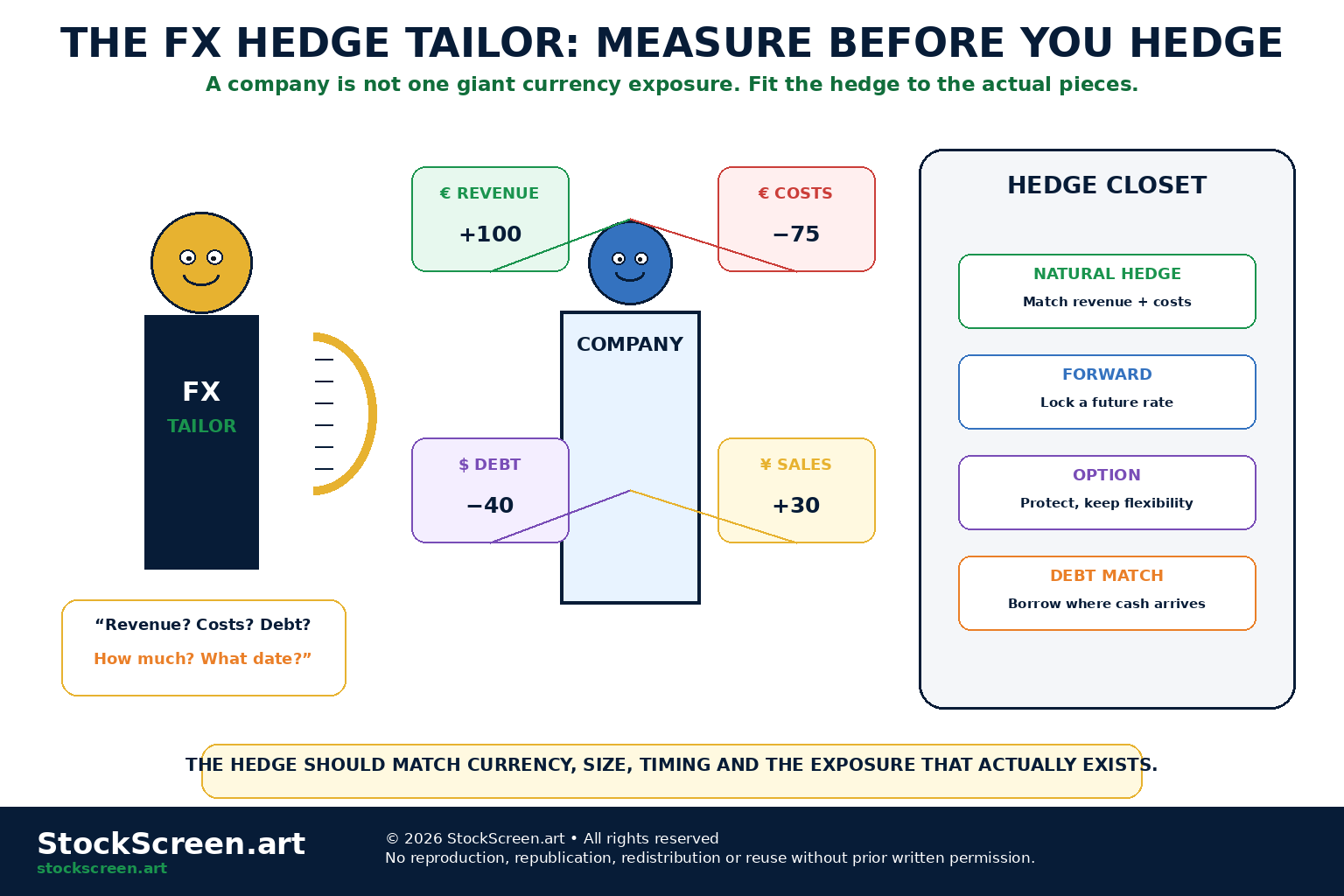
- company earns €100 million;
- company pays €75 million of European operating costs.
The net euro exposure is much smaller than gross revenue alone suggests.
42. Matching revenue and costs
Companies can intentionally place:
- factories;
- suppliers;
- employees;
- financing
in currencies that offset major revenue exposures.
The hedge can live inside the business model.
43. Foreign-Currency Debt and Corporate FX Risk
A company earning substantial euro cash flow might borrow in euros.
Euro revenue can then help service euro debt.
BIS research on corporate foreign-currency borrowing notes that firms can offset FX debt risk with foreign-currency income or assets.
Matching matters.
44. Unmatched foreign-currency debt
Foreign-currency debt becomes more dangerous when the company does not earn enough cash flow in that currency.
Suppose:
- company earns local currency;
- debt is denominated in U.S. dollars;
- local currency weakens sharply.
The local-currency burden of repaying U.S.-dollar debt increases.
45. Balance-sheet FX risk
Currency changes can alter the domestic-currency value of:
- foreign debt;
- foreign cash;
- foreign receivables;
- foreign investments;
- intercompany balances.
FX exposure is not confined to revenue.
46. Foreign investment risk for shareholders
Investor.gov notes that currency changes can increase or reduce the return on an international investment when translated back into the investor's home currency.
A foreign stock can rise in its local market while the investor's home-currency return is lower because the foreign currency weakened.
Stock right.
Currency wrong.
Portfolio confused.
47. ADRs do not remove currency economics
A U.S.-traded depositary receipt may trade in dollars, but the underlying company can still:
- operate abroad;
- earn foreign currencies;
- report in another currency.
Trading currency and economic exposure are not the same thing.
48. Foreign subsidiaries create layered exposure
A multinational parent may have subsidiaries that:
- earn local revenue;
- pay local costs;
- borrow locally;
- send dividends to the parent.
Currency can affect each layer differently.
49. Repatriation
A foreign subsidiary may generate cash in its local currency.
When cash is returned to the parent, the exchange rate at that time affects the parent-currency value.
Tax, legal and capital-control considerations can matter too.
50. Currency controls
Investor.gov notes that some countries can impose currency controls that restrict or delay movement of currency.
That adds another risk:
even if the money exists, can it be converted and moved when needed?
51. FX Forward Contracts for Corporate Hedging
An FX forward can lock an exchange rate today for a currency exchange at a future date.
A company with a known future foreign-currency receivable can use a forward to reduce uncertainty about the reporting-currency value of that cash flow.
52. Forward hedge example
Suppose a Canadian exporter expects:
US$5 million in 90 days
It can enter a forward contract to sell those future U.S. dollars for Canadian dollars at an agreed forward rate.
The future CAD value becomes more predictable.
The company also gives up some benefit if the future spot rate would have been more favourable.
53. Futures
Currency futures can also hedge standardized foreign-exchange exposure.
They trade on exchanges with standardized:
- contract sizes;
- maturities;
- margin requirements.
Standardization improves tradability but may not perfectly match a company's exact exposure.
54. FX swaps
Foreign-exchange swaps exchange currencies and reverse the exchange at a future date under agreed terms.
They are widely used in institutional funding and liquidity management.
The mechanics can become technical quickly.
Foundation Path has placed cones around the advanced plumbing.
55. Currency options
Options can provide protection against adverse exchange-rate moves while preserving some benefit from favourable moves.
The trade-off:
flexibility usually costs premium
Currency insurance has also discovered billing.
56. Forecast exposure
Not every future foreign-currency amount is contractually certain.
A company might forecast:
- US$50 million of future export sales;
but actual sales could be:
- US$35 million;
- US$50 million;
- US$70 million.
Hedging a forecast introduces volume uncertainty.
57. Over-hedging forecast revenue
Suppose the company hedges US$50 million of forecast sales, but only US$30 million occurs.
The hedge may now exceed the underlying exposure.
Part of the “hedge” has become a separate currency position.
Congratulations.
Risk management has accidentally opened a trading desk.
58. Under-hedging
If the company hedges too little, some exposure remains unprotected.
This can be intentional.
Many firms hedge only part of expected exposure because:
- forecasts are uncertain;
- hedges cost money;
- natural offsets exist;
- management wants some favourable currency participation.
59. Hedge horizon
Currency risk can exist for:
- 30 days;
- one quarter;
- one year;
- many years.
A three-month hedge cannot fully protect a five-year economic exposure.
Wrong horizon remains wrong in every asset class.
60. Hedge accounting is separate from hedge economics
A hedge can be economically sensible while creating accounting timing or presentation issues.
Accounting standards contain detailed hedge-accounting requirements.
This lesson focuses on the economic exposure rather than the accounting qualification rules.
61. The FX hedge tailor
Good corporate hedging begins by measuring the actual exposure.
It should ask:
- What currency?
- How much?
- Revenue or cost?
- Committed or forecast?
- What date?
- What natural offsets already exist?
- What debt is in that currency?
62. Export competitiveness
Currency movements can change how expensive a company's products appear to foreign customers.
A stronger home currency can:
- make exports more expensive in foreign-currency terms;
- or compress home-currency margins if the company holds foreign prices constant.
Which occurs depends on pricing strategy.
63. Import competitiveness
A stronger domestic currency can make imported products cheaper.
Domestic producers may face more price competition.
Therefore a company can have FX exposure even if it never imports a single component itself.
64. Tourism and travel
Exchange rates can affect:
- hotel demand;
- air travel;
- cross-border shopping;
- tourist spending.
A stronger domestic currency can make foreign travel cheaper for residents while making the country more expensive for foreign visitors.
65. Luxury goods
Global luxury companies may:
- manufacture in one currency;
- sell in many currencies;
- adjust regional prices;
- face tourist-shopping shifts.
Currency exposure can alter both translation and where customers decide to shop.
66. Technology companies
Large technology companies often earn substantial revenue abroad.
Currency can therefore affect:
- reported revenue;
- reported operating income;
- regional pricing;
- competitiveness;
- cash balances.
Software may live in the cloud.
Revenue still has to choose a currency before entering the 10-Q.
67. Industrials
Industrial companies may have:
- foreign factories;
- foreign suppliers;
- multiyear contracts;
- global bidding competition.
Currency can influence both project economics and competitive pricing.
68. Commodity producers and currency
Many globally traded commodities are priced in U.S. dollars.
A producer can:
- receive U.S.-dollar-linked revenue;
- pay many operating costs in local currency.
If the local currency weakens against the U.S. dollar, local-currency margins can improve, all else equal.
Commodity price and currency therefore interact. The previous Commodity Markets and Sector Effects lesson shows how commodity revenue and input costs can combine with these exchange-rate effects.
69. Airlines can have several currency exposures at once
An airline might:
- sell tickets in local currency;
- buy aircraft in U.S. dollars;
- buy fuel linked to U.S.-dollar commodity pricing;
- borrow in multiple currencies.
One airline.
Several exchange-rate opinions.
70. Banks and foreign currencies
Banks can have currency exposure through:
- foreign loans;
- foreign deposits;
- securities;
- derivatives;
- foreign subsidiaries.
Regulators and banks closely monitor net open foreign-exchange positions because mismatched balance sheets can create risk.
71. Emerging-market foreign-currency debt
BIS research has repeatedly examined risks arising when companies borrow in foreign currencies.
The key issue is mismatch.
Foreign-currency borrowing is less dangerous when the company has offsetting:
- foreign-currency revenue;
- foreign assets;
- hedges.
Debt currency should meet cash-flow currency before signing a long-term relationship.
72. Currency can change leverage ratios
If foreign debt grows in reporting-currency terms because the reporting currency weakens, leverage metrics can worsen even without new borrowing.
Foreign assets or earnings may offset part of the effect.
Again:
map both sides of the balance sheet
73. Currency can affect acquisition economics
A stronger home currency can make foreign acquisitions cheaper in home-currency terms.
A weaker home currency can make them more expensive.
But the target's future earnings will also translate through future exchange rates.
Cheap purchase currency today does not freeze tomorrow's FX.
74. Currency and dividends
A foreign company's dividend can remain unchanged in local currency while changing in the investor's home currency.
Income investors with international holdings therefore carry currency exposure too.
75. Currency and valuation multiples
Currency effects can influence:
- reported earnings;
- reported revenue;
- cash flow;
- debt;
- growth rates.
That means valuation ratios can change partly because of FX translation.
Investors should understand the driver before declaring the business suddenly cheaper or more expensive.
76. A strong currency can be both good and bad for the same company
Example:
- foreign revenue translates lower;
- imported raw materials become cheaper;
- foreign debt becomes cheaper to repay;
- export competitiveness weakens.
One exchange-rate move.
Four arrows.
77. Net Currency Exposure Matters More Than Gross Exposure
Gross foreign revenue may look enormous.
But after:
- foreign costs;
- foreign debt;
- natural hedges;
- derivative hedges
the net earnings or cash-flow sensitivity can be much smaller.
Or much larger.
Measure before narrating.
78. Sensitivity disclosures
Some companies disclose how hypothetical currency moves could affect:
- earnings;
- cash flows;
- fair values;
- market risk.
These disclosures can be useful, but they depend on assumptions and the exposure measured at that point in time.
79. Earnings-call language
Listen for phrases such as:
- currency headwind;
- currency tailwind;
- constant currency;
- transactional FX;
- translation impact;
- natural hedge;
- hedge rate;
- FX-neutral growth.
Each phrase should trigger:
“Show me the mechanism.”
80. Currency headwind does not excuse everything
Management may correctly identify FX as a headwind.
Investors should still ask:
- How large was it?
- Was the exposure expected?
- Was it hedged?
- How did local-currency volume perform?
- Did pricing offset it?
- Did competitors face the same currency?
“FX” is an explanation.
It is not a permission slip.
81. Currency tailwind does not prove operational excellence
Favourable FX can lift:
- reported sales;
- reported earnings;
- reported cash flow.
Investors should separate:
- currency help;
- unit growth;
- pricing;
- margin improvement.
Wind at your back is useful.
It is not the same as stronger legs.
82. A Practical Corporate FX Exposure Map
- Reporting currency: what currency are the statements presented in?
- Revenue currencies: where are customers paying?
- Cost currencies: where are labour, materials and suppliers paid?
- Debt currencies: what currencies must be repaid?
- Cash and asset currencies: what sits on the balance sheet?
- Pricing currencies: what currency appears in customer contracts?
- Natural hedges: which inflows and outflows offset?
- Derivative hedges: what exposure is fixed, capped or protected?
- Hedge horizon: how long does the protection last?
- Competitive exposure: how do currencies affect rivals and customer demand?
83. A Practical Currency-Risk Checklist for Company Earnings
- Reported growth versus constant-currency growth?
- Was FX mainly transaction or translation?
- Did revenue and cost currencies offset?
- How much exposure was hedged?
- What exchange rates were used?
- Did pricing change because of FX?
- Did volume respond?
- Did foreign debt change in reporting-currency terms?
- Is the currency effect temporary, recurring or structural?
- What happens if the currency reverses?
84. Eight terrible currency conclusions
- “The dollar strengthened, so every U.S. company loses.”
- “The company has 50% foreign revenue, therefore 50% of earnings has the same FX exposure.”
- “Revenue fell in dollars, therefore customers bought less.”
- “Constant-currency growth is the real growth number and reported results are optional.”
- “The company hedged FX, therefore currency risk is gone.”
- “The debt is in dollars, but the company is profitable, so currency mismatch does not matter.”
- “The ADR trades in dollars, therefore it has no foreign-currency exposure.”
- “The CFO said ‘currency headwind.’ Investigation complete.”
85. Ten mental models worth keeping
- Every exchange rate is relative.
- Map revenue, costs, assets and debt by currency.
- Transaction and translation exposure are different.
- Economic exposure can exist without a foreign invoice.
- Strong domestic currency often helps importers and challenges exporters, all else equal.
- Reported growth can differ from local-currency operating growth.
- Constant currency is supplemental analysis, not a replacement for reported results.
- Natural hedges can matter as much as derivatives.
- Foreign debt is safest when matched with foreign cash flow or hedges.
- Net exposure matters more than a headline foreign-revenue percentage.
Corporate Currency Risk Questions
How do exchange rates affect companies?
Exchange rates can change the reporting-currency value of foreign revenue and costs, alter the burden of foreign-currency debt, affect import and export competitiveness, change asset values and influence profit margins. The effect depends on the company's specific mix of currencies rather than on whether one currency simply went “up” or “down.”
What is the difference between transaction and translation exposure?
Transaction exposure comes from specific foreign-currency amounts that will actually be received or paid, such as receivables, payables or debt. Translation exposure comes from converting foreign operations and financial statements into the company's reporting currency for consolidated reporting.
What is economic currency exposure?
Economic exposure is the longer-term effect of exchange-rate changes on a company's competitiveness, pricing power, demand and future cash flows. It can exist even when the company has no current foreign-currency invoice.
What does constant-currency growth mean?
Constant-currency growth is a supplemental measure designed to show how results might have changed if exchange rates had been held comparable between periods. It can help separate operating growth from currency translation, but definitions can differ across companies and reported financial results still matter.
How do companies hedge currency risk?
Companies can use natural hedges by matching foreign-currency revenue with costs, debt or assets in the same currency. They can also use forwards, futures, swaps or options to reduce uncertainty. Hedging can reduce risk, but it does not remove cost, basis, timing, counterparty or forecast-volume risk.
Quick knowledge check
Ten questions. Exchange rates may fluctuate before grading.
1. What is an exchange rate?
The price of one currency expressed in terms of another currency.
2. Why can a stronger reporting currency reduce reported foreign revenue?
Because the same amount of foreign-currency revenue converts into fewer units of the stronger reporting currency.
3. What is transaction exposure?
Exposure created by specific foreign-currency receivables, payables, debt or contractual commitments that will be settled in the future.
4. What is translation exposure?
The effect of converting foreign operations or financial-statement amounts into the company's reporting currency for consolidated reporting.
5. What is economic exposure?
The broader effect of exchange-rate changes on a company's competitiveness, pricing, demand and future cash flows.
6. What is a natural currency hedge?
An offset that arises when a company has revenues and costs, assets and liabilities, or debt and cash flows in the same currency.
7. Why might a company use constant-currency growth?
To help investors compare operating performance between periods while reducing the effect of changing exchange rates.
8. Does an FX forward preserve all upside from a favourable currency move?
No. A forward locks an exchange rate, reducing uncertainty but also giving up the benefit of a more favourable future spot rate on the hedged amount.
9. Why can foreign-currency debt be risky?
If the borrower's home or revenue currency weakens against the debt currency, the local-currency burden of debt service can rise, especially when there is no natural or derivative hedge.
10. What is the best first question when a company cites FX as a headwind?
Which currencies affected revenue, costs, debt or translation, and by how much after natural and derivative hedges?
Where we go next
We now know how macro prices move through:
- interest rates;
- the yield curve;
- commodities;
- currencies.
Next comes the ritual where governments publish a number at a precisely scheduled time and several million market participants simultaneously discover they interpreted it differently.
Next:
FND-RW-06 — Economic Releases and Market Reactions.
We will examine CPI, employment, GDP and other releases, why expectations matter more than headlines alone, and why “good data” can produce a bad market day before breakfast is finished.
Primary sources & further reading
- Investor.gov — Foreign Currency Exchange
- Investor.gov — International Investing
- Bank of Canada — Understanding Exchange Rates
- IFRS Foundation — IAS 21: The Effects of Changes in Foreign Exchange Rates
- U.S. Securities and Exchange Commission — Non-GAAP Financial Measures Guidance
- Bank for International Settlements — FX Debt and Optimal Exchange Rate Hedging