AlphaEngine Scan Summary
Most investing tools are built around a familiar question:
What should I buy?
It is the question investors naturally ask. We look for companies with strong growth, improving earnings, reasonable valuations, good momentum or a compelling story. Increasingly, we also look to artificial intelligence to help sort through the noise.
But that question only takes us so far.
An investor does not experience a stock in isolation. Once it is purchased, it becomes part of a portfolio. It begins interacting with everything else the investor owns.
That changes the problem.
A stock may look attractive on its own and still be a poor addition to a particular portfolio. It may add too much exposure to one sector. It may behave almost exactly like several existing holdings. It may depend on the same interest-rate environment, commodity cycle or consumer trend.
This is easy to overlook because the company names may be different.
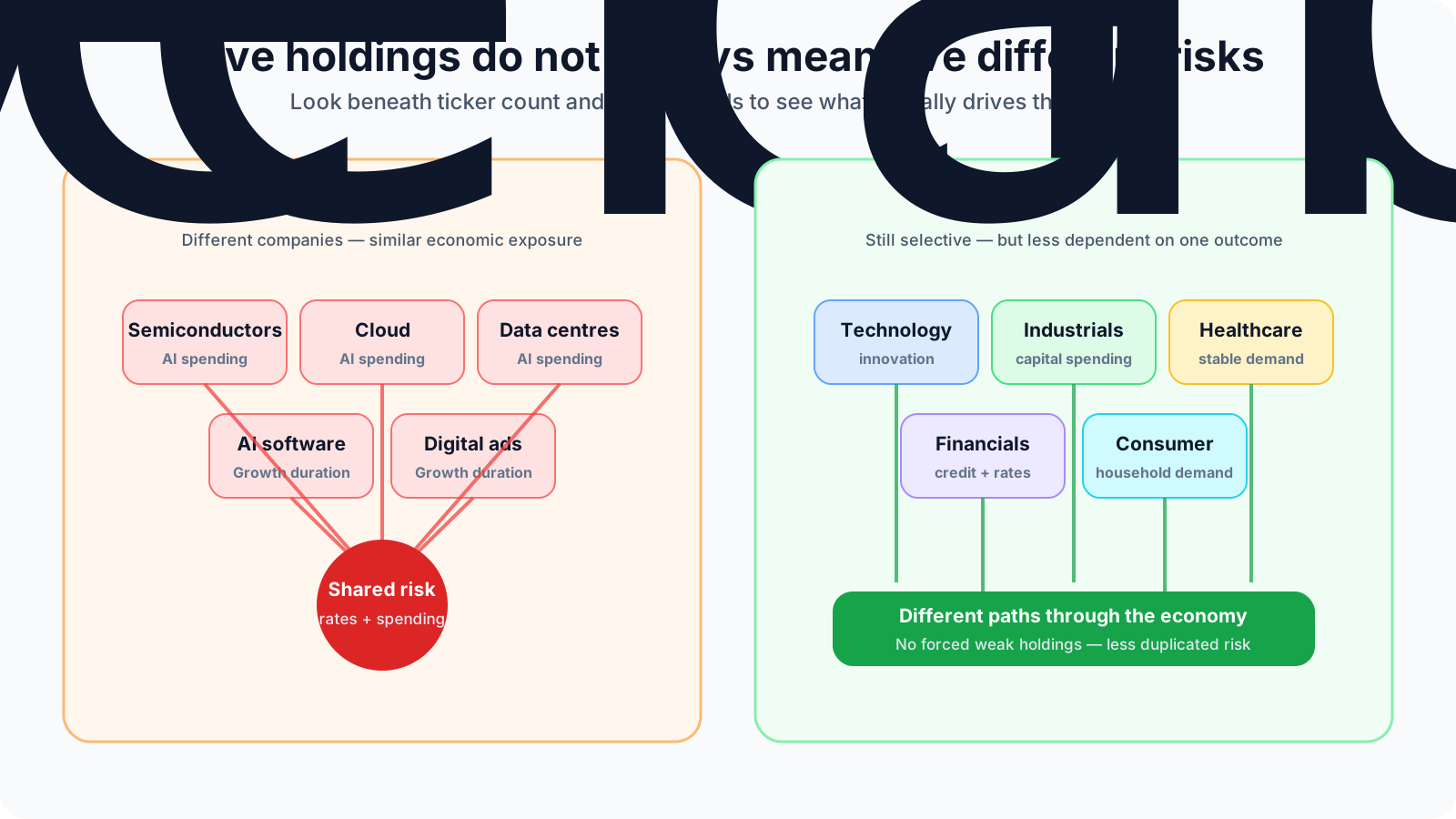
A semiconductor manufacturer, a cloud-computing company and a data-centre supplier may appear to be three separate investments. In reality, all three may be tied to the same wave of technology spending. If that spending slows, the diversification may disappear very quickly.
That is why the future of AI in investing is unlikely to be limited to picking better stocks.
The more interesting challenge is building better portfolios.
That portfolio-level problem begins after the single-stock research problem. For the broader framework behind how artificial intelligence can support security-level research, see our AI stock analysis guide.
What is AI portfolio management?
AI portfolio management uses statistical models, machine learning or other algorithmic methods to support decisions about how investments should fit together—not just which individual securities look attractive. The focus moves from a single-stock question to portfolio-level questions involving diversification, correlation, concentration, position size, changing market conditions and risk.
AI portfolio optimization is closely related, but the useful goal is not to produce a mathematically perfect allocation from uncertain inputs. A more defensible use of AI is to improve those inputs, identify overlapping exposures, monitor changing relationships and help test whether a proposed portfolio remains balanced under current conditions.
That means the strongest-ranked stocks do not automatically become the strongest portfolio. AlphaEngine™ quantitative stock rankings can help identify attractive candidates, while portfolio construction asks a different question: which combination of those candidates creates the most sensible overall exposure?
Five good stocks can still be one big bet
Imagine that an AI system analyzes hundreds of companies and identifies five especially attractive opportunities.
The list includes a semiconductor company, a cloud-infrastructure provider, an AI software business, a digital-advertising platform and a data-centre equipment manufacturer.
Every company may deserve its place on the list. Each may have strong momentum, attractive expected upside and a favourable probability score.
Still, the portfolio has a problem.
All five holdings may be vulnerable to the same change in market mood. They may all suffer if real interest rates rise, technology spending slows or investors move away from high-growth companies.
The portfolio contains five ticker symbols, but it may really contain only one investment idea.
Now consider a slightly different group: one technology company, one industrial business, one healthcare company, one financial company and one consumer company.
Perhaps the second portfolio has a slightly lower average AI score. Perhaps the industrial or healthcare company ranked seventh rather than third.
That does not automatically make the second portfolio worse.
It may be better balanced. Its holdings may respond to different economic forces. One position may hold up when another struggles. The portfolio may have less exposure to a single market narrative.
This does not mean investors should include weak companies for the sake of variety. Diversification should not become an excuse to lower standards.
Find strong opportunities without accidentally making the entire portfolio dependent on the same outcome.
That is not just stock selection. It is portfolio construction.
The idea that changed portfolio management
Modern Portfolio Theory is sometimes presented as a collection of equations, but its central insight is easy to understand.
An investment cannot be judged only by its own return and volatility. We also need to understand how it behaves alongside the other investments in the portfolio.
Two volatile assets can sometimes work well together if they tend to move differently. Two apparently stable assets can create more risk than expected if they respond to the same conditions.
In other words, the relationships matter.
This changed the meaning of diversification. It was no longer enough to own a large number of securities. Investors needed to think about how those securities behaved together.
That thinking eventually led to the efficient frontier: the idea that some portfolios provide a better balance of expected return and risk than others.
The mathematics was important, but the practical lesson was even more useful:
A portfolio should be designed as a whole. It should not be assembled as a pile of unrelated recommendations.
The theory remains valuable. The trouble lies in the estimates it needs.
This is where the real world gets messy
A portfolio model needs assumptions.
It needs an estimate of what each investment may return. It needs an estimate of volatility. It needs to know how the holdings are likely to move relative to one another.
None of those quantities is known in advance.
Expected returns are particularly difficult. Historical averages depend heavily on the period selected. Analyst forecasts can be optimistic. Recent performance can dominate our expectations even when it is unlikely to continue.
Correlations are not fixed either.
Two stocks may appear to move independently for years, then suddenly fall together during a crisis. Diversification that looks convincing in a spreadsheet can become much less useful when markets are under pressure.
Volatility changes too. A quiet stock can become unstable after an earnings disappointment, a regulatory problem or a shift in its industry.
Traditional portfolio optimization is therefore built on an awkward foundation: a strong framework using inputs that are often uncertain and unstable.
Small changes in those inputs can lead to surprisingly large changes in the recommended portfolio.
That is one reason optimization can create false precision. A portfolio may look mathematically exact even though the assumptions behind it are rough.
This is where AI may have something useful to contribute.
How AI Portfolio Optimization Can Improve the Inputs
There is a tendency to talk about AI as though it will sweep away everything that came before it.
In portfolio management, that would be a mistake.
AI does not make diversification irrelevant. It does not remove the need for risk limits, position sizing or judgement. It does not solve uncertainty.
What it may do is help us work with better, more responsive information.
Portfolio theory asks
- How should investments be combined?
- How concentrated is the portfolio?
- Which positions add the most risk?
- Which holdings are likely to move together?
- Is the expected reward worth the risk?
AI can help ask
- Which securities currently appear strongest?
- Which risks seem to be increasing?
- Which sectors are improving?
- Are recent correlations changing?
- Is behaviour shifting from its own history?
The two approaches are not competitors.
Portfolio theory gives us the structure. AI may help make the structure less static.
Markets do not behave the same way all the time
A common weakness in traditional models is their reliance on long-term averages.
A stock may have an average return, an average volatility and an average correlation with the market. Those numbers are useful, but they can hide important differences.
A financial company may behave one way when the yield curve is steepening and another way when it is flattening. An energy producer may respond differently when oil is rising than when it is falling. A high-growth technology company may react very differently to declining real interest rates than to rising ones.
The same security can have several personalities depending on the environment.
This is one area where AI and machine learning may become genuinely useful. Instead of asking only how a security behaved on average, a system can ask how it behaved under conditions similar to those we are seeing now.
It might examine whether a stock is becoming more sensitive to interest rates, whether its sector is gaining relative strength, whether volatility is expanding, whether downside moves are becoming more severe, or whether the stock is becoming more correlated with the rest of the portfolio.
None of this produces certainty. Markets do not become predictable simply because more data is being analyzed.
The goal is more modest: to make the portfolio's assumptions more responsive to current conditions.
Stock Ranking Is Not the Same as AI Portfolio Management
This distinction matters for StockScreen.art.
A ranking system and a portfolio-construction system answer different questions.
A ranking system asks:
Which securities look strongest on their own?
A portfolio system asks:
Which combination of those securities makes the most sense together?
The StockScreen.art research architecture is already moving through several layers.
The universe-construction process determines which securities are suitable for serious analysis. It filters out instruments that do not fit the research mandate and focuses on companies with usable history, sufficient liquidity and appropriate listing characteristics.
AlphaEngine™ quantitative stock rankings then ask whether a security currently has a credible setup. The engine examines trend, momentum, relative strength, liquidity and trade structure.
MLAlpha works at the next level. It compares qualified candidates and estimates which appear more likely to produce favourable relative outcomes. Our machine learning stock ranking research explains the historical cohorts, walk-forward validation, calibration and production controls behind that narrower ranking task.
Market and sector context add another layer. A good stock can still face an unfavourable economic or industry backdrop; our AI market regime analysis research explores that contextual problem in more detail.
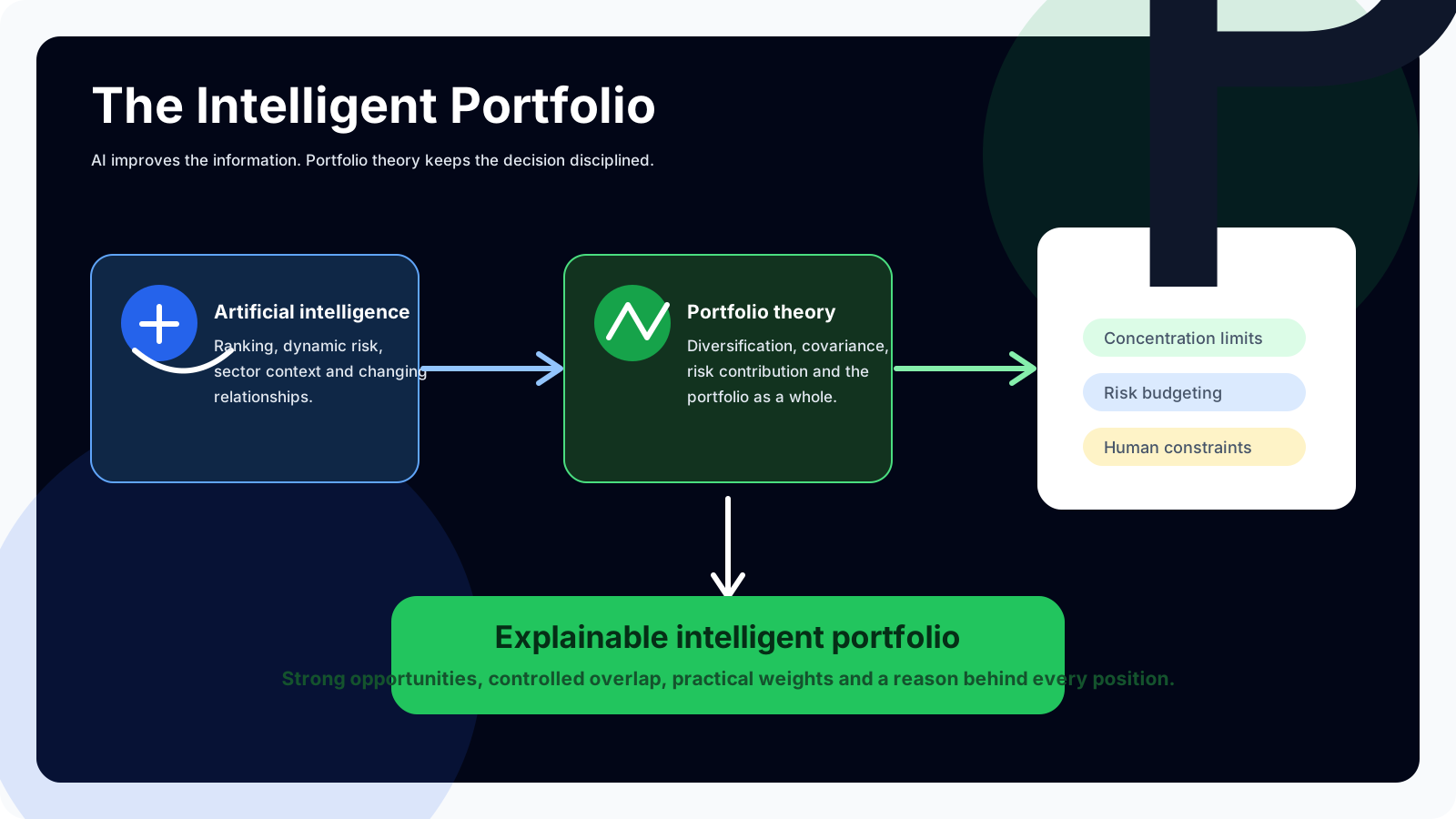
The portfolio layer would bring those pieces together.
It would ask which of the strongest candidates should be held at the same time, how much should be allocated to each, whether several positions are expressing the same idea, whether one sector is dominating the portfolio, and whether a slightly lower-ranked security would improve the overall balance.
That is where AI-assisted stock research starts becoming portfolio intelligence.
Sometimes the sixth-ranked stock belongs in the portfolio
Suppose MLAlpha ranks ten securities.
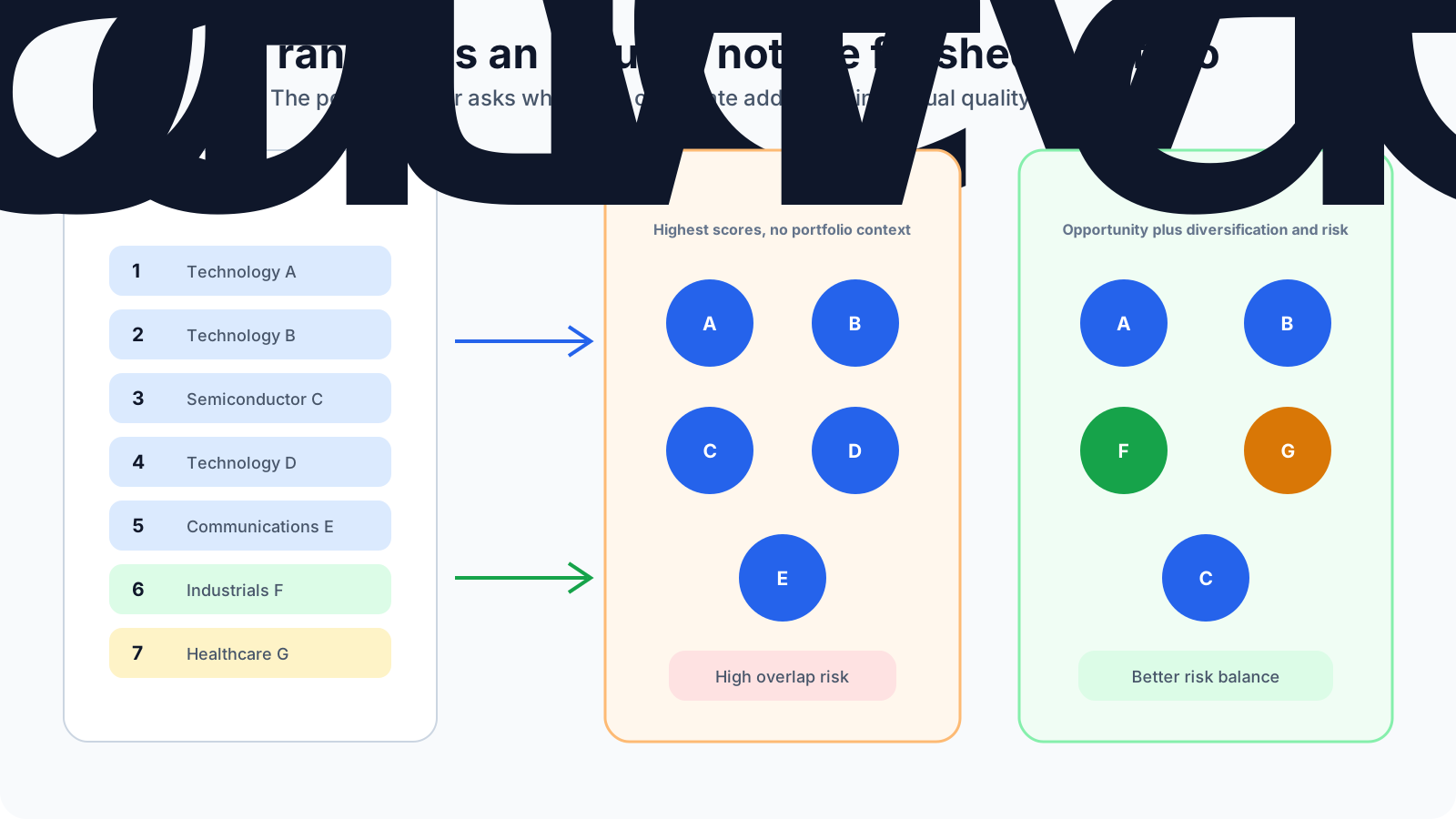
The top five have the highest estimated probabilities, so a basic system selects those five automatically.
A portfolio-aware system may not.
Perhaps four of those five companies belong to closely related industries. Their recent returns may be strongly correlated. They may all be sensitive to the same interest-rate move.
The sixth-ranked candidate may add something the others do not.
It may operate in a different part of the economy. It may have lower correlation with the leading names. It may provide more stable downside behaviour. It may benefit from a different sector cycle.
Adding it could reduce the average prediction score of the portfolio very slightly while improving the portfolio itself.
That is not an inconsistency.
It simply reflects the fact that the best five individual stocks are not always the best five-stock portfolio.
Diversification is not a headcount
People often talk about diversification as though it can be measured by counting positions.
Ten stocks must be more diversified than five. Twenty must be better than ten.
It is not that simple.
A portfolio can own many securities and still be concentrated in one economic idea.
Consider a portfolio containing regional banks, a mortgage lender, an insurance company, a homebuilder and a real-estate investment trust. The companies sit in different industries, but all may be influenced by rates, lending conditions and credit availability.
The labels differ. The underlying exposure may not.
Real diversification requires us to look beneath the company name and ask what is actually driving the investment.
That may include interest-rate sensitivity, consumer demand, commodity prices, credit conditions, economic growth, market volatility, momentum, company size, defensive characteristics and common downside behaviour.
AI may help identify these overlapping exposures, especially when the relationships cross normal sector boundaries.
Correlations tend to become uncomfortable at the worst time
Historical correlations are useful, but they are not promises. The Foundation lesson on drawdowns and volatility goes deeper into how changing volatility, concentration and correlation can magnify portfolio losses.
Two holdings may behave differently during calm markets and then fall together when investors become fearful. In periods of stress, many assets begin responding to the same forces: liquidity, risk aversion, forced selling or a rush toward safety.
This creates one of the most frustrating features of diversification. It can look strongest when it is least needed and weaken when it matters most.
A more adaptive system would not rely on one permanent correlation estimate.
It could examine how relationships changed during high-volatility markets, rapid interest-rate increases, sector selloffs, economic slowdowns and prior market shocks. It could also monitor whether recent correlations are rising.
The purpose would not be to predict the next crisis. It would be to recognize when the portfolio is becoming more connected than it appears.
Every sector has its own story
One of the more promising research directions is the idea that sectors do not all share the same market regime.
The market is rarely moving as one uniform block.
Energy may be strengthening because commodity prices are rising. Industrials may be benefiting from capital spending. Financials may be improving as credit conditions stabilize. At the same time, consumer companies may be weakening and rate-sensitive real estate may still be under pressure.
Calling the entire market bullish or bearish can miss these differences.
A more useful system might evaluate each sector on its own terms. It could ask whether the sector is outperforming the broader market, whether participation is broad, whether the sector's economic drivers are improving, and whether its strongest individual securities are confirming the trend.
A bullish sector would not make every stock in that sector attractive.
It would provide context.
A security that already qualifies through AlphaEngine and ranks well through MLAlpha may deserve additional attention if the sector's economic and market conditions are also improving.
A strong company in a weak sector should not automatically be excluded either. It may be unusually resilient or have company-specific advantages.
The sector signal should inform the decision, not dictate it.
This is still an active research direction. It should be treated that way. But it illustrates the kind of information a future portfolio layer could use.
Position sizing changes everything
Even after deciding which securities belong in the portfolio, one major question remains. The Foundation lesson on position sizing develops the underlying portfolio-weight, risk-budget and concentration concepts in more detail:
How much should be invested in each one?
Equal weighting is popular because it is simple and transparent. In many cases, it is a sensible starting point.
But equal dollar weights do not create equal risk.
A 10% position in a mature healthcare company is not necessarily equivalent to a 10% position in a highly volatile small technology company. The dollar values may match, but the effect on the portfolio may be very different.
A risk-aware system may assign smaller weights to securities that are unusually volatile, highly correlated with existing positions, difficult to trade, or exposed to a sector that is already heavily represented.
It may assign more weight to positions that offer strong opportunity while contributing less duplicated risk.
Possible inputs could include volatility, downside deviation, expected drawdown, liquidity, correlation, sector concentration, prediction confidence, risk/reward and economic context.
The weighting policy should not become a black box.
An investor should be able to understand why one position received a larger allocation than another.
Constraints make portfolios more realistic
An unconstrained optimizer can produce bizarre results.
It may recommend placing most of the portfolio in one stock because that stock's estimated return is marginally higher. It may suggest tiny positions that add complexity without adding value. It may change allocations dramatically after a small change in the inputs.
Real portfolios need boundaries.
A practical system may include rules such as a maximum position size, a maximum sector exposure, minimum liquidity, limits on highly correlated positions, turnover limits, a ceiling on total portfolio volatility and a minimum number of meaningful holdings.
These rules are not signs that the model has failed.
They are acknowledgements that the estimates are imperfect.
Constraints can prevent a mathematically optimized portfolio from becoming practically unreasonable. Once target weights exist, portfolio maintenance becomes a separate discipline; the Foundation lesson on portfolio rebalancing and hedging explains how allocations drift and how defined risks can be managed without confusing maintenance with a new stock-selection signal.
The portfolio should be able to explain itself
A stock recommendation should be understandable.
A portfolio decision should be even more transparent.
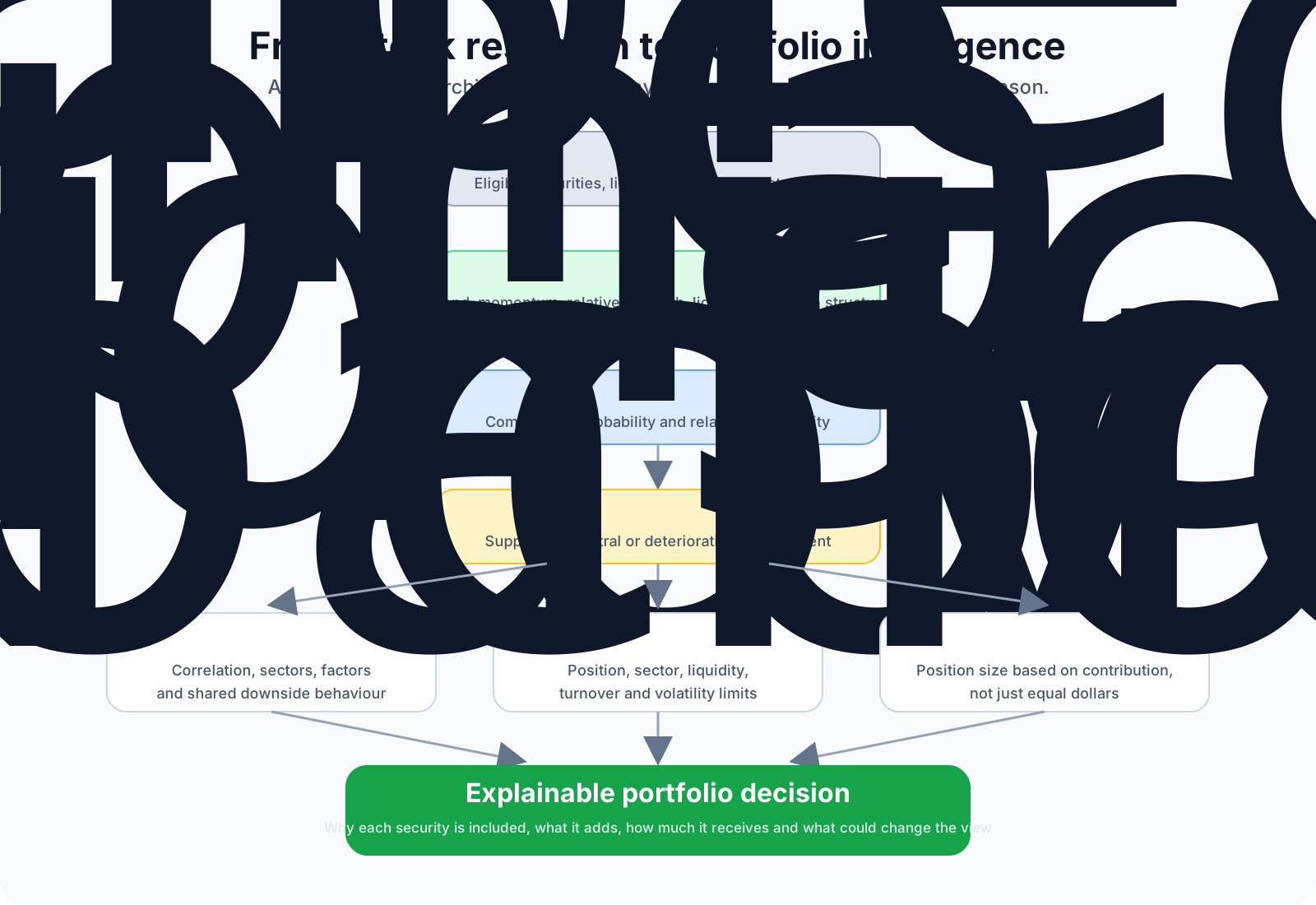
An investor should be able to see why a security was included, why another highly ranked stock was left out, why one position received a smaller weight, which risk the position adds, what exposure it helps diversify and what could cause the portfolio view to change.
This is why StockScreen.art separates concepts that are often compressed into one score.
A company can have a strong quality rating and still be a Hold. The business may be attractive while the current entry, expected upside or risk/reward is not.
The same principle applies at the portfolio level.
A stock may rank highly and still receive a smaller allocation because it duplicates an exposure already present in the portfolio.
That is not conflicting information. It is a more complete analysis.
AI should make the reasoning clearer, not more mysterious
There is a temptation to present AI as an all-knowing system that produces a final answer from somewhere behind the curtain.
That may sound impressive. It is not particularly helpful.
Investors do not need another mysterious score.
They need to know what appears attractive, what risks are being accepted and how each recommendation fits into the larger picture.
AI can process more information than a person can reasonably review. It can compare hundreds of securities, monitor changing relationships and identify patterns that might otherwise be missed. For the broader question of where those capabilities help—and where model confidence can outrun evidence—see our AI stock-picking research.
But the investment policy still needs clear principles: diversification matters, concentration should be controlled, downside risk should be visible, weak securities should not be included simply to fill a category, uncertainty should be acknowledged, and model changes should require evidence.
AI should make portfolio construction more informed without making it less understandable.
What an AI Portfolio Management Process Might Look Like
A future portfolio workflow could develop in stages.
First, the system builds an investable universe. It removes inappropriate instruments and focuses on securities with sufficient liquidity, history and data quality.
Next, AlphaEngine identifies companies with credible technical and risk/reward characteristics.
MLAlpha then ranks those candidates based on learned relative-outcome probabilities.
Sector and market analysis provide context. They help determine whether the environment surrounding each security is improving, stable or deteriorating.
The portfolio layer then examines how the candidates fit together. It looks for overlapping risks, excessive sector exposure, correlation and concentration.
Practical constraints are applied.
Finally, the system determines position sizes and explains the role of each holding.
The result is not merely a ranked list.
It is a portfolio with a reason behind it.
What this could mean for ordinary investors
Most individual investors do not have the time or tools to calculate covariance matrices, monitor sector regimes or estimate how correlations change during market stress.
Many rely on watchlists, analyst recommendations, equal weighting and personal conviction.
Those approaches are understandable. They are also limited.
A well-designed AI-assisted portfolio system could help answer more useful questions:
- Am I too dependent on one sector?
- Do several of my holdings rely on the same economic outcome?
- Would this new stock improve the portfolio or merely duplicate existing risk?
- Which position contributes the most downside exposure?
- Are my holdings becoming more correlated?
- Should a highly volatile opportunity receive a smaller weight?
- Is the portfolio genuinely diversified?
For many investors, these questions may be more valuable than receiving one more Buy rating.
The next step is bigger than stock picking
Artificial intelligence is already changing the way securities are screened and analyzed. The broader AI stock analysis framework explains how AI can support security-level research; for live individual-ticker analysis, MarketEngine™ stock analysis provides the practical research view. The portfolio problem begins after attractive candidates have been identified.
The next step is not simply to produce more accurate rankings.
It is to understand how the opportunities fit together.
A portfolio is where separate investment ideas begin interacting. It is where correlations, concentration, position size and market conditions become real. It is where several good stocks can either balance one another or quietly magnify the same risk.
Modern Portfolio Theory taught investors to pay attention to those relationships.
AI may help us understand how those relationships are changing.
The most promising future is not one where AI replaces portfolio theory or human judgement.
It is one where each plays a clear role.
Portfolio theory provides the discipline. AI helps interpret changing information. Constraints keep the result practical. Human judgement defines the objective and decides how much uncertainty is acceptable.
At StockScreen.art, the work today remains focused on building reliable layers of investment intelligence: a stronger investable universe, disciplined qualification, probabilistic ranking, market context and explainable analysis.
The natural next frontier is connecting those layers at the portfolio level.
Finding a good stock is useful.
Understanding whether it belongs in your portfolio, how much of it you should own and what risk it adds is a much more complete investment decision.
AI Portfolio Management Questions
What is the difference between AI stock picking and AI portfolio management?
AI stock picking focuses on identifying or ranking individual securities. AI portfolio management focuses on how those securities interact once combined, including correlation, concentration, diversification, position sizing and portfolio-level risk.
Can AI optimize a portfolio automatically?
Algorithms can optimize a portfolio under a defined set of assumptions and constraints, but the result is only as reliable as its inputs and objectives. Expected returns, correlations and volatility are uncertain and can change, so practical AI portfolio optimization should include risk limits, diversification constraints and human oversight rather than treating the mathematical optimum as certain.
Does AI replace Modern Portfolio Theory?
No. Modern Portfolio Theory provides a framework for thinking about return, risk and the relationships among holdings. AI can potentially make some of the inputs more adaptive, but diversification, correlation, portfolio constraints and risk discipline remain central to the decision.
Research note: The portfolio-construction layer described in this article is a forward-looking research direction. It is not presented as a completed production capability or as evidence of investment performance.
Reference: Markowitz, Harry. “Portfolio Selection.” The Journal of Finance, vol. 7, no. 1, 1952, pp. 77–91.
Disclaimer: StockScreen.art provides educational investment research and analytical tools. Nothing in this article is personalized financial advice, a recommendation to buy or sell a security, or a guarantee of future investment performance.