Finance loves turning useful ideas into teams.
Bulls versus bears.
Technical versus fundamental.
Active versus passive.
And, naturally:
Growth versus Value.
Entire investment products, indexes and professional careers are organized around those two words.
They are useful.
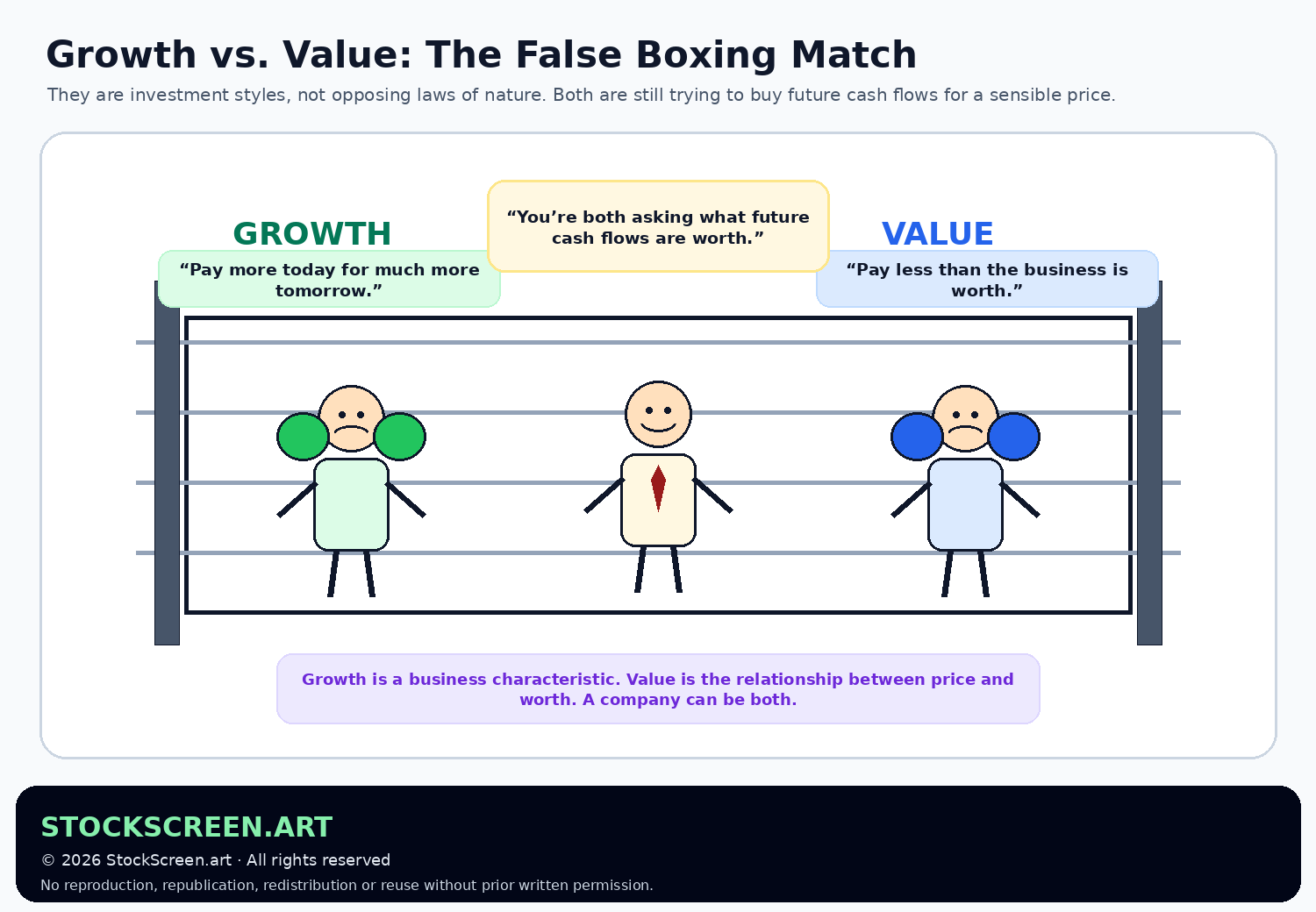
They are also easier to understand if we stop imagining them as two investors throwing chairs at each other.
Value asks: What is the business worth relative to the price I am paying?
Those questions can coexist perfectly well.
1. What is a growth stock?
FINRA describes growth stocks as shares of companies that are expanding, sometimes rapidly and sometimes over a longer period of time.
Growth can come from:
- new products;
- new markets;
- technological advances;
- acquisitions;
- gaining market share;
- increasing customer spending;
- expanding margins.
A growth company does not have to be young.
A mature company can reaccelerate because its strategy, technology or market opportunity changes.
2. Growth is not just revenue growth
A company can grow revenue while creating very little economic value.
Suppose revenue increases 30% but:
- gross margins collapse;
- customer acquisition becomes more expensive;
- share count rises dramatically;
- free cash flow becomes increasingly negative.
The company is growing.
Shareholder economics may not be improving.
Investors therefore look at several forms of growth:
- revenue growth;
- earnings growth;
- free-cash-flow growth;
- growth per share;
- returns on reinvested capital.
3. Why growth companies often trade at higher multiples
Imagine two companies each earning $1 per share today.
Company Slow grows earnings 3% per year.
Company Fast grows earnings 25% per year.
If investors believe Company Fast can sustain that growth, they may rationally pay more for its current $1 of earnings because the future earnings base could become much larger.
This is why growth companies often carry:
- higher P/E ratios;
- higher P/S ratios;
- lower current dividend yields;
- greater expectations embedded in the share price.
Higher multiple does not automatically mean overpriced.
It means investors are paying more for the current denominator.
4. The price paid still matters
Growth investing sometimes becomes:
“Wonderful company. Therefore any price.”
That final step is where the furniture catches fire.
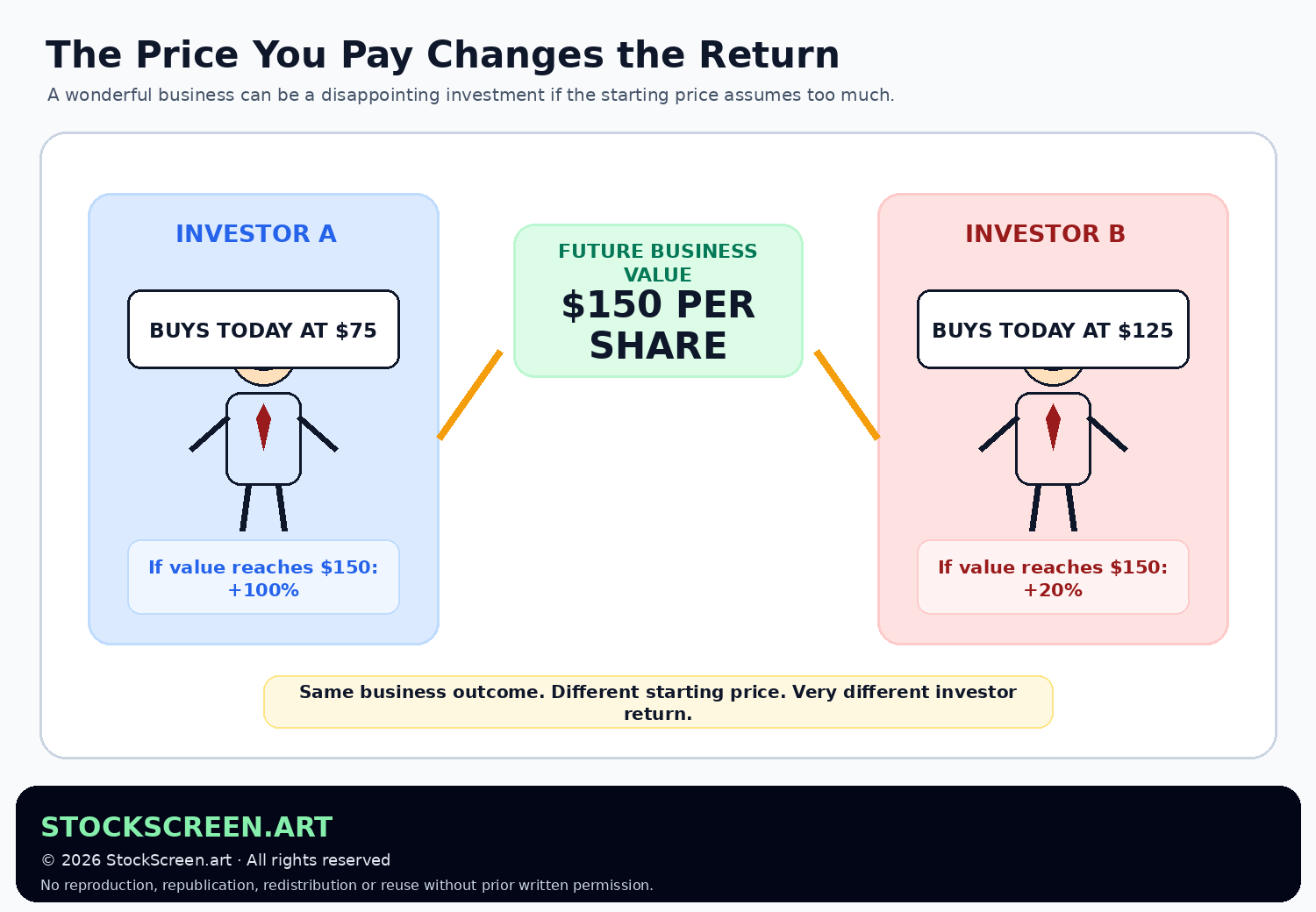
Suppose two investors eventually receive the same business outcome: the company reaches an economic value of $150 per share.
Investor A bought at $75.
Investor B bought at $125.
Same company.
Same ending value.
Very different investment return.
5. Expectations are part of the price
Recall FND-MKT-06:
markets trade expectations.
A stock priced for spectacular growth does not merely need to grow.
It may need to grow as fast as or faster than investors already expect.
Imagine analysts expect 40% revenue growth.
The company reports 28%.
Twenty-eight percent sounds excellent in isolation.
The stock can still fall sharply because the market had priced in more.
6. Multiple compression
Suppose a stock earns $2 per share and trades at 40× earnings:
$2 × 40 = $80 share price
A year later earnings rise 25% to $2.50.
Excellent growth.
But investors now assign the stock only a 25× P/E:
$2.50 × 25 = $62.50
Earnings grew.
The stock fell.
The valuation multiple compressed faster than earnings expanded.
7. Why rates can matter more to high-growth valuations
High-growth companies are often valued heavily on profits expected farther into the future.
As we learned in FND-MKT-06, higher discount rates reduce the present value of distant future cash flows, all else equal.
This does not mean:
“Rates up = every growth stock down.”
Actual company results, investor expectations, balance sheets and industry economics all matter.
But rate changes can be an important valuation headwind or tailwind for long-duration growth expectations.
8. What is a value stock?
FINRA describes value stocks as investments selling at prices that appear low relative to their history and economic position.
The underlying belief is:
“The market price is below what I think the business is worth.”
Value investors often look for characteristics such as:
- low P/E;
- low P/B;
- low EV/EBITDA;
- high free-cash-flow yield;
- strong assets relative to price;
- temporary problems that may eventually improve.
But the ratio is evidence.
The thesis is the reason the ratio is wrong.
9. Value is not the same thing as “low multiple”
This distinction is critical.
A stock trading at 6× earnings can be expensive if earnings are about to collapse.
A stock trading at 25× earnings can be good value if earnings and cash flows compound far faster than the market assumes.
FINRA describes intrinsic value as an estimate based on fundamentals such as earnings, assets, cash flow, growth prospects and interest rates.
10. The value trap
We met the value trap in VAL-04.
It deserves another appearance because it is extremely good at dressing like opportunity.
Imagine:
- P/E: 7×
- P/B: 0.8×
- Dividend yield: 6%
Looks cheap.
Now add:
- revenue falling 12%;
- operating margin shrinking;
- debt rising;
- free cash flow deteriorating;
- competitive position weakening.
The market may not be irrational.
It may be early.
11. “Cheap” earnings can disappear
Suppose a stock trades at $40 and earned $5 per share.
P/E = 8×
Earnings then fall to $2.
If the stock price remains $40:
P/E = 20×
Nothing happened to the numerator.
The cheapness vanished because the denominator weakened.
12. Value investing usually needs a catalyst — or patience
If a stock is genuinely undervalued, one question remains:
“What causes the market to recognize it?”
Possible catalysts include earnings recovery, debt reduction, margin improvement, asset sales, management change, industry recovery, share repurchases or simply enough time for cash generation to become difficult to ignore.
Sometimes no immediate catalyst exists.
Patience is frequently described as a virtue by people whose stocks are currently doing absolutely nothing.
13. A company can be growth and value at the same time
Imagine a company:
- growing earnings 18% annually;
- generating strong free cash flow;
- carrying little debt;
- trading at 14× earnings because the market dislikes its industry.
It clearly has growth characteristics.
It may also be a value investment if your analysis concludes the market price is materially below intrinsic value.
The labels overlap.
The stock does not receive a fine from the Style Police.
14. Growth at a reasonable price
Some investors explicitly combine the two ideas through an approach often called growth at a reasonable price, or GARP.
The philosophy is straightforward:
“I want above-average growth, but I still care what I pay.”
This is less a magical third category than a reminder that growth and valuation belong in the same equation.
15. Why style labels can change
A fast-growing company can mature.
Its growth rate slows.
Its multiple falls.
It begins paying dividends.
It may start appearing in value-oriented portfolios.
Another mature company can discover a new growth engine and begin expanding again.
The business changes.
The price changes.
The label follows.
16. Growth and value can lead at different times
FINRA notes that growth and value returns tend to experience cycles of relative strength and weakness.
Different environments can favor different characteristics.
Growth may benefit when investors strongly reward expanding earnings and are willing to pay higher multiples.
Value may benefit when investors become more price-sensitive, when previously neglected sectors recover, or when expensive expectations are being repriced.
Market regimes do not arrive wearing name badges.
17. Growth risk: expectations are fragile
Common growth-stock risks include:
- growth slowing;
- competition increasing;
- customer-acquisition economics worsening;
- margins failing to expand;
- valuation multiples compressing;
- future estimates proving too optimistic.
The more perfection embedded in the price, the less room exists for ordinary disappointment.
18. Value risk: the market may know something
Common value-stock risks include:
- structural business decline;
- excessive debt;
- cyclical earnings near a peak;
- asset values that deserve write-downs;
- management destroying capital;
- the expected turnaround never arriving.
A stock can remain cheap much longer than the investor remains interested in explaining it at family gatherings.
19. Dividends do not define value
Many mature value-oriented companies pay dividends.
Many growth companies reinvest profits instead.
But a dividend-paying company is not automatically a value stock, and a non-dividend-paying company is not automatically a growth stock.
Dividend policy is one characteristic.
20. Buybacks can appear in both styles
A mature value company may repurchase shares because management believes the stock is undervalued.
A profitable growth company may also repurchase shares to return excess cash or offset dilution.
The question is whether repurchases create value at the price paid.
Buying back an overpriced stock is still buying something overpriced.
The buyer merely happens to be the company.
21. The quality dimension
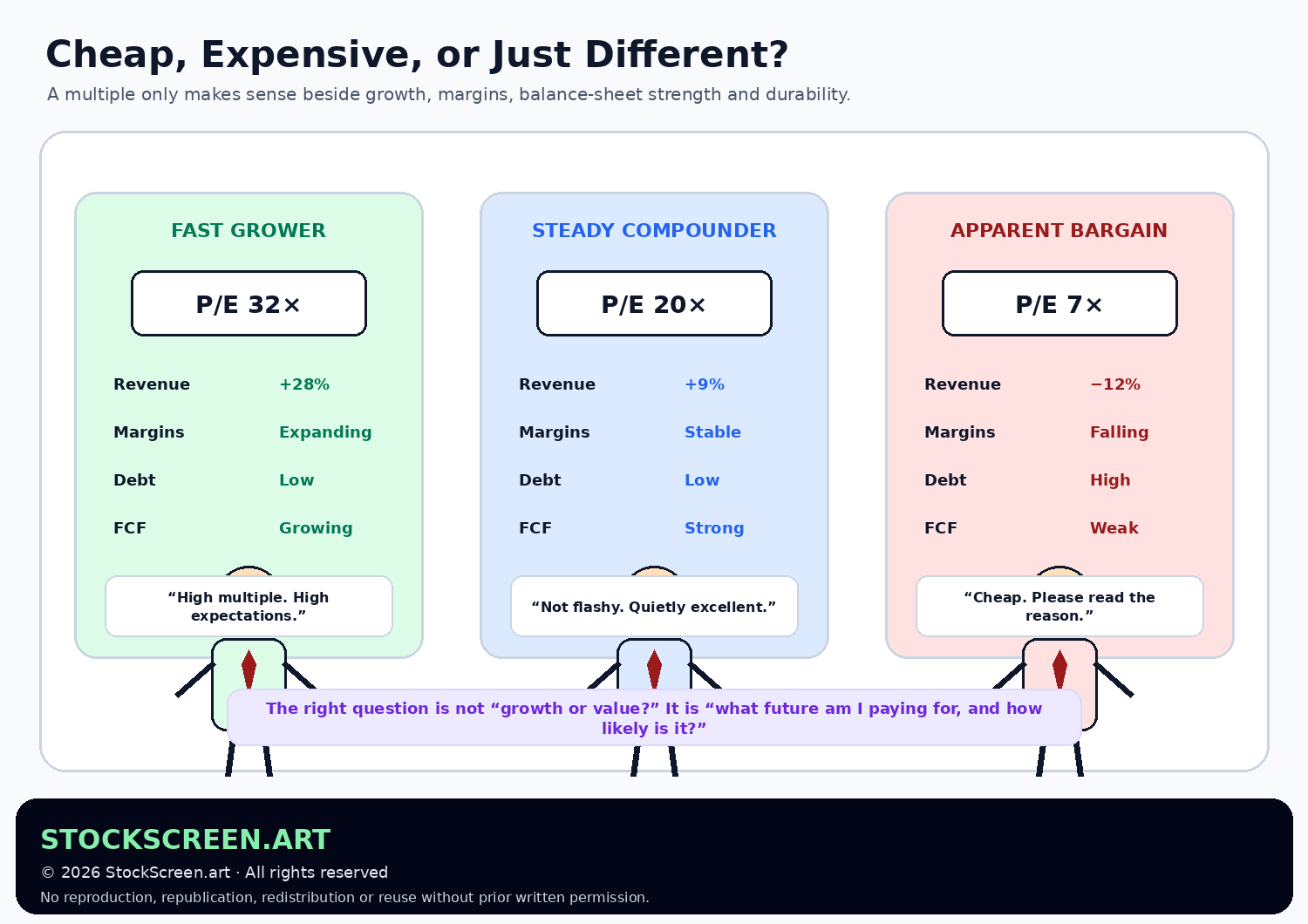
The 7× P/E company is cheapest by one measure.
That does not automatically make it the best value.
The 32× company is most expensive relative to current earnings.
That does not automatically make it a poor investment.
The investor must estimate what happens next.
22. A simple expected-return framework
One useful mental model is to think of future stock return as coming from:
- growth in earnings or cash flow per share;
- dividends or other distributions;
- change in the valuation multiple.
Investor return ≈ business growth + cash distributions + valuation change
This is not a precise forecasting formula.
It helps explain why a slow-growing cheap stock can perform well if its multiple rises, while a fast-growing expensive stock can disappoint if its multiple collapses.
23. The denominator matters again
Suppose:
- Company Growth trades at 35× earnings and grows EPS 25%.
- Company Value trades at 10× earnings and grows EPS 5%.
Which will perform better?
We cannot answer from those four numbers.
We still need to know how long growth persists, what happens to margins, whether cash flow supports earnings, how much leverage or dilution exists, and what future valuation investors assign.
24. Growth per share matters more than company growth alone
Suppose revenue doubles.
Wonderful.
But the company also doubles the number of shares outstanding to fund that growth.
Existing shareholders may not receive anything close to a doubling of economic value per share.
This is why investors track EPS growth, FCF per share and share-count changes.
Companies own businesses.
Investors own shares.
25. Value needs a margin of safety
A classic value-investing idea is to buy with a margin of safety: a meaningful gap between estimated intrinsic value and market price.
Estimates are uncertain.
Revenue forecasts are uncertain.
Margins are uncertain.
Discount rates are uncertain.
Occasionally the spreadsheet is impressively wrong in all four directions at once.
A margin of safety acknowledges uncertainty rather than pretending precision removed it.
26. Growth needs a margin of execution
High-growth investing has a related problem.
If the valuation assumes years of 30% growth, margin expansion, low competitive pressure and successful expansion, management has a narrow corridor to walk.
The company may still succeed spectacularly.
The investor should still understand how much execution is already embedded in the price.
27. Compare companies in context
FINRA emphasizes comparing stock metrics with industry peers and company history.
Compare:
- growth rates;
- margins;
- cash conversion;
- debt;
- valuation;
- competitive position.
A 20× P/E can be expensive in one industry and unusually cheap in another.
Context is not optional.
28. Why this matters for StockScreen.art
StockScreen.art is naturally good at finding stocks where the market is already showing evidence: trend, momentum, relative strength, liquidity and favorable technical risk/reward.
Growth and value analysis adds:
“What sort of business and valuation are sitting underneath that market behavior?”
A strong momentum stock may be a growth company whose fundamentals are accelerating, a value stock being rerated after a turnaround, a high-quality compounder attracting renewed demand, or an expensive narrative approaching expectations that are difficult to satisfy.
The label is less important than understanding which story the evidence supports.
29. Eight mental models worth keeping
- Growth and value are styles, not enemy camps.
- Growth describes what the business may become; value compares price with estimated worth.
- A wonderful company can be a poor investment at an excessive price.
- A low multiple can be opportunity or a value trap.
- Expectations matter: good growth can disappoint if investors expected better.
- Multiple compression can overwhelm earnings growth.
- Per-share growth matters more to shareholders than company size alone.
- Quality, price, cash flow and balance-sheet strength matter more than the label.
Quick knowledge check
Ten questions. No style box is provided for the answers.
1. What generally characterizes a growth stock?
A company expected to expand business measures such as revenue, earnings or cash flow relatively quickly or persistently.
2. What generally characterizes a value investment?
An investment whose market price appears low relative to fundamentals or estimated intrinsic value.
3. Can a company be both growth and value?
Yes. A company can have strong growth while also trading below an investor’s estimate of intrinsic value.
4. Why can a fast-growing company’s stock fall even when earnings rise?
The valuation multiple can compress, or results may fail to meet expectations already embedded in the price.
5. What is a value trap?
A stock that appears cheap on conventional measures but remains cheap or falls further because the underlying business deteriorates or the cheapness was justified.
6. Does a low P/E automatically make a stock a good value?
No. Earnings may be cyclical, deteriorating or unsustainable, and financial risk may justify the low valuation.
7. Why does starting price matter for an excellent business?
Because the investor’s return depends on the price paid relative to the future value eventually realized.
8. Why can high-growth stocks be sensitive to interest rates?
More of their valuation may depend on cash flows expected farther into the future, which are worth less today when discount rates rise, all else equal.
9. Why track growth per share?
Because shareholders own shares. Company-level growth can be diluted if the share count rises substantially.
10. What is the more useful question than simply “growth or value?”
“What future economics am I paying for, how durable are they, and does the current price leave enough room for uncertainty?”
Where we go next
We now have the pieces required to move from comparative shortcuts to an actual valuation model: revenue, earnings, cash flow, balance sheets, multiples and growth expectations.
Next:
FND-VAL-06 — Discounted Cash Flow Fundamentals.
This is where finance politely asks us to forecast the future, discount it back to today, and then act surprised when changing one assumption moves the answer by 30%.
Primary sources & further reading
- FINRA — Stocks: Growth and Value
- FINRA — Evaluating Stocks
- FINRA — Defining the Value of an Investment
- Investor.gov — Price-Earnings (P/E) Ratio