Open almost any brokerage app and the experience looks suspiciously uniform.
Search for a stock. There is a Buy button. Search for a bond ETF. There is a Buy button. Search for another ETF. Also a Buy button.
This is wonderfully convenient and slightly dangerous.
Because the button looks the same, it is easy to assume the thing behind it works the same. It does not.
Three clicks. Three very different legal and economic relationships.
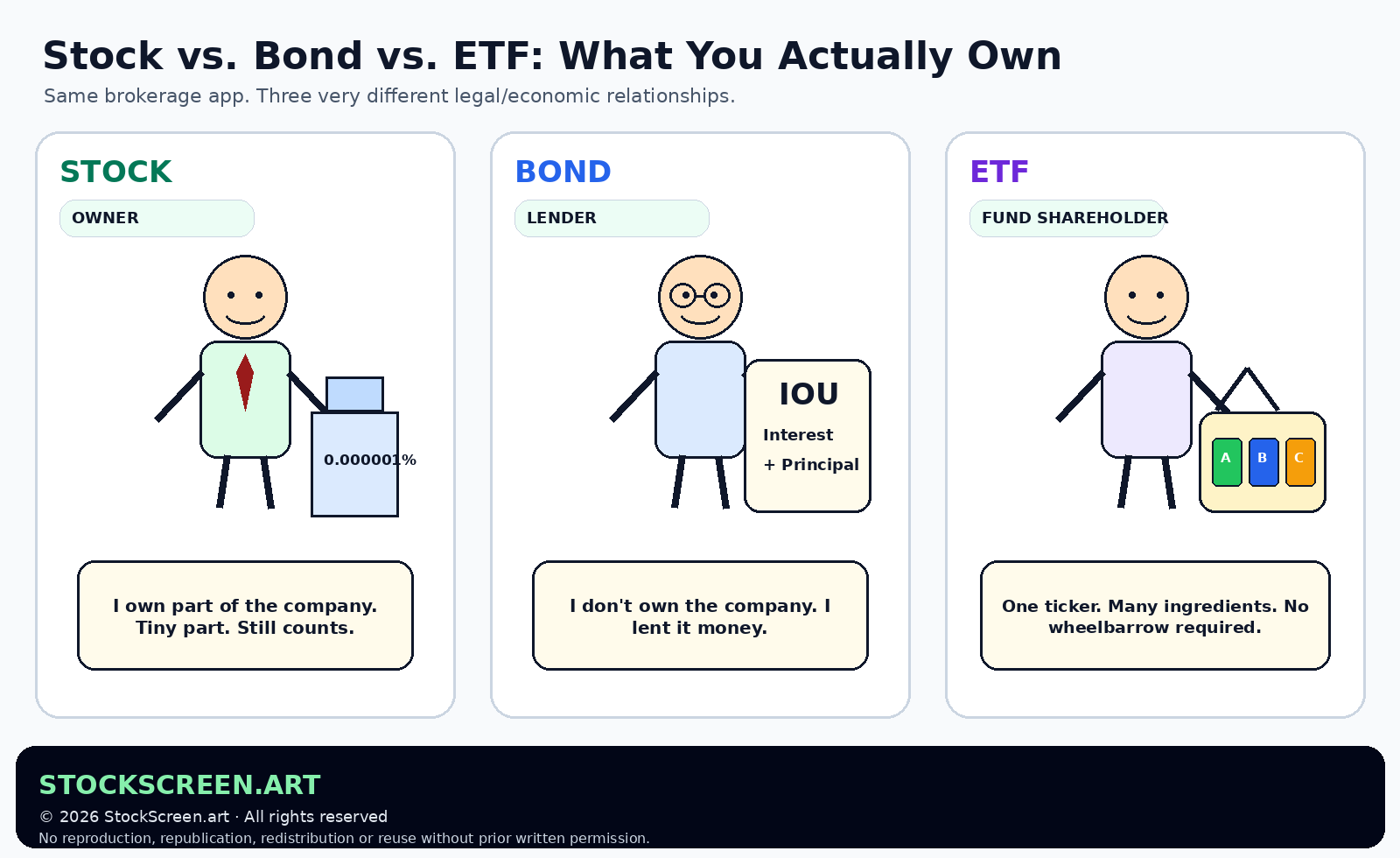
1. Stock: you own part of the company
Investor.gov describes stock as a security that gives stockholders a share of ownership in a company. Stocks are therefore also called equities.
If you own common shares of fictional company XYZ, you are one of its owners.
Maybe a very, very, very small owner.
Owning one share of a company with billions of shares outstanding does not normally entitle you to an office, a parking space, or the right to wander into headquarters and announce: “Relax, everyone. Ownership is here.”
But the economic relationship is real.
What does common-stock ownership usually mean?
Common stock can give shareholders several important economic rights, which may include:
- participation in the company's value if the stock price rises;
- the possibility of dividends if the board declares them;
- voting rights on certain corporate matters, depending on the share class;
- a residual claim on company assets after creditors and other higher-priority claims are satisfied.
That last phrase — residual claim — matters.
Shareholders participate in the upside of the business, but they are also relatively far back in line if the company gets into serious financial trouble. Common shareholders do not have a contractual promise that the company will repay their original purchase price.
Stocks do not mature
Ordinary common stock does not come with a date saying:
“Congratulations. On June 15, 2034, the company will return your original investment and everyone can go home.”
You can continue owning the shares as long as they remain outstanding and you choose to hold them.
Your return generally depends on some combination of:
- price appreciation — someone later values the shares more highly;
- dividends — if the company declares and pays them.
Neither is guaranteed.
2. Bond: you lent somebody money
A bond is fundamentally different.
Investor.gov describes a bond as a debt security, similar to an IOU. Governments, municipalities and corporations issue bonds to borrow money from investors.
When you buy a corporate bond, you are not buying part of the company.
You are lending money to it.
The bond defines a contractual relationship that typically includes:
- principal or face value — the amount scheduled to be repaid;
- interest — payments the issuer agrees to make under the bond terms;
- maturity — the date on which the principal is due;
- other terms that may cover security, seniority, call provisions and additional rights.
Bondholder: “The business owes me money.”
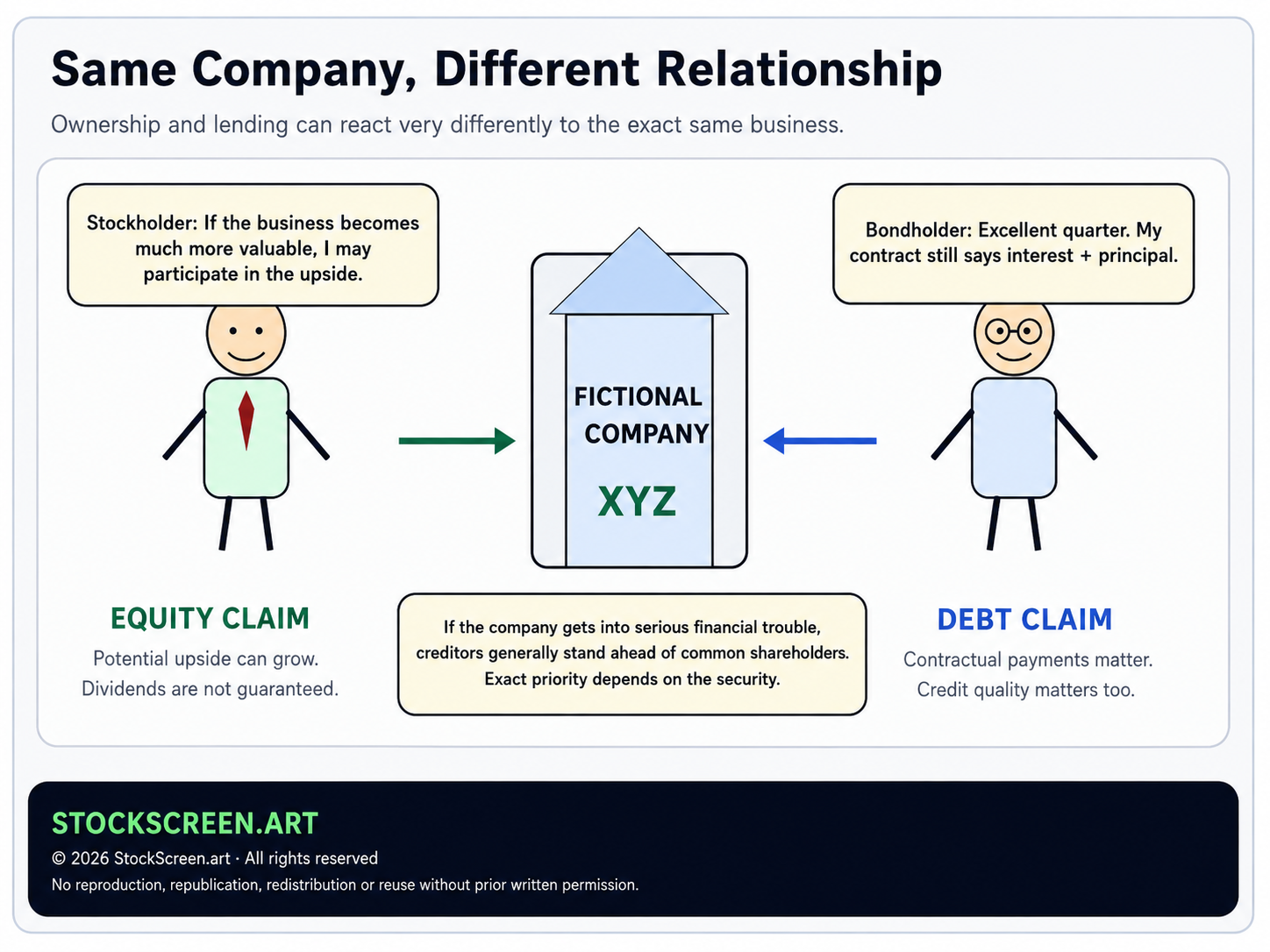
This distinction becomes very obvious if the company has a spectacular year.
Imagine fictional XYZ invents something brilliant, profits explode, and investors decide the company is suddenly worth twice as much.
The common shareholder may participate substantially in that increase through a higher stock price.
The bondholder's response may be closer to:
“Wonderful. I am delighted for everyone. My contract still says you owe me the agreed interest and principal.”
Bondholders generally do not receive unlimited participation in the company's upside simply because the business becomes more valuable. Their claim is primarily contractual.
3. Why bond prices move if the payments are contractual
This is where bonds stop being as boring as they first appear.
A bond can have fixed contractual payments and still change substantially in market value before maturity.
Why?
Because investors compare the bond with alternatives available today.
Suppose you own a bond paying 3% and newly issued comparable bonds suddenly offer 5%. Your old 3% bond has become less attractive. If you need to sell it before maturity, buyers may demand a lower price.
Investor.gov highlights several major bond risks, including:
- credit risk — the issuer may fail to make promised payments;
- interest-rate risk — changing market rates can change the bond's market value;
- inflation risk — fixed payments can lose purchasing power;
- liquidity risk — there may not be an easy market when you want to sell;
- call risk — some bonds can be repaid early under specified terms.
So no, bond is not finance-speak for nothing exciting can possibly happen here.
4. What happens if the company gets into trouble?
Stockholders and bondholders also have different positions when a company fails.
Investor.gov notes that in bankruptcy, bond investors have priority over shareholders in claims on company assets. The exact order among creditors can depend on whether debt is secured, senior unsecured, subordinated and so on.
For a Foundation lesson, the important concept is simpler:
This is one reason stock can offer greater upside while also absorbing more business risk.
5. ETF: you own a share of a fund
Now we reach the instrument that causes some of the most innocent-looking confusion.
An ETF is an exchange-traded fund.
For the conventional registered ETFs discussed in this lesson, investors pool money into a fund, and the fund invests in a portfolio of securities or other permitted assets.
Investor.gov explains that each ETF share represents an investor's part ownership of the ETF's portfolio and the income that portfolio generates.
That means if you buy one share of a broad stock-market ETF, you do not normally become the individually registered owner of a microscopic personal position in every underlying company.
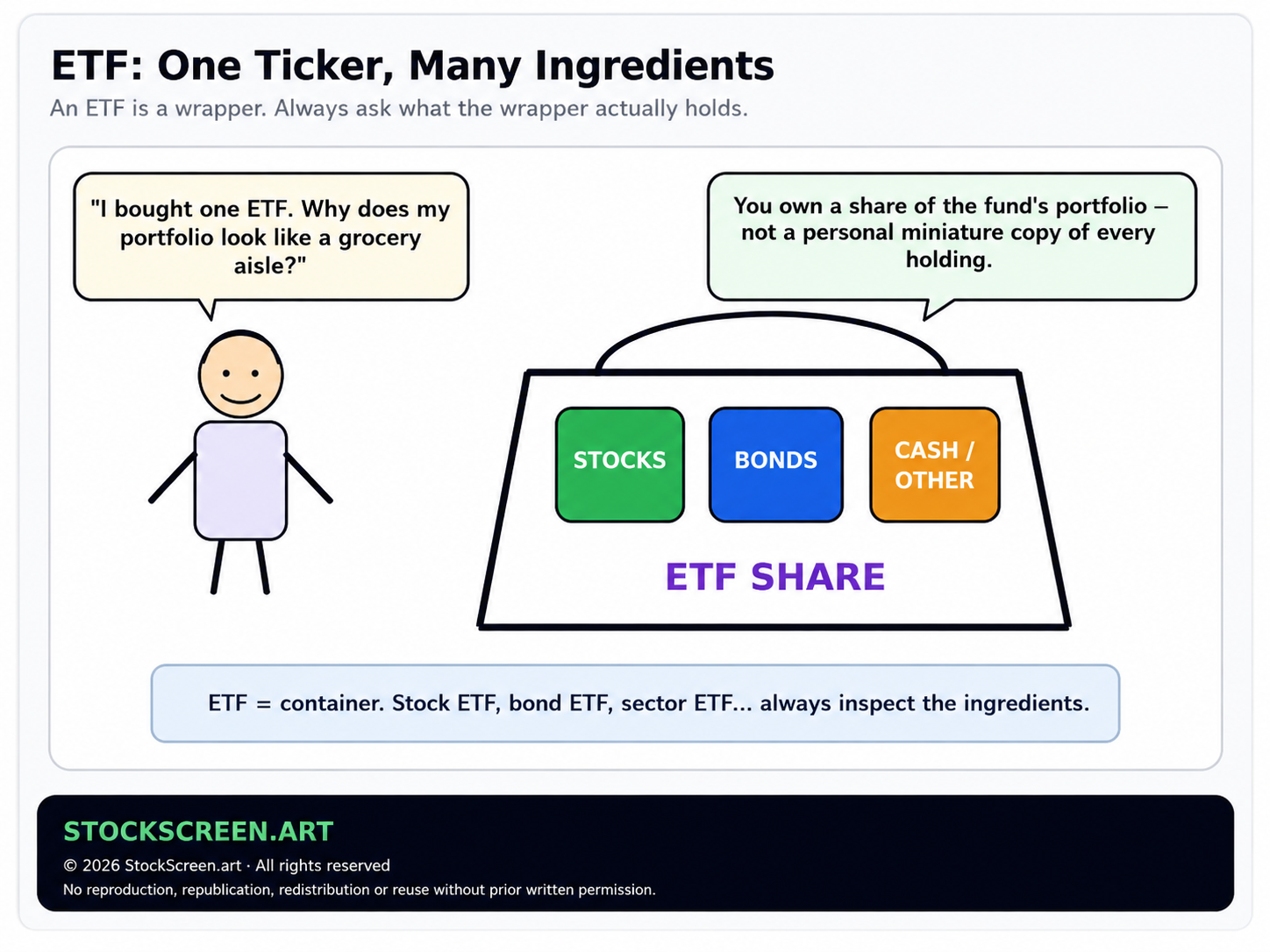
You own a share of the fund. The fund owns the portfolio.
The wrapper can contain stocks, bonds, short-term instruments, or other assets depending on the fund.
This is why saying “ETFs are safe” is not a very useful statement.
It is a little like saying:
“Boxes are nutritious.”
Possibly. But perhaps we should inspect the contents first.
6. A stock ETF and a bond ETF can behave very differently
Imagine two funds:
- ETF A owns hundreds of large-company stocks.
- ETF B owns a portfolio of government and corporate bonds.
Both trade on an exchange. Both have ticker symbols. Both can be bought in the same brokerage account. Both are ETFs.
But the economic exposures inside them are very different.
ETF A is primarily exposed to equity-market risk. ETF B is primarily exposed to the risks associated with its bond portfolio — which may include interest-rate risk and credit risk.
The word ETF tells you about the packaging and trading structure. It does not tell you enough about what you actually own.
7. Individual bond vs. bond ETF: an important distinction
Suppose you buy an individual bond with a stated maturity date.
Assuming the issuer does not default and the bond is not otherwise redeemed early under its terms, the maturity gives you a specific endpoint at which principal is due.
Now suppose instead you buy a conventional bond ETF.
You own shares of a fund that holds many bonds. Those underlying bonds mature at different times and the portfolio may continually buy, sell and replace securities.
The ETF itself does not generally behave like one individual bond marching toward one personal maturity date.
Investor.gov specifically warns that bond funds can lose money and are subject to risks such as interest-rate and credit risk.
8. How can each investment make money?
| Instrument | What you own | Potential sources of return | Important risks |
|---|---|---|---|
| Common stock | Equity ownership in a company | Price appreciation; dividends if declared | Business risk, market risk, valuation risk, possible loss of capital |
| Individual bond | A debt claim against the issuer | Interest; principal repayment; possible price gain if sold above purchase price | Credit, interest-rate, inflation, liquidity and call risk |
| ETF | A share of a fund and its portfolio | Changes in ETF market price; portfolio income/distributions; possible capital-gain distributions | Depends on holdings; market risk; fees; liquidity; possible premium/discount to NAV |
Notice how the ETF row refuses to fit into one neat risk category.
That is because an ETF can hold many different things.
9. ETF market price vs. NAV
There is another layer.
An ETF has a portfolio whose value can be summarized through its net asset value, or NAV. ETF shares also trade during the day at market prices.
Investor.gov notes that the market price can be higher or lower than the ETF's NAV per share. If the market price is higher, the ETF is said to trade at a premium. If lower, it trades at a discount.
For many large, heavily traded ETFs, those differences may often be small under ordinary conditions. But they are still part of understanding what the instrument is.
We will deal with spreads and liquidity in the next Foundation lesson, where the market begins charging admission for impatience.
10. Diversification: useful word, dangerous shortcut
ETFs are often associated with diversification because one fund can hold many securities.
That can be extremely useful.
But ETF does not automatically mean well diversified.
A fund could own:
- hundreds of companies across many sectors;
- only one narrow industry;
- only long-term bonds;
- a concentrated group of technology companies;
- a specialized strategy with risks very different from a broad-market index fund.
The ticker symbol is the label on the container. The holdings tell you what you brought home.
11. The questions you should ask before clicking Buy
If it is a stock
- What business am I becoming an owner of?
- How does the company make money?
- What is the valuation?
- What could cause the business or stock thesis to fail?
If it is an individual bond
- Who owes me the money?
- What is the issuer's credit quality?
- What are the coupon, yield and maturity?
- Is the bond callable?
- Where does the debt sit in the capital structure?
If it is an ETF
- What exactly does the fund own?
- What index or strategy does it follow?
- How concentrated are the holdings?
- What are the fund's expenses?
- How liquid are the ETF shares?
- Does it typically trade close to NAV?
The brokerage interface may use the same Buy button for all three. Your research process should not.
12. Why this matters for StockScreen.art
StockScreen.art's current screening and analysis tools focus on publicly traded stocks.
That matters because the signals shown for an operating company's stock — trend, momentum, relative strength, expected upside and risk/reward — are being applied to an equity security.
A bond or ETF can also have a chart, volume and momentum. But the underlying economic object is different.
Good analysis starts by asking:
“What am I looking at?”
Only then does:
“What is the chart doing?”
become the right next question.
Quick knowledge check
Six questions. No calculator. No tie required.
1. If you own common stock, are you a lender to the company?
No. Common stock is an equity ownership interest. A bondholder, by contrast, is a creditor/lender to the issuer.
2. Does a company have to repay a common shareholder's original stock purchase price on a maturity date?
No. Ordinary common stock does not have a bond-like maturity date requiring repayment of the shareholder's purchase price.
3. If you own an ETF, do you personally own each underlying security directly in your brokerage account?
Generally no. For the conventional registered ETFs discussed here, you own shares of the fund, and those shares represent your ownership interest in the fund's portfolio and income.
4. Is “ETF” itself an asset class?
No. ETF describes a fund structure and trading format. An ETF can hold stocks, bonds or other permitted assets and strategies.
5. Is an individual bond the same thing as a bond ETF?
No. An individual bond has its own contractual terms and maturity. A conventional bond ETF is a continuing fund that owns a portfolio of bonds and whose shares fluctuate in value.
6. In a corporate bankruptcy, who generally has priority: bondholders or common shareholders?
Creditors such as bondholders generally have priority over common shareholders, although the exact priority among creditors depends on the specific securities and capital structure.
Where we go next
You now know what the instrument is.
Next we look at what happens when you actually try to trade it: bids, asks, spreads and liquidity.
This is where a quoted price stops being a single magical number and reveals itself as two groups of people politely refusing to agree.
Primary sources & further reading
- Investor.gov — Stocks FAQs
- Investor.gov — Bonds FAQs
- Investor.gov — Corporate Bonds
- Investor.gov — Exchange-Traded Funds
- Investor.gov — Updated Investor Bulletin: Exchange-Traded Funds
- Investor.gov — Bond Funds and Income Funds