You press Buy. Your brokerage app flashes a reassuring little confirmation. Somewhere, perhaps, a tiny bell rings.
It is very tempting to imagine that your phone has just shouted across Wall Street: “I would like 100 shares of this company, please.”
The reality is both less cinematic and more interesting.
Your order enters a network of brokers, trading venues, matching systems, market makers, clearing organizations and settlement infrastructure. Most of it happens so quickly that the investor sees little more than a spinning icon and, ideally, the word Filled.
1. First: what exactly is the stock market?
The phrase stock market sounds like a place. It is more accurate to think of it as a system: the organized trading of shares through exchanges and other computerized trading venues.
A stock represents an ownership interest in a company. When a company first sells shares to investors, that happens in the primary market. An initial public offering — the famous IPO — is one example.
After those shares are publicly tradable, investors mostly buy and sell them from one another in the secondary market.
That distinction matters. If you buy 20 shares of a large public company on an ordinary Tuesday, the company itself is usually not sitting on the other side of your trade saying: “Wonderful, another shareholder. Welcome aboard.”
You are normally buying shares from another market participant who is willing to sell.
2. So what is a stock exchange?
A stock exchange is a regulated marketplace that brings together buyers and sellers under a defined set of rules. Exchanges provide systems for displaying prices, receiving orders, matching trades and reporting activity.
Familiar U.S. examples include the New York Stock Exchange and the Nasdaq Stock Market.
But there is an important wrinkle: not every stock order executes on the exchange whose name you recognize.
FINRA explains that when a broker receives a customer order, it must decide where to route that order for execution. The destination — the execution venue — could be a traditional exchange, but it may also be another type of venue such as an alternative trading system or a wholesaler.
Stock market = the overall network.
Exchange = one regulated type of trading venue inside that network.
Execution venue = wherever the order actually gets filled.
Think of the stock market as a city, exchanges as major train stations, and your broker as the transit planner. You care that you get where you are going efficiently. You do not necessarily get to insist on Track 7 at Grand Central.
3. What happens after you click Buy?
Let us follow a deliberately ordinary order:
You want to buy 100 shares of fictional company XYZ.
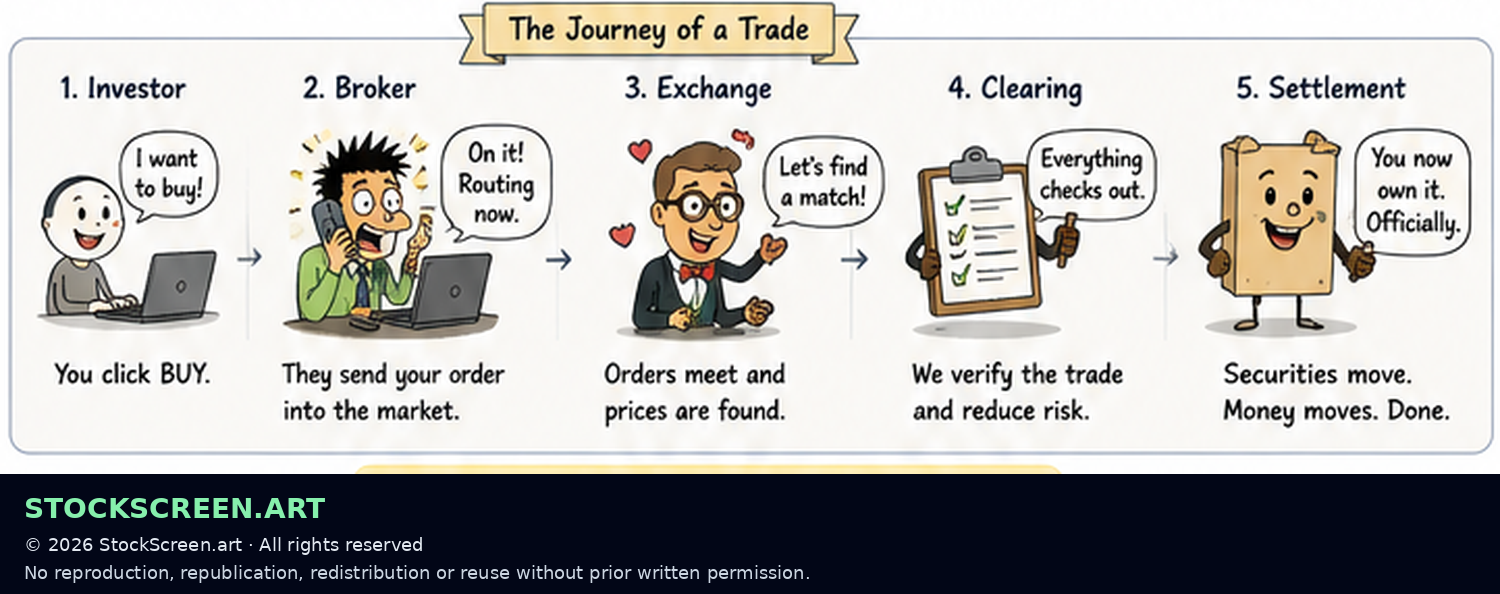
Step 1 — You enter the order
You open your brokerage account and submit an instruction to buy XYZ.
At this point, you have expressed an intention. You do not yet have a magical direct wire into Nasdaq, and there is no exhausted trader in a colorful jacket sprinting across a floor on your behalf.
Step 2 — Your broker receives it
Your brokerage firm receives the order and determines how it should be handled. For customer orders, brokers have execution obligations and routing procedures designed to seek favorable execution under prevailing market conditions.
This process is why the price on your screen and your eventual execution price are not always identical. Quotes can move, the displayed quantity can change, and another participant may trade before your order arrives.
Step 3 — The order is routed to an execution venue
The broker sends the order to a venue where a potential match exists.
That venue could be an exchange. It could also be another qualified trading venue. Modern markets are fragmented across multiple destinations, which sounds alarming until you realize that your food-delivery app also checks several drivers before finding someone willing to bring you noodles.
Step 4 — A buyer and seller match
A trade occurs when compatible buying and selling interest meets.
If a buyer is willing to pay a price that a seller is willing to accept, the market has found itself a match. No candlelight dinner is required.
Step 5 — The trade is executed
Once the order matches, the trade is executed. Your brokerage interface may update almost immediately to show the fill.
This is the moment most investors mentally translate into: “I own the shares now.”
Operationally, however, there is still work happening behind the scenes.
Step 6 — Clearing figures out who owes what
Clearing organizations compare, net and prepare trades for settlement. In U.S. equities, the National Securities Clearing Corporation, part of DTCC, plays a major role in clearing broker-to-broker transactions.
One of the benefits of centralized clearing and netting is that market participants do not necessarily have to move the full gross amount of every individual transaction back and forth separately.
Imagine 500 people at a restaurant each paying one another for bites of appetizers they traded during dinner. Netting is the adult who finally arrives with a calculator.
Step 7 — Settlement completes the trade lifecycle
Settlement is the final transfer of securities ownership and cash between the relevant market participants. DTCC describes settlement as the final step in the lifecycle of a securities trade.
In the United States, the standard settlement cycle for most broker-dealer securities transactions shortened from T+2 to T+1 on May 28, 2024.
T+1 means trade date plus one business day.
So if an eligible stock trade is executed on Monday, the standard settlement date is generally Tuesday, assuming Tuesday is a business day.
4. Where does the stock price come from?
This is one of the most important ideas in the entire Foundation Path:
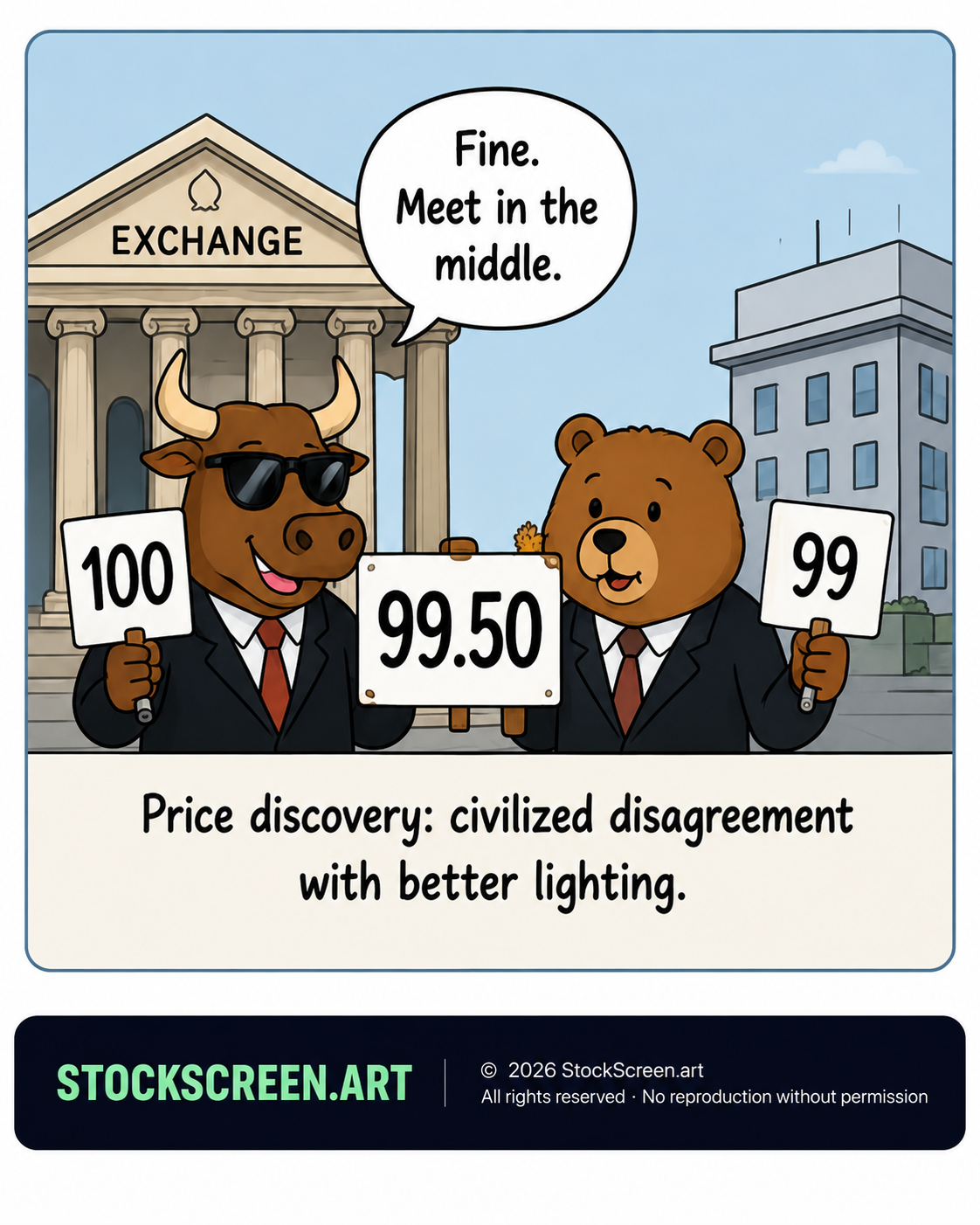
Suppose XYZ has buyers willing to pay $49.95 and sellers asking $50.00.
The highest current buying price is called the bid. The lowest current selling price is called the ask or offer.
The space between them is the bid-ask spread.
We will devote an entire later lesson to bids, asks, spreads and liquidity, because they deserve more than three paragraphs and because forcing everything into one lesson is how educational websites accidentally become doorstops.
For now, remember this:
A transaction happens when a buyer and seller become compatible on price. The latest completed transaction becomes a last traded price, but that does not mean the next transaction must happen at exactly the same price.
5. Why prices can move even when “nothing happened”
Investors often ask why a stock moved when there was no obvious news.
Because the market itself is information.
Orders arrive, disappear and change. Institutions rebalance. Funds receive inflows or redemptions. Market makers adjust risk. Traders respond to other assets. Someone somewhere decides that $50.00 is too expensive, while someone else decides it is suddenly a bargain.
Price is the result of all that buying and selling pressure interacting.
News can change those opinions dramatically, but a press release is not required for every tick.
6. Who are all these market participants?
Modern stock markets work because many different participants perform different jobs. A simplified cast includes:
- Individual investors: people buying and selling for their own accounts.
- Institutional investors: mutual funds, pension funds, asset managers, hedge funds and other large investors.
- Broker-dealers: firms that handle transactions for customers and may also trade as principals.
- Market makers and wholesalers: firms that provide liquidity and may stand ready to buy or sell securities.
- Exchanges and other execution venues: systems where trading interest can meet and transactions can occur.
- Clearing agencies and depositories: organizations that help clear trades, manage obligations and complete settlement.
- Regulators and self-regulatory organizations: bodies responsible for market rules, oversight and investor protection.
If this sounds like a lot of infrastructure for one person buying 10 shares, it is.
The same machinery must also handle enormous institutional trading volumes while keeping records straight, managing risk and making sure one participant's “I thought you had the shares” does not become everybody's problem.
7. What an exchange does — and does not — do
Exchanges matter enormously, but they are sometimes given mystical powers they do not possess.
An exchange can provide rules, technology, transparency, order matching and market oversight. It does not:
- decide whether a company is a good investment;
- guarantee that a stock price is reasonable;
- promise that a buyer will always exist at the price you want;
- protect you from volatility;
- phone you before a bad trade and ask whether you have reconsidered your life choices.
Markets facilitate trading. They do not remove uncertainty.
8. A simple example from click to settlement
Imagine fictional XYZ is quoted around $50.
You submit an order to buy 100 shares.
- Your brokerage receives the order.
- The broker routes it to an execution venue.
- Compatible selling interest is found.
- Your order executes at the available price or prices.
- The trade details enter clearing processes.
- Cash and securities obligations are prepared for settlement.
- Under the normal U.S. T+1 cycle, settlement generally completes the following business day.
Notice what we did not say:
“You saw $50.00 on your screen, therefore exactly 100 shares are guaranteed to execute at precisely $50.00.”
That assumption is one of the reasons our later lessons on order types, spreads and liquidity exist.
9. Why this matters when you analyze stocks
StockScreen.art focuses heavily on screening, technical analysis, momentum, expected upside and risk/reward. None of those ideas exist outside market mechanics.
A technically attractive setup in a highly liquid stock is not operationally identical to the same-looking setup in a thinly traded security with a wide spread.
A breakout is partly a price pattern, but it is also the result of actual orders interacting.
Volume matters because transactions represent real participation.
Entry levels matter because the price on a chart is not a personal reservation held for you by the exchange.
10. Five things to remember before the next lesson
- The stock market is a network, not one place.
- Your broker routes your order. You generally do not communicate directly with an exchange.
- Execution venues match trading interest. Traditional exchanges are important, but they are not the only venues.
- Price is discovered through buyers and sellers. The exchange organizes the process; it does not invent the value.
- Execution and settlement are different. A fill can appear quickly while settlement follows on the applicable settlement cycle.
Quick knowledge check
No calculator. No trick questions. No stern professor adjusting spectacles.
1. Is the “stock market” the same thing as the New York Stock Exchange?
No. The stock market is the broader system of organized stock trading. The NYSE is one important exchange within that system.
2. When you click Buy in a brokerage app, does the order normally go directly from your phone to an exchange?
No. Your brokerage receives the order and determines how to route it for execution.
3. Does the exchange decide what a stock should be worth?
No. Prices emerge from buying and selling interest. Exchanges provide the marketplace and rules that allow that interaction to occur.
4. Is execution the same thing as settlement?
No. Execution is the completion of the trade match. Settlement is the later completion of the transfer of securities and cash.
5. What does T+1 mean?
Trade date plus one business day. Most U.S. broker-dealer securities transactions moved to this standard settlement cycle on May 28, 2024.
Where we go next
You now know the basic plumbing.
Next we can start looking at the things that actually travel through those pipes: stocks, bonds and ETFs — and what you really own when you buy each one.
The Foundation Path will then circle back into bids, asks, spreads and order types in more detail. By then, phrases like “market liquidity” should sound less like something served at a finance conference.
Primary sources & further reading
- Investor.gov — How Stock Markets Work
- Investor.gov — Executing an Order
- FINRA — Where Do Stocks Trade?
- Investor.gov — Market Participants
- U.S. Securities and Exchange Commission — T+1 Settlement Cycle
- DTCC — Clearing & Settlement Services