You have found a stock you want to buy.
The research is done. The chart looks sensible. You have a plan.
Now your brokerage app asks one deceptively simple question:
Order type?
This is the financial-market equivalent of being asked:
“Would you like speed, control, or the comforting illusion that you can always have both?”
The two most important answers for a new investor are market order and limit order.
Limit order: “Execute my trade only at this price or better.”
Neither order type is universally superior.
They solve different problems.
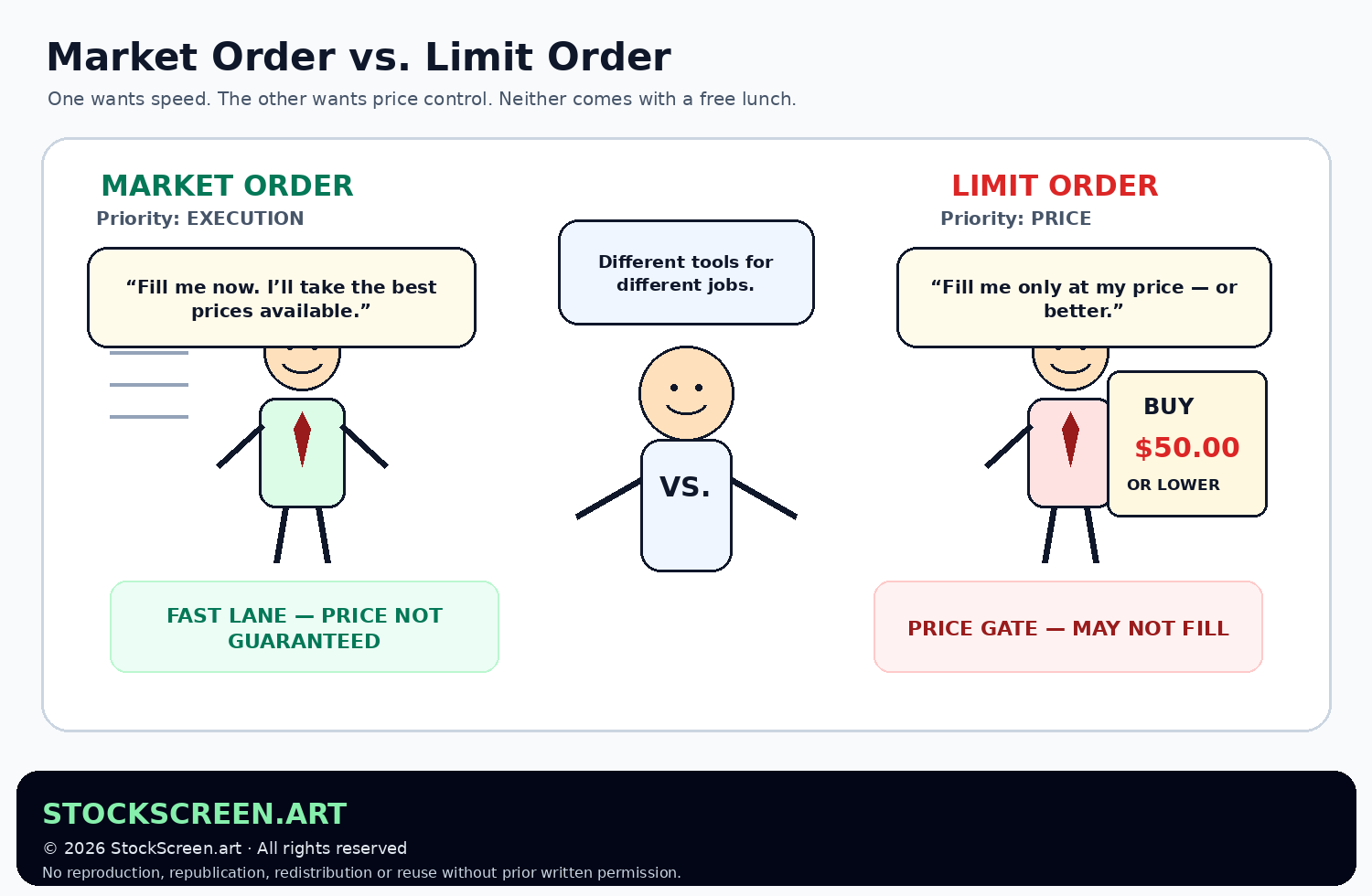
1. A market order says: get the trade
Investor.gov describes a market order as an instruction to buy or sell a security immediately.
In normal trading conditions, a market order generally seeks execution at or near the current ask for a buy order or the current bid for a sell order.
The important part is what the order does not say.
It does not say:
“Buy this stock at exactly the large number currently displayed on my screen.”
It says, in effect:
“Use the best prices available in the market and execute.”
That difference matters because quotes can change between the moment you see them and the moment your order reaches an execution venue.
2. Why a market order does not guarantee your price
Suppose fictional XYZ shows:
- Bid: $49.98
- Ask: $50.00
- Last trade: $49.99
You submit a market order to buy 100 shares.
If sufficient quantity is still available at $50.00 when your order arrives, your order might execute there.
But perhaps another order reaches the market first.
Or the quote changes.
Or there are only 40 shares left at $50.00 and the next available sellers want $50.04.
Investor.gov explicitly warns that the last-traded price is not necessarily the price at which a market order will execute.
This usually matters less in a highly liquid stock with a tiny spread and substantial available depth.
It can matter considerably more in a thinly traded stock, during a volatile market, around major news, or when your order is large relative to available liquidity.
3. Your market order can fill at more than one price
Lesson 3 introduced the idea that a quote includes both a price and a quantity.
Let us make that operational.
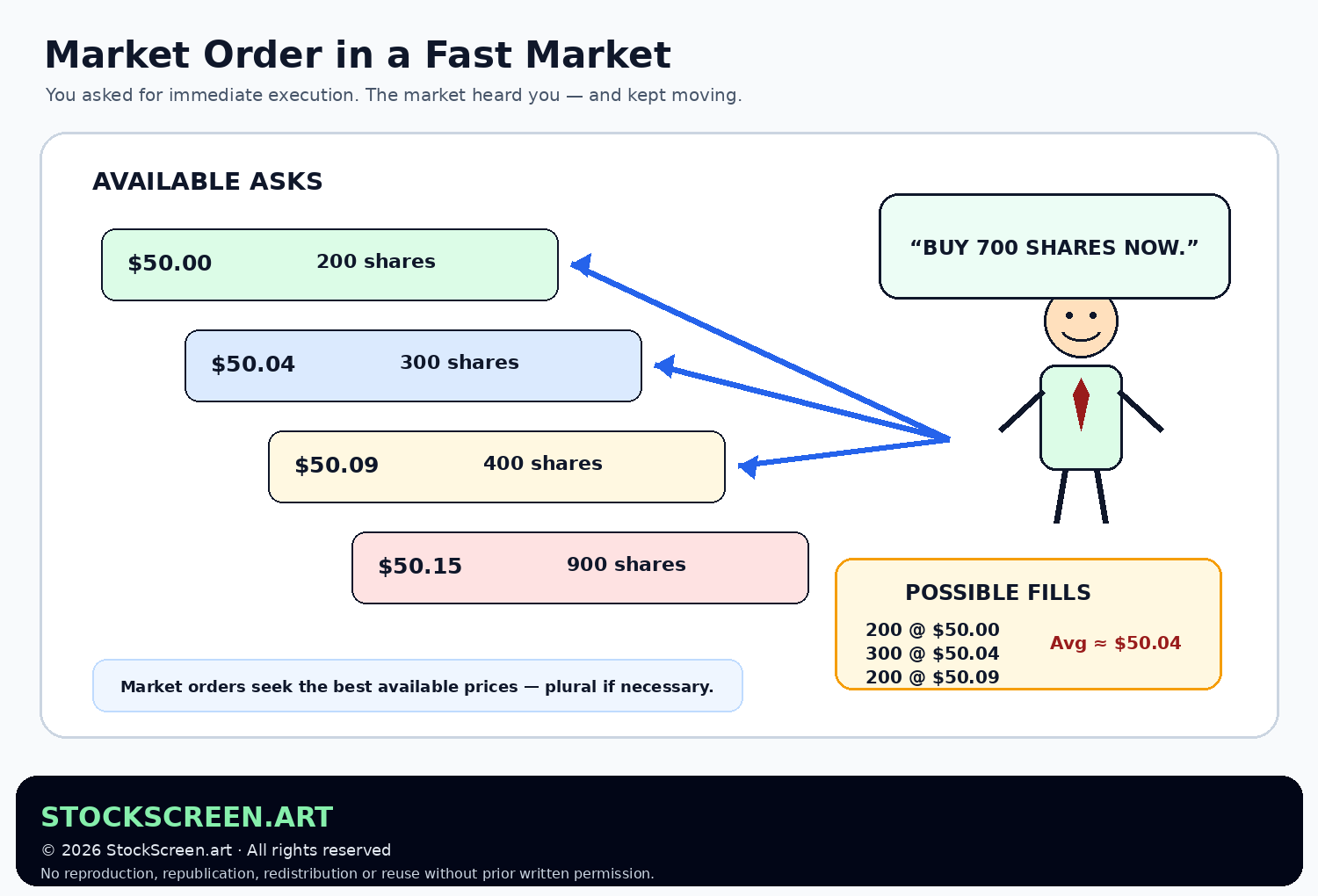
Suppose the ask side of XYZ looks like this:
| Ask Price | Shares Available |
|---|---|
| $50.00 | 200 |
| $50.04 | 300 |
| $50.09 | 400 |
| $50.15 | 900 |
Now you send a market order to buy 700 shares.
If the book remains unchanged long enough for that order to execute, a simplified fill could look like:
- 200 shares at $50.00;
- 300 shares at $50.04;
- 200 shares at $50.09.
Your approximate average price would be around $50.04.
The screen may have shown $50.00 when you clicked.
But only 200 shares were waiting there.
4. Is that slippage?
The term slippage is commonly used for the difference between an expected trade price and the actual execution price.
Slippage can happen because prices move or because available liquidity at the expected price is insufficient.
It can work against you.
It can occasionally work in your favor.
But the important Foundation-level lesson is:
The stock exchange has not put a tiny velvet rope around your preferred price while you locate the Buy button.
5. A limit order says: I care about the price
A limit order lets you define the price boundary.
Investor.gov states that:
- a buy limit order can execute only at the limit price or lower;
- a sell limit order can execute only at the limit price or higher.
Suppose XYZ is currently offered at $50.25, but you are unwilling to pay more than $50.00.
You could enter:
Buy 100 XYZ, limit $50.00.
Your instruction is now:
“I will buy this stock, but only at $50.00 or less.”
If compatible selling interest becomes available at $50.00 or below, your order may execute.
If it never does, your order may remain unfilled until it expires or is canceled according to the order's time instructions and your broker's rules.
6. The beautiful frustration of a limit order
Limit orders solve one problem very well:
They stop you from paying more than your buy limit or accepting less than your sell limit.
They create another problem:
The market does not have to trade with you.
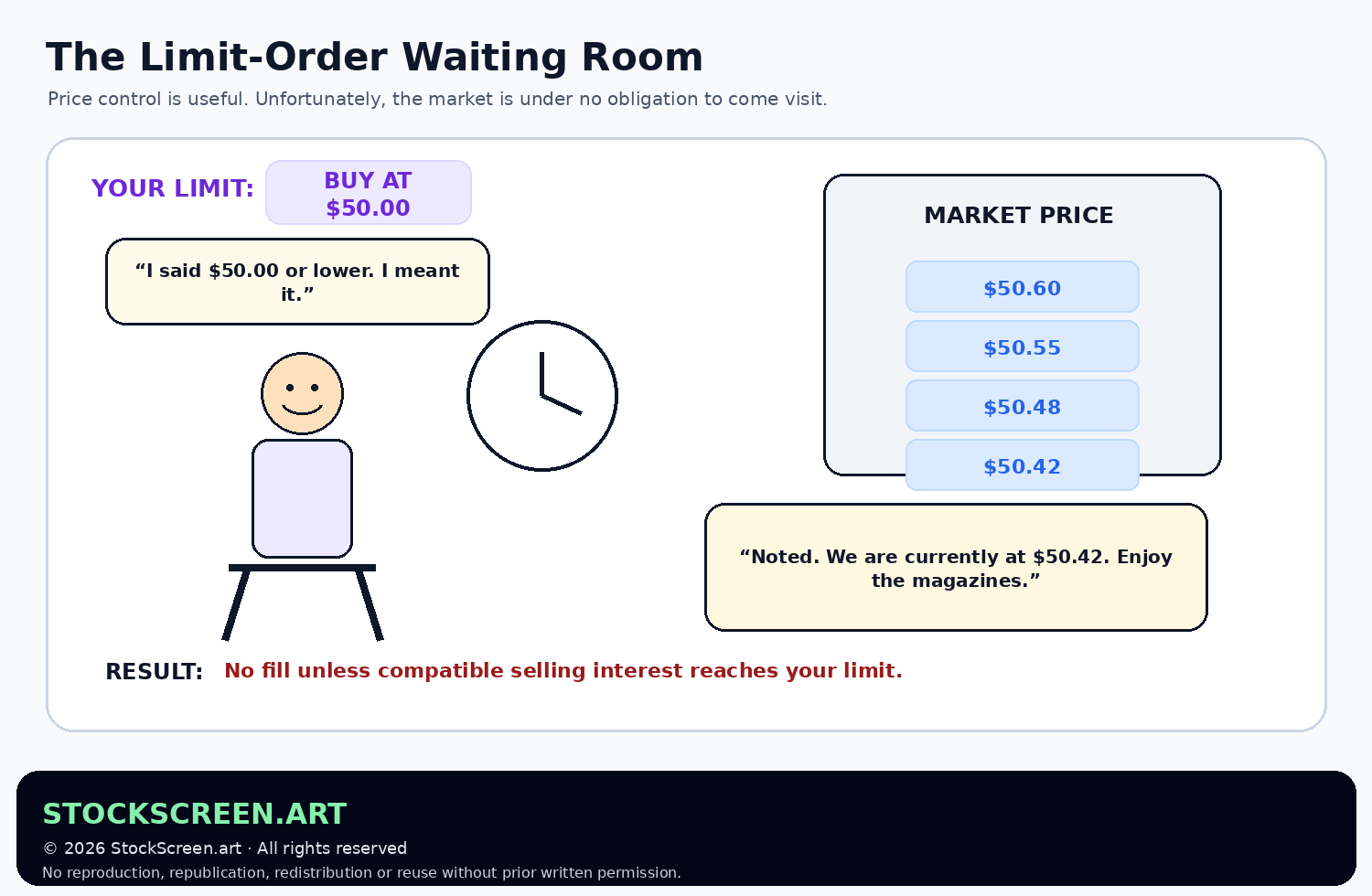
Imagine XYZ is at $50.42.
You enter a buy limit at $50.00.
XYZ trades:
- $50.48
- $50.55
- $50.60
- $50.78
- $51.10
Your limit order is still sitting at $50.00.
Perfectly disciplined.
Perfectly unfilled.
7. “But the stock touched my limit!”
This complaint is common enough to deserve its own section.
Suppose your buy limit is $50.00.
Later, your chart shows a trade at exactly $50.00.
Yet your order did not fill.
Is your broker plotting against you?
Probably not.
A trade occurring at your limit price does not automatically mean enough shares were available to execute every order waiting at that price.
Other orders may have been ahead of yours.
Available quantity may have been small.
Market structure and routing can also affect execution.
8. Buy limits and sell limits point in opposite directions
This is simple once you see the logic.
Buy limit
You are setting the maximum price you will pay.
Buy at $50.00 or lower.
Sell limit
You are setting the minimum price you will accept.
Sell at $55.00 or higher.
If you ever forget which direction applies, ask:
“Am I trying to avoid paying too much, or avoid selling too cheaply?”
The answer usually rescues the brain before it begins drawing arrows on napkins.
9. Market vs. limit: which is better?
There is no universal answer.
The useful question is:
What matters more for this order — execution or price control?
| Market Order | Limit Order | |
|---|---|---|
| Main priority | Execution | Price control |
| Execution price guaranteed? | No | Price boundary is controlled if executed |
| Execution guaranteed? | Generally intended for immediate execution when a market is available | No |
| Typical concern | Unexpected execution price | No fill |
| More sensitive to thin liquidity? | Potentially, because the order can trade through available prices | Potentially, because execution may be difficult at your chosen limit |
10. When a market order may be more reasonable
Without giving personalized trading advice, a market order can make conceptual sense when:
- the security is highly liquid;
- the spread is very tight;
- your order is small relative to available trading activity;
- immediate execution matters more to you than controlling every cent of price;
- market conditions are relatively orderly.
Even then, price is not guaranteed.
11. When a limit order can be especially useful
A limit order can become more appealing conceptually when:
- the spread is wider;
- the security trades less frequently;
- the market is moving quickly;
- you have a specific maximum purchase price or minimum sale price;
- you are willing to miss the trade rather than accept a worse price.
That final bullet is the heart of the limit order.
“I would rather have no trade than this trade at the wrong price.”
12. Order type does not fix a bad plan
An elegant limit order cannot rescue a terrible investment thesis.
A perfectly executed market order cannot improve a security you should never have purchased.
Order types manage execution instructions.
They do not replace:
- research;
- valuation;
- risk management;
- position sizing;
- understanding what you own.
This sounds obvious, but brokerage interfaces have large green buttons.
Large green buttons have historically caused humanity to become optimistic.
13. Time instructions: how long should the order wait?
Order type and order duration are related but different decisions.
Investor.gov notes that common timing instructions can include:
- Day: the order remains active for that trading day unless executed or canceled.
- Good-Til-Canceled (GTC): the order can remain active until executed or canceled, subject to the brokerage firm's time limits and policies.
Brokers may offer other instructions, and availability can differ by firm.
So a limit order needs two questions:
- What price am I willing to accept?
- How long am I willing to wait?
Finance has now recreated both negotiation and dating.
14. A quick word about stop orders
You may also see stop or stop-loss orders in your brokerage platform.
They are different from ordinary market and limit orders.
Investor.gov explains that a stop order becomes a market order once its specified stop price is reached.
That means the stop price is a trigger.
It is not a guaranteed execution price.
A stop-limit order adds a limit instruction after the trigger, which provides more price control but introduces the possibility that the order will not execute.
Market order = execute using available market prices.
Limit order = execute only at your limit or better.
Stop order = wait for a trigger, then become an order.
We do not need to turn this lesson into the Encyclopedia of Brokerage Dropdown Menus.
The important thing is recognizing that trigger price, limit price, and execution price are not interchangeable concepts.
15. Three scenarios
Scenario A — Very liquid stock
Bid: $100.00
Ask: $100.01
Thousands of shares available near the quote.
You want 25 shares.
The practical difference between a sensible market order and a nearby limit order may be small under calm conditions.
Scenario B — Thinly traded stock
Bid: $9.50
Ask: $10.10
Only 100 shares displayed at the ask.
You want 1,000 shares.
A market order could potentially trade through several higher price levels. The execution instruction matters much more.
Scenario C — Your valuation matters more than urgency
XYZ trades around $52, but your research says you are only comfortable buying at $50 or less.
A buy limit at $50 expresses that decision directly.
The market may never agree with you.
That is not a malfunction.
Sometimes not getting the trade is exactly what your order instructed the market to do.
16. Practical habits before submitting an order
- Look at the current bid and ask. Do not rely only on the last price.
- Look at the spread. A wide spread increases execution uncertainty and friction.
- Consider your order size. The best quote may contain less quantity than you need.
- Decide what matters more: execution or price control.
- Check the order duration. A forgotten open order can become tomorrow-you's problem.
- Review before submitting. Buy, sell, quantity, order type, price and duration are all worth one final glance.
17. Why this matters for StockScreen.art
StockScreen.art can help surface an interesting stock and analyze trend, momentum, technical conditions and risk/reward.
But there is still a gap between:
“This stock deserves research.”
and:
“I know exactly how I would execute a trade.”
Market structure lives inside that gap.
A candidate with attractive upside can still be a poor execution environment if liquidity is weak or spreads are wide.
Understanding the order instruction means your execution method becomes part of the plan instead of an afterthought.
Quick knowledge check
Seven questions. Market orders get through quickly. Limit orders may choose to answer later.
1. What is the main priority of a market order?
Execution using the best prices available in the market. The execution price is not guaranteed.
2. You enter a buy limit at $25.00. Can it execute at $25.10?
No. A buy limit can execute only at the limit price or lower.
3. You enter a sell limit at $40.00. Can it execute at $40.25?
Yes. A sell limit can execute at the limit price or higher.
4. Does a limit order guarantee you will get a trade?
No. The market may never reach the limit price, or there may not be sufficient compatible interest to fill your order.
5. Why can a large market order receive several execution prices?
Because the quantity available at the best quote may be smaller than the order, forcing remaining shares to execute against other available price levels.
6. If a stop price is reached, is that stop price guaranteed as the execution price?
No. A standard stop order becomes a market order when triggered, so the actual execution price can differ from the stop price.
7. Which question best separates market and limit orders?
“What matters more in this situation: getting the trade executed, or controlling the price?”
Where we go next
We have now covered the mechanics of the marketplace:
exchanges, instruments, bids and asks, liquidity, and order types.
Next the Foundation Path moves into one of the ideas underneath nearly every investment decision:
Risk, Return, Volatility and Compounding.
This is where we discover that a 50% loss followed by a 50% gain does not, despite emotional arguments to the contrary, put you back where you started.
Primary sources & further reading
- Investor.gov — Types of Orders
- Investor.gov — Investor Bulletin: Understanding Order Types
- Investor.gov — Market Order
- Investor.gov — Limit Orders
- Investor.gov — Executing an Order
- FINRA — Order Types