Twenty years ago, quantitative research was already mathematically sophisticated. What changed was the scale: vastly more data, vastly cheaper computing, an enormous open-source Python ecosystem, machine learning, AI-assisted development and a job description that appears to have eaten several other job descriptions.
There was a time when being a quant sounded mysterious.
Actually, it still sounds mysterious.
Tell someone at a dinner party that you work in quantitative finance and there is usually a brief pause while they decide whether to ask about stocks, mathematics or whether you can help fix their Wi-Fi.
Twenty years ago, the image was reasonably clear.
A quant was usually very good at mathematics, very comfortable with statistics, knew enough programming to make a computer do something unpleasantly complicated and had developed an unusually high tolerance for staring at numbers that would cause most normal people to suddenly remember another appointment.
The job still requires all of those things.
The difference is that today's quant may also be expected to understand machine learning, Python, databases, cloud computing, APIs, distributed systems, alternative data, model governance and, increasingly, artificial intelligence.
Apparently the mathematics wasn't enough.
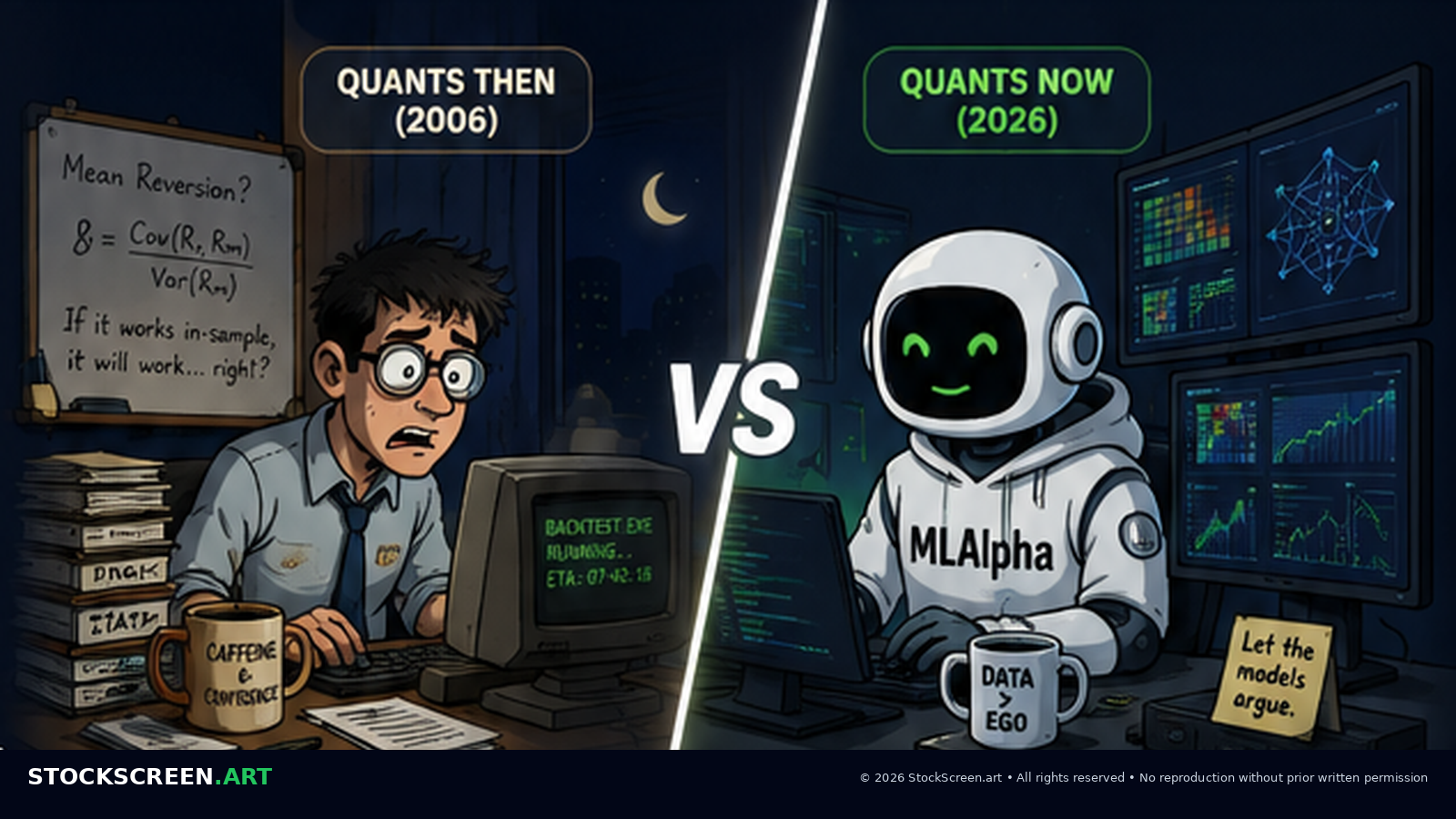
The quant of 2006
Picture a quantitative research desk somewhere in the mid-2000s.
There are several monitors. One contains market data. One contains code. One contains a spreadsheet that has become so important to the organization that nobody is willing to ask who actually wrote it.
There is probably a whiteboard nearby.
On that whiteboard is an equation.
Half the team understands it. The other half understands it too but would prefer not to be asked to explain the final term before coffee.
The underlying work could already be extremely sophisticated. Quantitative finance was not primitive twenty years ago.
Researchers were building factor models, statistical-arbitrage strategies, derivatives models, optimization systems and automated trading infrastructure long before anybody started putting the letters “AI” on every available surface.
The mathematics was serious. The computing was serious.
The difference was accessibility.
Compute was expensive enough that researchers thought carefully about it. Data was something you acquired, stored and guarded rather than something you assumed would arrive continuously from eighteen different sources.
And experiments often had a very familiar ending:
That sentence probably powered half of quantitative finance.
You would start the job, leave the office and return the next morning hoping to discover that the model had finished.
Sometimes it had.
Sometimes it had crashed.
And sometimes it had spent eight hours doing exactly the wrong calculation because somebody pointed it at the wrong directory.
The computer was extremely obedient.
That remains a problem.
The old quant's toolbox
A capable quant twenty years ago might have worked with C++, MATLAB, R, SQL, spreadsheets and a collection of proprietary tools.
Python existed, but it had not yet become the almost universal scientific workbench it is today.
A great deal of quantitative work lived inside specialized environments. And that shaped how research happened.
You didn't casually decide at 3:17 p.m. to test 900 variations of a hypothesis just because you were curious. At least, you didn't do it unless you were prepared to explain why the computing cluster had become very warm.
There was friction between an idea and an experiment.
That wasn't always bad.
Friction forces people to think.
The modern world has solved much of that friction.
Naturally, we found new problems.
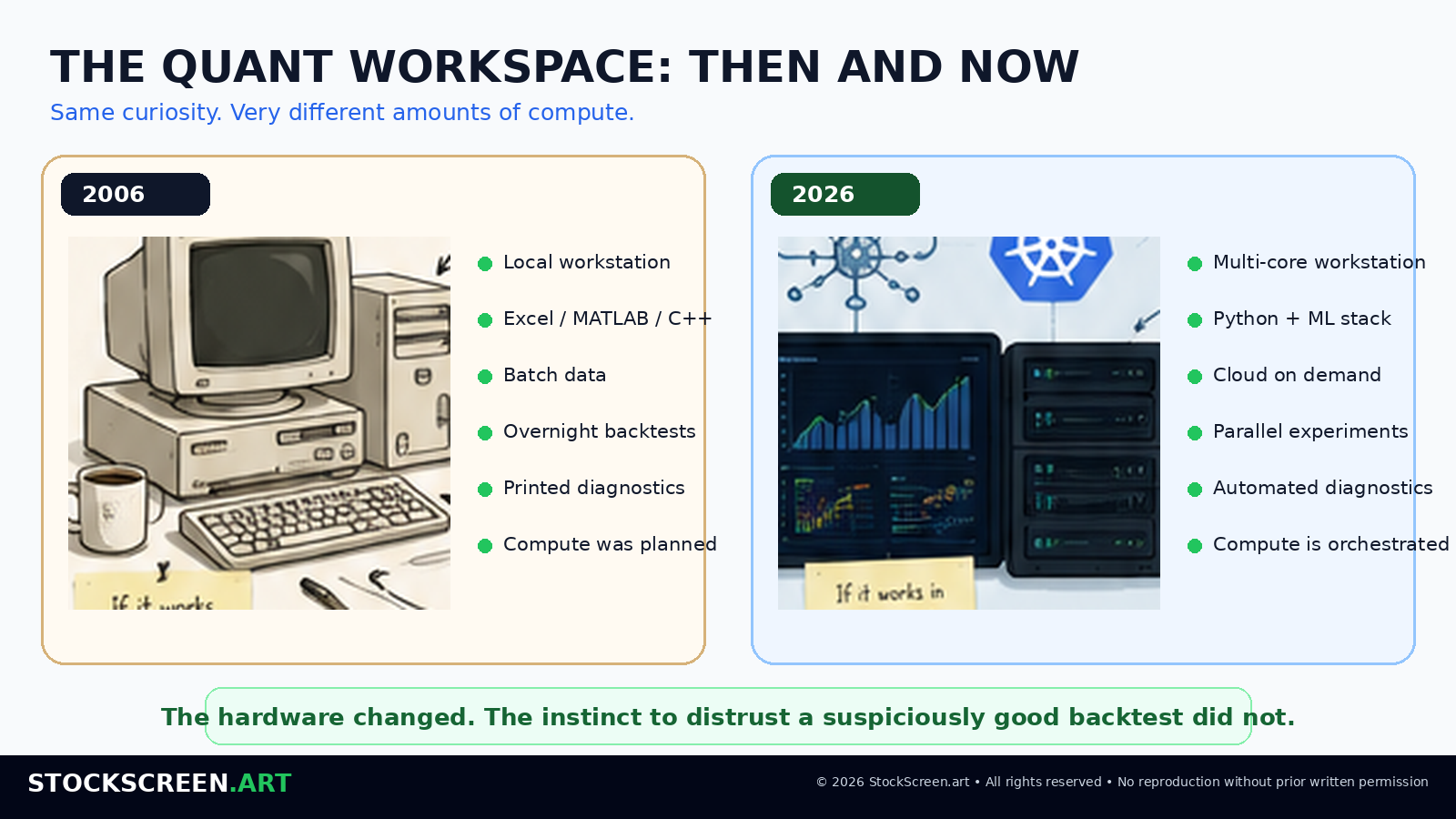
Then the workbench changed
The rise of Python transformed quantitative research.
Not because Python suddenly invented mathematics.
The equations remained stubbornly the same.
What changed was the ecosystem around them.
A modern researcher can use Python to pull data, clean it, manipulate millions of observations, build features, train machine-learning models, run statistical tests, visualize results, connect to databases, expose an API and automate the whole thing.
All without leaving the language.
That is an extraordinary change.
Get data → clean data → build features → test hypothesis → train model → evaluate model → break model → fix problem → discover different problem → repeat.
That final section tends not to appear in machine-learning advertisements. It occupies a surprisingly large amount of real life.
The modern quant has a different data problem
Twenty years ago, researchers often worried about getting enough good data.
Today the problem is frequently the opposite.
There is data everywhere.
Prices. Trades. Quotes. Fundamentals. Options. Economic releases. News. Earnings-call transcripts. Web traffic. Shipping information. Employment data. Satellite imagery. Social sentiment.
And presumably, somewhere, a researcher is evaluating whether the number of cars in the parking lot outside a chain of restaurants predicts quarterly earnings.
It probably does.
Until it doesn't.
The modern quant's job is therefore not simply to obtain information.
It is to decide which information is worth having.
That sounds easier than it is.
More data means more potential signal. It also means more noise, more missing values, more timing problems, more opportunities for leakage and more ways to accidentally discover something that looks predictive only because you searched long enough.
The old problem was:
The modern version is:
Progress.
Machine learning changed the nature of the question
Traditional quantitative research often begins with an idea.
Perhaps cheap stocks outperform expensive ones under certain conditions. Perhaps momentum persists. Perhaps volatility changes expected behaviour. Perhaps two related securities have temporarily diverged.
The researcher expresses the idea mathematically and tests it.
Machine learning adds another possibility.
Instead of telling the model exactly what relationship to look for, we can ask it to identify patterns and interactions across many variables.
That can be extremely powerful.
It can also produce the mathematical equivalent of seeing a face in a cloud.
The model sees a pattern.
The researcher has to determine whether the pattern means anything.
A machine-learning model can discover that some obscure combination of market characteristics happened to precede stronger historical outcomes.
Wonderful.
Now comes the difficult part.
Why? Does it happen repeatedly? Does it survive different market environments? Does it survive after costs? Would the information actually have been available at the time? Does it still work when an unusual winner is removed?
These questions are considerably less exciting than MODEL DISCOVERS MARKET EDGE.
They are also considerably more important.
We moved from formulas to systems
This may be the biggest change of all.
Modern quantitative research increasingly isn't about building a model. It is about building a system around the model.
The system has to collect information.
The system has to know what information was available historically.
The system has to construct the right universe of securities.
The system has to reproduce the same features in research and production.
The system has to test models through time.
The system has to compare them against useful baselines.
The system has to record what happened.
And ideally, when something looks suspiciously wonderful, the system should make it harder to immediately declare victory.
At StockScreen.art, this is increasingly how we think about MLAlpha.
The interesting part isn't just training another machine-learning model.
It is building the machinery around the model that continually asks:
That question is not glamorous. It has saved an astonishing amount of trouble throughout the history of engineering.
Computing power changed what a small team can do
This part is difficult to overstate.
A modern desktop computer has computational capacity that would have looked extraordinary to a researcher two decades ago.
Add cloud computing and the difference becomes even more dramatic.
Need more cores?
Rent them.
Need a GPU?
Rent one.
Need fifty machines for six hours?
This can now be a procurement decision measured in minutes rather than a capital-budget discussion measured in quarters.
That changes experimentation.
A research group can test more ideas, train more models, run more historical reconstructions, compare more configurations and explore larger datasets.
This democratization of compute is one of the biggest reasons sophisticated quantitative research is no longer restricted to institutions with enormous technology budgets.
But there is a catch.
There is always a catch.
Faster computers also let us make mistakes faster
Suppose you test one investment hypothesis and it performs extremely well.
Interesting.
Suppose you test 100,000 investment hypotheses.
One of them is almost guaranteed to look incredible.
That is not alpha.
That is arithmetic.
Modern computing power has made it possible to search enormous spaces of parameters, models and variables. That means quantitative researchers need to be even more careful about overfitting, multiple testing and selection bias.
It is surprisingly easy to build a model that explains the past magnificently.
The past is very cooperative that way.
It has already happened.
The future is much less accommodating.
So while computing power made the quant enormously more capable, it also made skepticism more important.
The computer can test more ideas.
The researcher has to say no to more of them.
AI didn't replace the quant. It gave the quant another employee.
Artificial intelligence has created a strange new dynamic in research.
A modern quant can now ask an AI system to:
- write code;
- review code;
- generate tests;
- explain unfamiliar libraries;
- write SQL;
- summarize documentation;
- prototype an experiment;
- inspect errors;
- suggest alternative implementations;
- and occasionally explain why something has been broken for three hours.
This is genuinely useful.
But it doesn't eliminate the need to understand the problem.
In some ways, it increases it.
If a programmer writes bad code personally, they at least have a vague memory of why they wrote it.
AI can generate bad code beautifully, instantly and with excellent formatting.
That creates a new skill:
This matters enormously in quantitative finance.
If an AI assistant creates a backtest with look-ahead bias, the fact that the code is elegant does not improve the backtest.
If it accidentally lets future information enter the training data, congratulating it on its clean architecture is unlikely to help.
The modern quant therefore works with AI.
Not underneath it.
Coding went from useful to unavoidable
Twenty years ago, some quantitative researchers could survive with limited production-programming ability. They might prototype a model and work with software engineers to turn it into a system.
That still happens.
But the boundary has moved.
Today, programming is frequently part of the research itself.
Want to test a new idea?
You may need to build a data loader. Clean the data. Join multiple datasets. Write validation checks. Construct historical samples. Train several models. Generate diagnostics. Track experiments. Deploy an API. Monitor results.
That is no longer “supporting work.”
It is quantitative research.
The modern quant is therefore increasingly part mathematician and part software engineer.
Sometimes part system administrator too.
Usually when something stops working.
And the software engineer became more quantitative
The traffic also moved in the other direction.
Many people entering quantitative work today come from software engineering, computer science or machine learning rather than traditional financial mathematics.
They are comfortable with distributed systems. They understand data pipelines. They can build scalable infrastructure. They know Python intimately.
They may have deployed neural networks before they ever calculated a bond duration.
This creates an interesting hybrid profession.
The old quant needed to learn more programming.
The modern programmer entering finance needs to learn more mathematics and markets.
They eventually meet in the middle.
Usually somewhere near a Jupyter notebook that has been running for 43 minutes.
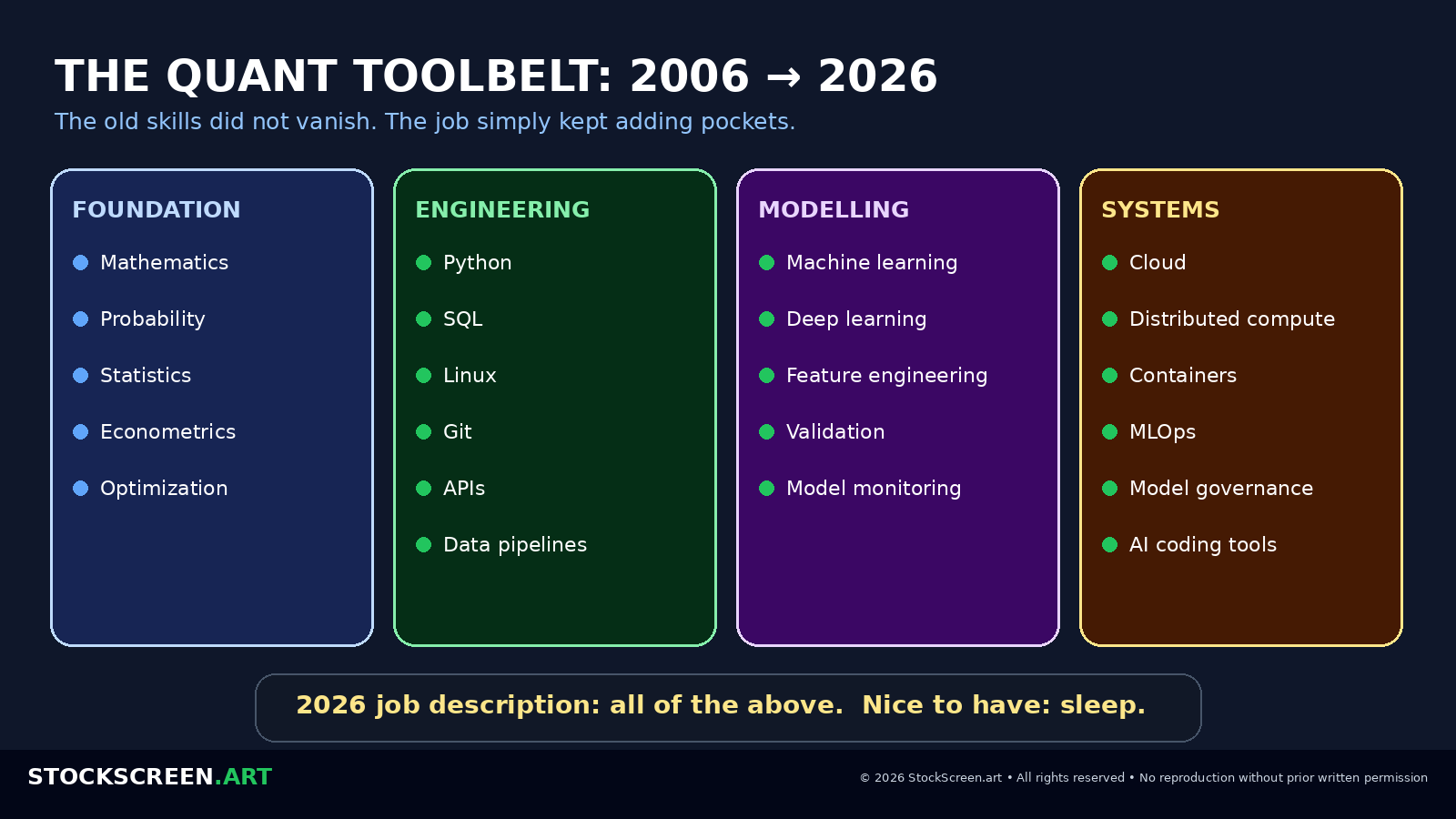
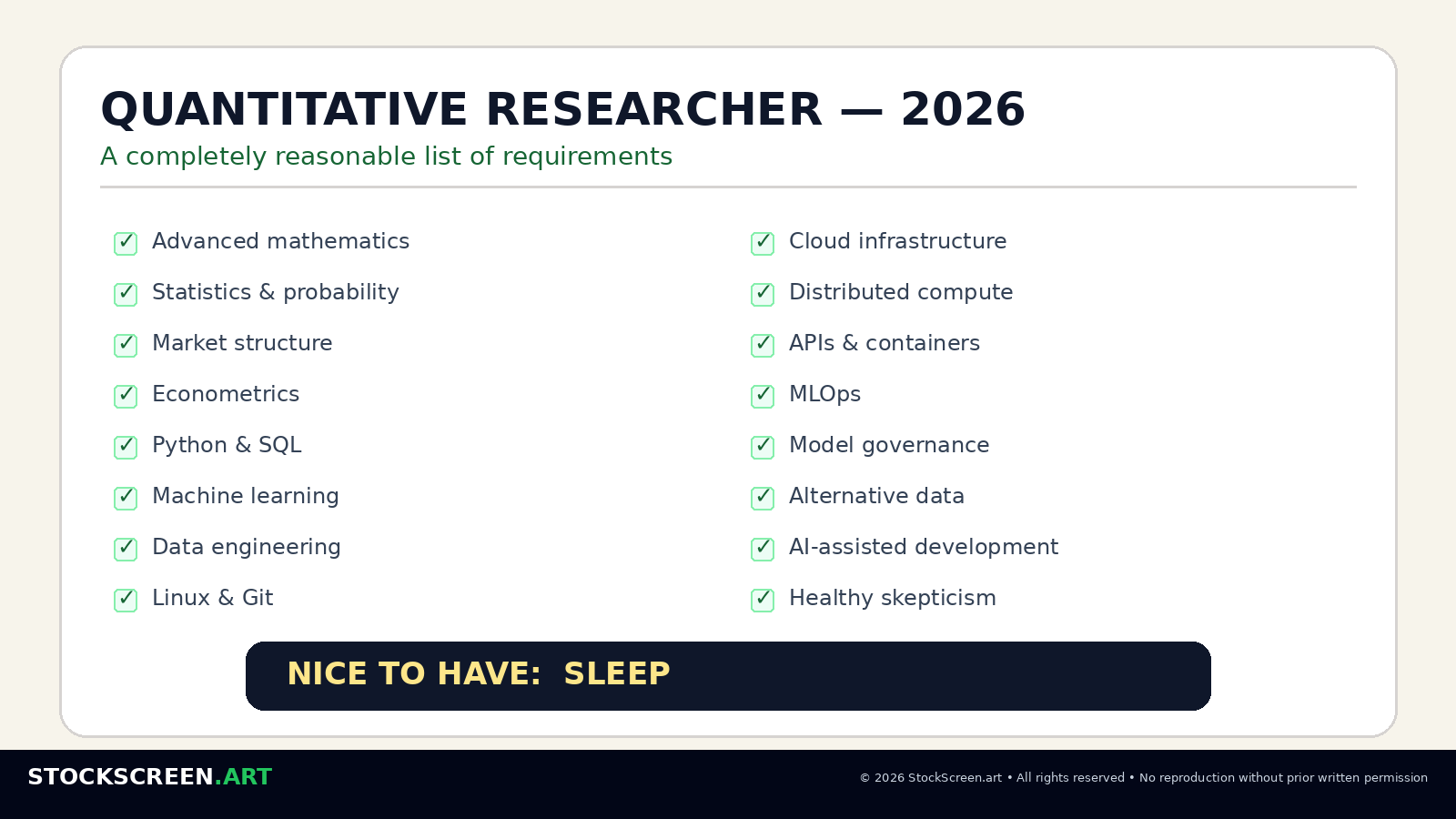
What the quant now has to know is slightly absurd
If we wrote a stereotypical job advertisement, the evolution might look like this.
Required
- Advanced mathematics
- Statistics
- Probability
- Econometrics
- Optimization
- Financial markets
- Strong numerical programming
- Database skills
- Ability to debate a correlation coefficient for an unreasonable length of time
Required
- Everything in the other box
- Python and machine learning
- Data engineering and Linux
- Cloud computing and APIs
- Version control and deployment
- Alternative data
- Model monitoring and reproducibility
- AI tools
- Enough security knowledge not to put the database on the public Internet
The skill that became more important precisely because everything else became easier
Here is the irony.
As computers became more powerful, software became more accessible and AI became more capable, one very old skill became more valuable.
Judgment.
The ability to look at a result and say:
The ability to ask whether the result is economically plausible.
The ability to distinguish correlation from mechanism.
The ability to recognize that the data does not support the conclusion.
The ability to abandon six weeks of work because the experiment failed.
That last one is particularly unpleasant.
Models do not experience sunk-cost fallacy.
Researchers definitely do.
A good modern quant needs enough intellectual discipline to kill an idea they personally love.
Preferably before production does it for them.
Some things haven't changed at all
Twenty years of progress have dramatically changed the tools.
The core questions remain remarkably familiar.
- Is the data correct?
- Was the information available at the time?
- Is the result stable?
- Does it work outside the period used to build it?
- Does it survive realistic costs?
- Does the relationship make financial sense?
- What happens when market conditions change?
- What would cause it to fail?
Those questions would have been recognizable to a good quant twenty years ago.
They should be recognizable twenty years from now.
The equations change. The machines change. The programming languages change.
The temptation to believe a beautiful backtest appears remarkably durable.
If a 2006 quant met a 2026 quant
“You run all of this from here?”
“Mostly.”
“And that machine has how many cores?”
“Thirty-two.”
“You have a GPU?”
“Not on this one.”
“Not on this one?”
“We can rent them.”
“And the AI helps write the code?”
“Yes.”
The older quant considers this enormous technological advantage.
“So research is easy now?”
The modern quant looks at the six-hour experiment, the failing coverage test, the rapidly expanding database, the model that was brilliant until one leakage bug disappeared, and the AI assistant proposing an operating-system reinstall to solve a CSV problem.
“No.”
The older quant nods. Finally, something familiar.
The quant didn't disappear. The quant expanded.
The stereotype of the old quant was someone who understood mathematics deeply enough to extract structure from financial markets.
That is still at the heart of the profession.
But the role has grown around it.
The modern quant increasingly combines:
mathematics + statistics + finance + software engineering + data engineering + machine learning + systems thinking + AI.
That sounds excessive.
It probably is.
But the payoff is enormous.
A small team can now run research that once demanded institutional infrastructure. A skilled researcher can test ideas in hours that might once have taken days or weeks.
Machine learning can explore relationships humans would struggle to specify manually. AI can accelerate the mechanical parts of research and development. Cloud computing can provide enormous temporary capacity.
Open-source software has put professional-grade quantitative tools within reach of anyone willing to learn how to use them.
That is an extraordinary democratization of capability.
It also means more people can produce sophisticated-looking nonsense.
Technology has always been generous that way.
Where we are now
At StockScreen.art, we're experiencing this evolution directly.
The platform started with quantitative screening and technical analysis.
AlphaEngine added systematic ranking and structured candidate selection.
MLAlpha takes the next step, adding machine-learning research on top of that quantitative foundation.
Behind those visible tools is an increasingly substantial research environment: market-data pipelines, historical reconstruction, model testing, experimental controls, infrastructure and a lot of Python.
A lot.
If Python suddenly disappeared tomorrow, several computers would become extremely confused.
So would we.
But the most important lesson from all of this isn't that today's tools are better.
Of course they are.
The important lesson is what better tools allow researchers to do.
- Ask better questions.
- Test more ideas.
- Reject bad ones faster.
- Investigate relationships that were previously impractical.
- Build systems capable of challenging their own assumptions.
That is where modern quantitative research becomes genuinely interesting.
Twenty years later, the market is still the market
Our machines are faster.
Our models are more sophisticated.
Our data is larger.
Our software is better.
Our AI assistants occasionally work weekends.
And the stock market remains wonderfully unimpressed.
It still changes.
It still surprises.
It still punishes certainty.
Perhaps that is why quantitative finance remains so interesting.
The tools keep evolving.
The challenge does too.
And somewhere, right now, a quant is staring at an unusually good result and thinking:
Which may still be one of the healthiest sentences in finance.
Tools evolve. Edge remains earned.
StockScreen.art builds quantitative investment research tools designed to make market analysis more systematic, transparent and useful. Explore StockScreen.art Learning for the market concepts beneath the systems, visit StockScreen.art Labs for deeper engineering work, or explore AlphaEngine™ and the live analysis tools. MLAlpha remains under active development and testing.
StockScreen.art provides research and educational information only and does not constitute financial, investment, trading, tax, legal or professional advice.